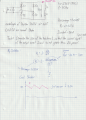
Hello, I need to dimension the inductance L so that the current ripple from the output current(approximatelly 30A) is not greater than 20 percent.
Please look at the picture below. I don't quite know how to do this.
kind regards
The most important thing to note is that L is not going to be a precision component. The inductance will probably be ±20% and it will vary with the load current.
Assume that the input voltage is a rectangular wave equal to Vpeak of the rectified sine and work it out from there.
Have you any idea how large the finished component will be? I doubt you will be able to lift it on your own.
No but I can simulate the circuit with Plexim to check the result later.
Oke, if I assume the truncated sine is a square wave signal with Vpp of the truncated sine as amplitude-> 325V*sin(2*pi/3)=281.46V
And then I use the component law L=(Vpp * Δt)/ipp. So L=(281.46V*Δt)/(7.2A). But what do I use for my Δt now? The L is charged twice per period, i.e. (T/2)*(1/3). The 1/3 comes from the fact that voltage is only applied to the output for a third of the time at an ignition angle of 120 degrees. I'm not sure about the Δt, what do you think?
Worst case will be when the output voltage is Vpeak/π (half the average voltage).
So the current increases for 5ms and decreases for 5ms.
ΔI/Δt = V/L where V=Vpeak/π
Δt=5ms
so ΔI = Vpeak.Δt/(πL)
L=Vpeak.Δt/(ΔI π)
=71mH
This is 6mH at 30A. Imagine something at least three times as big.
Hello, I need to dimension the inductance L so that the current ripple from the output current(approximatelly 30A) is not greater than 20 percent.
Please look at the picture below. I don't quite know how to do this.View attachment 328881
kind regards
You could approach this from the standpoint of harmonics which turns this problem into a simple AC circuit with no rectifiers.
The output of a regular full wave bridge has major 2nd harmonic content which is around 70 percent of the fundamental. That means the major AC component the inductor sees is going to be 100Hz with a 50Hz power line input. The next harmonic is the 4th, which would be much lower maybe around 12 percent. You may be able to ignore that or just factor that in with the 2nd harmonic. The 6th will be about half of that, and the higher order harmonics will be reduced each by about 1/2 of the previous, so you may get away with just considering the 2nd harmonic and maybe the 4th if you want to be more accurate.
What this means is that you can use the same techniques you use for pure AC circuits just with a higher frequency.
Of course you also have to consider the DC component for the wire size and saturation characteristics if you have to think about that too.
The simplification that most readers use is:
Z=sqrt((w*L)^2+R^2)
and here w=2*pi*f, and f would not be 50Hz it would be 100Hz for that single 2nd harmonic. You can see how fast this gets you to an answer, but you can also include the 4th harmonic if you like.
The real question here though is how you were taught to do this in the past. Were you taught to do this all in the time domain (such as with differential equations) or in the frequency domain, or some other technique? If you want to get an answer that matches some other result you'd have to use that preferred method.
There are other more precise ways to do this based on the actual bridge output waveform, and of course you should check your results with a simulator.
Yes inductors like this can be big but that's just a given. I've worked with inductors that weigh over 100 pounds and use 1/4 inch diameter enameled copper wire. Power electronics is not anything like your typical Japanese portable radio. You might even see diodes as large as a hockey puck, or stud mounted parts as large as salt shakers.
Worst case will be when the output voltage is Vpeak/π (half the average voltage).
So the current increases for 5ms and decreases for 5ms.
ΔI/Δt = V/L where V=Vpeak/π
Δt=5ms
so ΔI = Vpeak.Δt/(πL)
L=Vpeak.Δt/(ΔI π)
=71mH
Question related to the time Δt:
OK, but for the time Δt you always take T/4, so no matter what ignition angle the thyristors have. Because the current always rises approximately T/4 and falls T/4. Is this right?
Worst case will be when the output voltage is Vpeak/π (half the average voltage).
So the current increases for 5ms and decreases for 5ms.
ΔI/Δt = V/L where V=Vpeak/π
Δt=5ms
so ΔI = Vpeak.Δt/(πL)
L=Vpeak.Δt/(ΔI π)
=71mH
The real question here though is how you were taught to do this in the past. Were you taught to do this all in the time domain (such as with differential equations) or in the frequency domain, or some other technique? If you want to get an answer that matches some other result you'd have to use that preferred method.
I don't have to learn it, so to speak. Doing this is my hobby.
My main concern is that I know a rough direction if I want to simulate circuits with Plexim and not just guess. Just so that I have an idea of where to start.
So I don't want complex calculations, just an approximate direction. Such as uL = L*ΔiL/Δt.
But I don't know exactly what to take as voltage uL and what as time Δt, and why I should take exactly these values. So what would be best, the result can never be exact with this method, but I have a rough direction.
Oke, but why the half of the average Voltage, and not the average voltage itself?
And for the time:
For the time Δt you always take T/4, so no matter what ignition angle the thyristors have. Because the current always rises approximately T/4 and falls T/4. Is this right?
Oke, but why the half of the average Voltage, and not the average voltage itself?
And for the time:
For the time Δt you always take T/4, so no matter what ignition angle the thyristors have. Because the current always rises approximately T/4 and falls T/4. Is this right?
The current ripple reaches a maximum when the output voltage is half the input voltage, and the output will be half the input when the mark-space ratio is 50% (that still applies when the input is a sinewave)
The current ripple reaches a maximum when the output voltage is half the input voltage, and the output will be half the input when the mark-space ratio is 50% (that still applies when the input is a sinewave)
Yes, but in my circuit we don't have a duty cycle of 50 percent, instead I have an ignition angle of 120 degrees. I don't quite understand that. What if I want to calculate it exactly for this circuit with a 120 degree ignition angle, does T/4 still apply as the time Δt?
Yes, but in my circuit we don't have a duty cycle of 50 percent, instead I have an ignition angle of 120 degrees. I don't quite understand that. What if I want to calculate it exactly for this circuit with a 120 degree ignition angle, does T/4 still apply as the time Δt?
50% duty cycle gives you the worst case ripple.
If your trigger angle is 120° you can use 33%. It will calculate a smaller amount of ripple, but it is all just an approximation.
The DC output voltage is proportional to the average input voltage and the duty cycle. The DC output current is the DC output voltage divided by the load resistance. The inductance doesn't matter at that stage, provided it is large enough for the current to be continuous.
I don't have to learn it, so to speak. Doing this is my hobby.
My main concern is that I know a rough direction if I want to simulate circuits with Plexim and not just guess. Just so that I have an idea of where to start.
So I don't want complex calculations, just an approximate direction. Such as uL = L*ΔiL/Δt.
But I don't know exactly what to take as voltage uL and what as time Δt, and why I should take exactly these values. So what would be best, the result can never be exact with this method, but I have a rough direction.
Ok no problem, but then I would have to ask why you put this in the homework section. This section is for students that need to learn to get passing grades and so members don't really give out answers here they are just supposed to guide students along.
Since that's not the case here, this probably should not be in the homework section.
Anyway, since you wanted a simple formula to estimate the calculation, I already gave you the simplest solution. That's using the 2nd harmonic. Let's see how this works out.
First, if we want max 30 amps DC with a 120vrms source, then the resistance will have to be:
R=170*0.6366/30=3.6 Ohms.
Then the reactance of an inductor L at frequency f is:
xL=2*pi*f*L
The magnitude of the impedance Z we will call Zm is:
Zm=sqrt(xL^2+R^2)
The current would be:
iZm=Vpk/Zm
but we also have to divide by 1.2 for the 2nd harmonic:
iZm2=Vpk/(1.2*Zm)
Now we want this to be 20 percent of Idc, so we set that equal to Idc*0.20:
Vpk/(1.2*Zm)=Idc*0.20
Solving this for L we get as an approximation:
L=sqrt((4.34*Vpk^2)/(pi^2*f^2*Idc^2)-(0.25*R^2)/(pi^2*f^2))
and using Vpk=170 and Idc=30 and R=3.6, and remembering this is with the 2nd harmonic so f=100Hz not 50Hz, we get:
L=0.0371 Henries
You don't have to use that formula you can just use Vpk/(1.2*Zm)=Idc*0.20 and then enter in the known values and then solve for L numerically. It's the same thing really.
Remember this is an approximation and might be limited to reasonable values of L that provide for a reasonably steady DC current.
This is also for the maximum peak to peak ripple current. If you cut back to some phase angle you would have to use the average value of the input line voltage for all the calculations. I would think they would all scale though in the approximation.
You might notice that we used all frequency domain concepts here no time domain ideas were needed.
Ok no problem, but then I would have to ask why you put this in the homework section. This section is for students that need to learn to get passing grades and so members don't really give out answers here they are just supposed to guide students along.
Since that's not the case here, this probably should not be in the homework section.
Anyway, since you wanted a simple formula to estimate the calculation, I already gave you the simplest solution. That's using the 2nd harmonic. Let's see how this works out.
First, if we want max 30 amps DC with a 120vrms source, then the resistance will have to be:
R=170*0.6366/30=3.6 Ohms.
Then the reactance of an inductor L at frequency f is:
xL=2*pi*f*L
The magnitude of the impedance Z we will call Zm is:
Zm=sqrt(xL^2+R^2)
The current would be:
iZm=Vpk/Zm
but we also have to divide by 1.2 for the 2nd harmonic:
iZm2=Vpk/(1.2*Zm)
Now we want this to be 20 percent of Idc, so we set that equal to Idc*0.20:
Vpk/(1.2*Zm)=Idc*0.20
Solving this for L we get as an approximation:
L=sqrt((4.34*Vpk^2)/(pi^2*f^2*Idc^2)-(0.25*R^2)/(pi^2*f^2))
and using Vpk=170 and Idc=30 and R=3.6, and remembering this is with the 2nd harmonic so f=100Hz not 50Hz, we get:
L=0.0371 Henries
You don't have to use that formula you can just use Vpk/(1.2*Zm)=Idc*0.20 and then enter in the known values and then solve for L numerically. It's the same thing really.
Remember this is an approximation and might be limited to reasonable values of L that provide for a reasonably steady DC current.
This is also for the maximum ripple current. If you cut back to some phase angle you would have to use the average value of the input line voltage for all the calculations. I would think they would all scale though in the approximation.
You might notice that we used all frequency domain concepts here no time domain ideas were needed.
You're welcome. I forgot to mention that that was for the maximum peak to peak ripple current although I edited that into that post now too. That's usually the desired units for these kinds of problems.

 Facebook
 Google
 GitHub
 Linkedin