Facebook
 Google
 GitHub
 Linkedin
I need to drive a highside mosfet switch from a GPIO pin. The high voltage supply can be between 42.5V and 90V. I was searching around for the simplest solution I could find (small, low cost, few external components). I found a few options, but then cam up with this on my own:
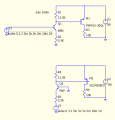
I didn't find this particular type of example online, but it seems like the simplest way to achieve my desired functionality. Does anyone have feedback or ideas on what I might be missing or what to watch out for? I like the simplicity of this circuit because it is very easy to set the drive parameters:
GPIO = 0 to 3.3V
R2 sets the gate drive current: I_pulldown = (3.3 - Vbe)/R2. In this example I_pulldown = (3.3-0.7)/2.5K roughly 1mA.
Set R1 based on desired Vgs of mosfet:Vgs =(R1/R2) * (3.3-Vbe).
Gate pull up will be comparable but a bit slower than pull down due to RC effects. (when BJT turns off).
Setting R2 is a trade off between on IQ and gate switch speed, but works for low speed applications (~100us to 1ms switch time)
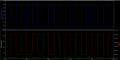
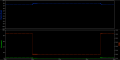
Waveforms in QSPICE look really clean, but still need to test on breadboard:
I didn't find this particular type of example online, but it seems like the simplest way to achieve my desired functionality. Does anyone have feedback or ideas on what I might be missing or what to watch out for? I like the simplicity of this circuit because it is very easy to set the drive parameters:
GPIO = 0 to 3.3V
R2 sets the gate drive current: I_pulldown = (3.3 - Vbe)/R2. In this example I_pulldown = (3.3-0.7)/2.5K roughly 1mA.
Set R1 based on desired Vgs of mosfet:Vgs =(R1/R2) * (3.3-Vbe).
Gate pull up will be comparable but a bit slower than pull down due to RC effects. (when BJT turns off).
Setting R2 is a trade off between on IQ and gate switch speed, but works for low speed applications (~100us to 1ms switch time)
Waveforms in QSPICE look really clean, but still need to test on breadboard: