Simple Antenna Rotor Circuit

Thread Starter

Backhive

Joined May 29, 2018
10
Hi All,
I discovered this interesting forum while searching for ideas on a small project I'm building. I've been interested in electronics for many years but never had formal training in that field, purely a hobby so please bear with me if my questions to you experts seem a little simplistic.

Anyway... As I'm interested also in radio and short wave listening, I recently built a magnetic loop antenna which works very well, basically, this antenna is for the shortwave bands and it's very much directional. This is very handy as you can use it's directional qualities to null out interference from certain directions or increase the signal strength of a weak signal and so on.

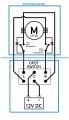
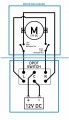
So, I'd like to place this antenna in the attic space and this of course means I will need to rotate it remotely from my radio/PC. I've rustled up a 3D design to make the required gears and enclosure etc on my 3D printer but I need a little help on the electronic side. The rotor only needs to rotate through about 180 degrees and so it has two micro switches to limit it's rotation within that range, The main gear will have a cam that closes the relevant microswitch. I've pasted below a quick drawing of what should work but I would really appreciate it if any folks more knowledgeable than I can offer advice on it's credibility and robustness or how it might be improved etc. Any help would be appreciated. Many thanks.

Terry
20180529_210634.jpg
 

Hymie

Joined Mar 30, 2018
1,347
Hi All,
I discovered this interesting forum while searching for ideas on a small project I'm building. I've been interested in electronics for many years but never had formal training in that field, purely a hobby so please bear with me if my questions to you experts seem a little simplistic.

Anyway... As I'm interested also in radio and short wave listening, I recently built a magnetic loop antenna which works very well, basically, this antenna is for the shortwave bands and it's very much directional. This is very handy as you can use it's directional qualities to null out interference from certain directions or increase the signal strength of a weak signal and so on.

So, I'd like to place this antenna in the attic space and this of course means I will need to rotate it remotely from my radio/PC. I've rustled up a 3D design to make the required gears and enclosure etc on my 3D printer but I need a little help on the electronic side. The rotor only needs to rotate through about 180 degrees and so it has two micro switches to limit it's rotation within that range, The main gear will have a cam that closes the relevant microswitch. I've pasted below a quick drawing of what should work but I would really appreciate it if any folks more knowledgeable than I can offer advice on it's credibility and robustness or how it might be improved etc. Any help would be appreciated. Many thanks.

Terry
View attachment 153348
It looks like the switching arrangement will work – I would recommend you use a DPDT biased switch with a centre off position, otherwise you will need another switch to de-energise the motor.

My only other observation on such a system is that the speed of antenna rotation should be fairly slow, otherwise you will be forever operating the position switch L/R to get the desired position.
 

Thread Starter

Backhive

Joined May 29, 2018
10
Thanks Hymie,
Yes, the switch I intend to use is a centre OFF type and the left and right positions are spring loaded. Regarding the speed of rotation, I intend using a small 12V motor with good torque that outputs about 6 rpm, but it will be geared well down to rotate the antenna to about 1 rpm. Fine tuning would be difficult if it rotated too fast so 1 rpm is probably about right.
Terry
 

RichardO

Joined May 4, 2013
2,270
It is common to put a power diodes across the limit switches. The diodes allows the motor to run in the reverse direction once it hits limit.
 

#12

Joined Nov 30, 2010
18,224
The old Radio Shack design had a potentiometer on the antenna shaft, and circuitry to (yes) rotate the shaft (in the correct direction) until the resistance in the attic matched the resistance in the control box then (don't) rotate the shaft. That makes finding where you expect the signal to be a bit simpler. Just turn the pointer on the downstairs pot to the direction you want the antenna to be and wait a few seconds for it to arrive.
 
You might search for "chicken coop door" here to get some ideas.

The current required for the motor would help.

Let's add that the arrangement means the microswitch carries the full motor current AND the motor may overrun the limits.

Two 12 V automotive relays, two limit switches and a couple of diodes can be arranged such that the motor is shorted when the control lines FWD REV are OFF OFF and ON ON. The limit switch only needs to be rated for the coil current.

Potentiometer feedback, say from a 3 or 10 turn pot can be used for position feedback.

You can easily add LEDs to tell you that the motor is rotating and it what direction.

Later you can try to add what #12 was suggesting. You point a knob and wait for the antenna to get there.
 

Thread Starter

Backhive

Joined May 29, 2018
10
RichardO, In my own non electronic simplistic view, when the motor turns to the left (because I'm holding the switch in the left position) it will eventually depress the LEFT LIMIT SWITCH (wired so it goes open circuit) and it will stop.... but if I now hold the switch in the RIGHT position (which at this time is closed circuit) it will turn to the right... why the diodes ?

Also, I didn't include it in my simple diagram but I intend to use a 10 turn pot, geared to the main gear to provide position feedback on a small voltage meter. LEDs etc are a straight forward addition but it's the 'basic' electronic circuit I'm a little unsure of and for my own sake, I won't over complicate things.
 
Your limit switches should probably be drawn normally closed. When the switch opens, it allows the polarity to be reversed, so the motor can move in the opposite direction.

The current path would be through one diode and one switch if at a limit. The diode "bypasses" the switch if the polarity is reversed.

With both limit switches closed or not at a end point, the polarity can be either way and the motor will move,
 
Here http://www.americanradiohistory.com...s/1969/Radio-Electronics-1969-12.pdf?#Page=35 are schematics to a few antenna rotators. The cover, page 1, has some pictures.

Most of the antenna rotators used 24 VAC reversible synchonous motors and a worm drive. Those motors have 3 wires. One is a common, CW and CCW. An AC capacitor goes between CW and CCW. Power is applied to common an CW or common and CCW to make it move.

I have the RCA unit. A basic dial and two lamps for the limit. Calibration is done top side when you aim the antenna.
 

Thread Starter

Backhive

Joined May 29, 2018
10
Guys, great info and very much appreciated. The pdf link.. wow! a different era indeed and very interesting.. I was two years old in 1969 :)... many thanks. Kjeldgaard... the circuit you posted is prob exactly what I'm looking for.. very clever and yet simple. I will use that setup.. thank you very much.
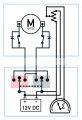
One last thing.... I purchased a cute little analog 0 to 10V DC voltmeter I'd like to use as a rough indicator for antenna direction via a potentiometer in the rotator itself (the usual setup). I will replace the meter's scale with a printed north to south affair instead of the existing volt scale later on. What I'd like to know is.. how do I figure what value pot to use ? I have a 500 ohm 10 turn Bournes pot (an unused spare replacement pot for my proper/professional Yeasu rotor up on the roof) so I expect it's perhaps it's value is in the correct ballpark ?
Inside the analog meter, there is an 11K resistor from the positive connection to the coil so I sorta expect to change that if needs be.

Many thanks.

Terry
 

Alec_t

Joined Sep 17, 2013
15,103
how do I figure what value pot to use ?
Depends what voltage you have available to drive the meter. An 11k resistor internally suggests the basic meter movement sensitivity is ~1mA for full-scale deflection. I think you'll want a single-turn pot for simplicity.
 

Thread Starter

Backhive

Joined May 29, 2018
10
I intend to send 12VDC from the same power source up to the pot and the variable voltage coming from the pot wiper back down into the analog meter. Will I have to somehow isolate the 12VDC to the pot from the 12VDC going to the motor ?
 

Alec_t

Joined Sep 17, 2013
15,103
Isolation shouldn't be necessary, but the 11k impedance of the meter will be in parallel with the pot wiper-to-ground resistance, so the scale will be quite non-linear unless a very low resistance pot is used. There are ways round this, using a transistor or op-amp as a buffer.
 

Thread Starter

Backhive

Joined May 29, 2018
10
Alec_t,

Many thanks for your info. If the meter ends up somewhat non linear, I can cope with that, a rough idea of direction is all that's needed. Also, I have no particular urge to go adding complications like transistors etc. :) . Here's an image of what I have now.... I'd appreciate any observations/corrections/abuse etc. Is the pot wired correctly etc ?

20180529_210634_C.jpg
 
Generally, voltmeters are made from ammeters. These ammeters have a low internal resistance compared to a multimeter. You said something like 10V with an 11K series resistor. So, what you do is say take a 9V battery and a 20K pot in series with the naked meter (set the pot for 20K). Adjust the pot for midscale. measure the voltage across the pot. Take the pot out of circuit. Measure R.

R is the internal resistance of the meter. I=Vp/Rp is the sensitivity for 1/2 scale.

You can then calculate what R is needed to make the system read any voltage, BUT R of the meter may be low compared to 10 M ohms of a digital voltmeter.

Your 12 V power supply MAY not be a stable enough voltage for position indication.
 
Top