Silly question about resistors

Thread Starter

Rufinus

Joined Apr 29, 2020
305
Hello. Warning, it is a very silly question.

Resistors reduce current. The higher the resistance, the lower de current flow.

If I have understood, this reduction is due the transformation of the current into heat. But the higher the value of resistance the less heat produced. I mean, if I use a low value resistor, it will allow a lot of current and will get very hot, but if I use a very high value will block all the current and very little heat will be generated.

So resistor blocks current or transform it into heat?

Thank you
 

Dodgydave

Joined Jun 22, 2012
11,395
Resistors limit current flow in circuits, with leds and transistors, and can also be used as voltage dividers with opamps, the heat is generated based on how much voltage is across the resistor, or how much current is flowing through it, so you choose a resistor and calculate how much wattage you need for it,using Ohms Law.
 
Last edited:

Thread Starter

Rufinus

Joined Apr 29, 2020
305
Thanks for your answers.

Yes I have done some research. The power is defined by I² x R. If I increase the resistance the power will decrease.

But I don't really understand what the resistors do with the current. block or transform into heat?
 

crutschow

Joined Mar 14, 2008
38,316
I don't really understand what the resistors do with the current. block or transform into heat?
They don't "block" current, but they do generate a voltage drop across them, V = I * R, which is transformed into heat, I² x R, so for a given current, the power will go up with the resistance value.

The power dissipated is also equal to V² / R, thus if you increase the resistance without changing the voltage (as, for example, supplied by a battery), then the power will go down as the resistance increases.
 
Hi

Resistors do not limit current flow. Resistors get hot and dissipate energy as heat (even if just a little bit). They are just lumps of some suitable compound and have no active features.

The only 'limit' that a resistor shows is given by ohms law. If you read that a resistor 'limits' the current to, say 10mA, in a circuit, put 20,000 volts across it - you will note that the 'limit' is exceeded (but ohms law still applies).

The expression comes from unguarded jargon. Consider a 'current limiting resistor' used to set the current through an LED. The current is set by both the resistor AND the LEDs characteristic. On its own the resistor doesn't limit current and the LED certainly doesn't if more than its forward voltage is applied.


Cheers
James
 
Last edited:

MisterBill2

Joined Jan 23, 2018
27,164
Thanks for your answers.

Yes I have done some research. The power is defined by I² x R. If I increase the resistance the power will decrease.

But I don't really understand what the resistors do with the current. block or transform into heat?
The heat isproduced by POWER, the product of voltage and current. So you need to take the firstfew weeks of bacic circuit theory course. Or study the book.Then it will be totally obvious.
 

MrChips

Joined Oct 2, 2009
34,628
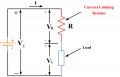
What is a current limiting resistor?

Current Limiting Resistor.jpg


Resistors have a role to play in a circuit. It reduces voltage applied to a load. That is because the load will experience a load voltage = supply voltage - voltage across the resistor R.

In other words,
Vs = VR + VL
VL = Vs - VR

where,
VR = I x R

Why is it called a current limiting resistor?
That is because, independent of the load, the maximum current in the circuit is Imax = Vs / R
The current will never exceed Imax. The current is limited to Imax.

(I prefer not to say, "A resistor drops voltage".
In a circuit, if current is flowing through a resistor, the voltage across the resistor is I x R.
"There is voltage across a resistor. This voltage is the current I times the resistance R.")
 

nsaspook

Joined Aug 27, 2009
16,250
Then you ask the question, there is a voltage across a resistor and a current though the resistor.
That means the resistor is dissipating power P=V*I.
Where does that power and heat come from?
Circuit theory doesn't tell you that, it only give you the means to calculate that power.
 

dl324

Joined Mar 30, 2015
18,219
If I have understood, this reduction is due the transformation of the current into heat. But the higher the value of resistance the less heat produced. I mean, if I use a low value resistor, it will allow a lot of current and will get very hot, but if I use a very high value will block all the current and very little heat will be generated.
Resistors resist the flow of current.

Ohm's law gives you the current: \( I = \frac{V}{R}\)

Power dissipation is given by \(P = I^2R\)
 

nsaspook

Joined Aug 27, 2009
16,250
Hello. Warning, it is a very silly question.

Resistors reduce current. The higher the resistance, the lower de current flow.

If I have understood, this reduction is due the transformation of the current into heat. But the higher the value of resistance the less heat produced. I mean, if I use a low value resistor, it will allow a lot of current and will get very hot, but if I use a very high value will block all the current and very little heat will be generated.

So resistor blocks current or transform it into heat?

Thank you
Step back a bit to reexamine what you think about circuits and resistance.
https://www.physicsclassroom.com/Class/circuits/u9l3a.cfm
https://www.physicsclassroom.com/Class/circuits/u9l3b.cfm

http://amasci.com/miscon/eleca.html#cflow
 
Top