Signal Interference grounding?

Thread Starter

Aykut11

Joined Jan 21, 2024
8
Hi,
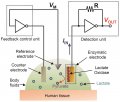
I was watching a PCB analysis and saw this glucose sensor shielding on the PCB. Is this a common way to prevent EMI other than via shielding or is it possibly used for any other purpose?
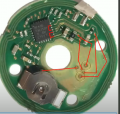
1739187010389.png I am talking about the 2 gold colored rings
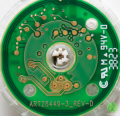
1739187091160.pngAnd they also appear on the back of the PCB too.


I think they also did not create a loop by putting little cuts in both of them
 

Thread Starter

Aykut11

Joined Jan 21, 2024
8

nsaspook

Joined Aug 27, 2009
16,251
Thank you, and is there any reason to not loop it? To maybe make sure the EMI goes to ground from every point of the shield.
It looks (wag) like a signal is being sensed (like electrode supply with a separate electrode supply sense) at points on the guarding traces. Ground/guards here are references to signal potentials. It's not a place to shunt energy, they act as shields to redirect energy by providing no path for energy flow.

Another wag
The loop gap could be for keeping the gap clean and clear (drain for fluids) during manufacturing, not sure
 
Last edited:

Thread Starter

Aykut11

Joined Jan 21, 2024
8
It looks (wag) like a signal is being sensed (like electrode supply with a separate electrode supply sense) at points on the guarding traces. Ground/guards here are references to signal potentials. It's not a place to shunt energy, they act as shields to redirect energy by providing no path for energy flow.
I think I kinda get it, thank you so much
 

sparky 1

Joined Nov 3, 2018
1,218
A section of pcb may not always maintain a consistent potential especially for sensitive applications.
The material can build up a charge. A circuit's dynamics and the material's properties might appear
to be in balance at a macro level but at a micro level there can be significant enough electrical activity
that effect the performance. Grounding is relative to the charge polarities. Dealing with charges effectively
often begins with getting hands on experience, as a curriculum the study material moves forward into specialized fields.

With semiconductors the structure of a Mosfet shows some of the better methods used to control small charges effectively.
The guard rings being a typical part in conjunction to Wells, N and P materials, gates and Taps.
Analog layout - Wells, Taps, and Guard rings | Pulsic
 
Last edited:

Thread Starter

Aykut11

Joined Jan 21, 2024
8
A section of pcb may not always maintain a consistent potential especially for sensitive applications.
The material can build up a charge. A circuit's dynamics and the material's properties might appear
to be in balance at a macro level but at a micro level there can be significant enough electrical activity
that effect the performance. Grounding is relative to the charge polarities. Dealing with charges effectively
often begins with getting hands on experience, as a curriculum the study material moves forward into specialized fields.

With semiconductors the structure of a Mosfet shows some of the better methods used to control small charges effectively.
The guard rings being a typical part in conjunction to Wells, N and P materials, gates and Taps.
Analog layout - Wells, Taps, and Guard rings | Pulsic
Thank you! Another thing that comes to my attention is that there is no analog front end or anything to do I/V conversion. To my knowledge, these sensors are supposed to be amperometric and some of the other examples I have seen have analog front ends between sensor and ADC
 

Thread Starter

Aykut11

Joined Jan 21, 2024
8
It seems some of the microcontrollers do have integrated modules but I could not find something similar for RF430 chip in the analysis video even if it has an analog front end inside for ISO15693. I am thinking maybe there is a passive converter like a resistor after working electrode to paralel it to ADC pins.
 

nsaspook

Joined Aug 27, 2009
16,251
It seems some of the microcontrollers do have integrated modules but I could not find something similar for RF430 chip in the analysis video even if it has an analog front end inside for ISO15693. I am thinking maybe there is a passive converter like a resistor after working electrode to paralel it to ADC pins.
You didn't look very hard if the chip was the RF430FRL153H.

https://www.ti.com/lit/wp/slyy065/s...s%3A%2F%2Fwww.ti.com%2Fproduct%2FRF430FRL152H

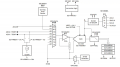
This chip was designed for biosensors with the the SD14 module.

The 14-bit sigma-delta ACD with ultra-low input current, low noise and ultra-low offset has sufficient resolution and sensitivity to eliminate most of the external analog components. Analog Input Range and PGA. A constant current source for a resistive bias interface. A SVSS generator for a virtual ground reference.

1739328344802.png

https://forum.digikey.com/t/getting-started-with-the-ti-rf430frl152hevm/12928
 

Thread Starter

Aykut11

Joined Jan 21, 2024
8
The chip I looked at was a different model but It has SD14 too. I checked the diagram but I am not sure what could be used for a transimpedance amplifier. Isn't PGA part only for amplification?
 

Thread Starter

Aykut11

Joined Jan 21, 2024
8
The chip I looked at was a different model but It has SD14 too. I checked the diagram but I am not sure what could be used for a transimpedance amplifier. Isn't PGA part only for amplification?
Also from the first pcb image and datasheet, I think the electrodes only go to ADC0 which is not a part of the resistive bias interface part.
 

sparky 1

Joined Nov 3, 2018
1,218
Thank you! Another thing that comes to my attention is that there is no analog front end or anything to do I/V conversion. To my knowledge, these sensors are supposed to be amperometric and some of the other examples I have seen have analog front ends between sensor and ADC
The ring is better refered to as the outer ring of a circuit board micro bio cell.
It is a potentiostat circuit, the analog interface 201 does converts current to voltage
Ref US7811231B2


Referring again to FIG. 2, the analog interface 201 of the transmitter 102 in one embodiment includes a sensor interface (not shown) configured to physically couple to the various sensor electrodes (such as, for example, working electrode, reference electrode, counter electrode, (not shown)) of the sensor 101 (FIG. 1) of the monitoring system 100. The analog interface section 201 further includes a potentiostat circuit (not shown) which is configured to generate the Poise voltage determined from the current signals received from the sensor electrodes. In particular, the Poise voltage is determined by setting the voltage difference between the working electrode and the reference electrode (i.e., the offset voltage between the working electrode and the reference electrode of the sensor 102). Further, the potentiostat circuit also includes a transimpedance amplifier for converting the current signal on the working electrode into a corresponding voltage signal proportional to the current. The signal from the potentiostat circuit is then low pass filtered with a predetermined cut-off frequency to provide anti-aliasing, and thereafter, passed through a gain stage to provide sufficient gain to allow accurate signal resolution detected from the sensor 101 for analog-to-digital conversion and encoding for transmission to the receiver 104.
 
Last edited:

Thread Starter

Aykut11

Joined Jan 21, 2024
8
Draw it all out and tell us how it works.
The ring is better refered to as the outer ring of a circuit board micro bio cell.
It is a potentiostat circuit, the analog interface 201 does converts current to voltage
Ref US7811231B2
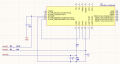
1739544485574.pngI think ADC connections should be something like this. In the patent file, there seems to be an AFE for current measurement but TI says that there is no SAC(Smart Analog Combo - an AFE module for MSP430 MCUs) or an AFE module inside RF430FRL152H to do current measurement. Therefore my best guesses would be 1) The system just consists of a filter and a shunt resistor to measure sensor current 2) The RF430 chip on the PCB is a custom one but I read somewhere that Its pin configurations etc. are all the same. So this may not be accurate and custom RF430 chip on the PCB may actually have an AFE.
 
Top