Sharp frequency cutoff in Op-Amp

Thread Starter

Flasz

Joined Aug 13, 2023
23
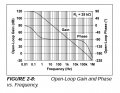
mcp607 graph.jpg
Hi, I know the gain bandwidth product, GBW, is defined as the product of the open loop voltage gain and the frequency at which it is measured.
But supposed the op-amp has resistors that create exact gain of say 100 (40dB) which is under the 2 kHz point. What happens if you push the frequency higher up to 50 kHz. Would the output still show voltage with lower gain? Are 100% of INA and op-amps like this?

Or are their Instrumentation amp or Op-amp where upon reaching the frequency of say 2kHz with the resisters set 100X gain and if you push the frequency a bit higher like 3 kHz, the voltage would suddenly reach 0 without just decrease in gain and increase in frequency but sudden stop? What kind of amps do you call this?
 

MrChips

Joined Oct 2, 2009
34,630
What you are asking for is an ideal low-pass filter that does not exist.

If you examine the frequency response of the open loop opamp, you will observe that the frequency rolls off at -20dB per decade. This is its natural response owing to internal capacitance in the circuit. This is also the response of a 1st order filter, or -6dB/octave.

The frequency falls off at -12dB/octave or -40dB/decade for a 2nd order filter.

For an Nth order filter, it is -6N dB/octave or -20N dB/decade.

Thus, the gain never suddenly falls off to zero.
 

Papabravo

Joined Feb 24, 2006
22,058
It should be noted that as you try to make the roll off steeper by increasing the order of the filter you create other problems that can be difficult to deal with. This is why you seldom see high order filters in most applications.
 

crutschow

Joined Mar 14, 2008
38,331
Are 100% of INA and op-amps like this?
All INA and op-amps that are designed to be stable with feedback to give a gain of 1 are like that.
It insures that they remain stable with the feedback.
Or are their Instrumentation amp or Op-amp where upon reaching the frequency of say 2kHz with the resisters set 100X gain and if you push the frequency a bit higher like 3 kHz, the voltage would suddenly reach 0 without just decrease in gain and increase in frequency but sudden stop? What kind of amps do you call this?
There are none that do that.
You can add a feedback filter circuit in to increase the rate of rolloff, but you cannot achieve a "sudden stop".
 

AnalogKid

Joined Aug 1, 2013
12,055
Hi, I know the gain bandwidth product, GBW, is defined as the product of the open loop voltage gain and the frequency at which it is measured.
But supposed the op-amp has resistors that create exact gain of say 100 (40dB) which is under the 2 kHz point. What happens if you push the frequency higher up to 50 kHz. Would the output still show voltage with lower gain?
Yes.

Are 100% of INA and op-amps like this?
No.

Or are their Instrumentation amp or Op-amp where upon reaching the frequency of say 2kHz with the resisters set 100X gain and if you push the frequency a bit higher like 3 kHz, the voltage would suddenly reach 0 without just decrease in gain and increase in frequency but sudden stop?
No.

The gain roll-off is due to an internal capacitor. Most standard opamps and instrumentation amplifiers have this, called frequency compensation. In the middle of the internal circuit, a naturally-occurring capacitance (called a Miller capacitor) is increased intentionally to create what is essentially a single-pole lowpass filter. That is a consequence, not an intent. The intent is a phase shift in the signal path. The combination of lower gain and this phase shift at high frequencies makes it much more difficult for an opamp circuit with low gain, such as less than 10, to oscillate.

https://www.analog.com/media/en/technical-documentation/application-notes/an148fa.pdf

An interesting example of this is the NE 5532 family of opamps, created by Signetics (now a part of Philips) in the 1970's. The NE5532 is internally compensated, and is stable in circuits down to a gain of 1, while the NE5533 is less compensated, and is stable in circuits with a gain of 3 or more. With less compensation, the 5533 has a higher open-loop gain at high frequencies, making it the better performer in high-gain applications such as a microphone or phono cartridge preamp, where the circuit gain is typically 30-40 dB.

ak
 
Last edited:

Audioguru again

Joined Oct 21, 2019
6,826
The very poor frequency response shown in post #1 is from a 55 years old 741 opamp or a lousy LM324 or LM358. They are never used for audio because they also produce lots of noise and distortion.

An audio opamp such as an OPA2134 dual opamp (singles and quads are available) produces a gain of 100 (40dB) up to 100kHz, has very high input impedance Fet inputs, low noise and low distortion.
 

LowQCab

Joined Nov 6, 2012
5,101
For High-Gain requirements ............
It's usually a good idea to split the total Gain between 2 Op-Amps.
Their Gains will multiply,
so 2-times 10X-Gain = a Gain of 100X.
Now both Amplifiers will be cruising along at a comfortable, and stable, ~10X Gain.

This also provides the opportunity to build a Filter around each Amplifier,
which will provide twice the roll-off-rate of a single Filter.
.
.
.
 

Thread Starter

Flasz

Joined Aug 13, 2023
23
For High-Gain requirements ............
It's usually a good idea to split the total Gain between 2 Op-Amps.
Their Gains will multiply,
so 2-times 10X-Gain = a Gain of 100X.
Now both Amplifiers will be cruising along at a comfortable, and stable, ~10X Gain.

This also provides the opportunity to build a Filter around each Amplifier,
which will provide twice the roll-off-rate of a single Filter.
.
.
.
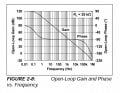
Going back to this graph which is for the MCP607

mcp607 graph.jpg

What is the difference in performances between the following:

1. Setting resistor settings for 100 gain (40 dB) corresponding to 2 kHz bandwidth and pushing the frequency to 10 kHz, versus

2. using 2 cascaded MCP607 where each would have resistor setting for gain of 10 (20 dB) corresponding to bandwidth of 10 kHz each.

Would the first one have more distortion and noises, that is when you push the frequency high up lowering the gain, or would the 2 cases perform equivalently?
 

BitsNBytes

Joined Mar 22, 2021
42
Going back to this graph which is for the MCP607

What is the difference in performances between the following:

1. Setting resistor settings for 100 gain (40 dB) corresponding to 2 kHz bandwidth and pushing the frequency to 10 kHz, versus
Higher signal gain means less loop gain which helps reduce errors both AC and DC.
Minimal components for a single stage.
Feedback resistor value is high, so thermal/Johnson noise is high

2. using 2 cascaded MCP607 where each would have resistor setting for gain of 10 (20 dB) corresponding to bandwidth of 10 kHz each.
Cascaded errors - final DC offset, etc.
More components for dual stage
Higher loop gain
Overall noise is lower (not sure, experts can chime in about cascaded amps and noise)
 

LowQCab

Joined Nov 6, 2012
5,101
You will get better overall performance using 2-Op-Amps in series,
there is no downside other than parts count.

The Slew-Rate for your chosen Op-Amp is REALLY slow, ( 0.08V/us )
this may not be an issue in some applications,
however, there are Op-Amps readily available that provide much higher performance,
such as, NCS20072DR2GOSCT-ND , ( 2.8V/us Slew-Rate ),
it also can easily provide ~50mA of Rail-to-Rail-Output-Current.

see the PDF below.
.
.
.
 

Attachments

Audioguru again

Joined Oct 21, 2019
6,826
The MCP607 opamp produces almost 10 times the noise of audio opamps.
Its distortion must be very high since the datasheet does not show it.
Since it has a poor high frequency response then there is no gain reserve to reduce distortion.
 

Thread Starter

Flasz

Joined Aug 13, 2023
23
The MCP607 opamp produces almost 10 times the noise of audio opamps.
Its distortion must be very high since the datasheet does not show it.
Since it has a poor high frequency response then there is no gain reserve to reduce distortion.
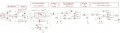
The MCP607 came from this EKG circuit:

ekg circuit.JPG

Do you know of other EMG schematic that is medical grade and has less noise? This is because I want to modify the frequency from 40 Hz to 10kHz. I just want to try other frequency and see and prove for myself the surface EMG couldn't detect the 10kHz used by needle EMG. No I'd NOT do needle and it is just for hobby use and not any medical use so don't worry.

What Op-Amp can I replace the MCP607 in the stage "Opamp with regulated gain" . If the MCP607 has 10 times the noise of audio amps. I need Op-Amp replacement that is 10 times even better than audio amps. What is it?

I'll also cut the entire 3rd order Butterworth filter since I don't need to use cut off filter. Unless RF or Megahertz frequency can mess up the circuit without a 10kHz low pass filter?

Thanks.
Thanks.
 

Audioguru again

Joined Oct 21, 2019
6,826
Your EMG circuit works at a bandpass from 16Hz to only 40Hz then the very slow MCP607 opamp works fine. It will not work properly at higher frequencies.

The missing parts on the "opamp with regulated gain" were for a 2nd-order lowpass filter.
Medical ECG and other measuring circuits use an "instrumentation amplifier" that has 3 low noise opamps in it.
 
Top