Servo Power

Thread Starter

NCH

Joined Feb 28, 2013
12
Hey gang!
Im trying to find a smart way to cut of the power to a Micro Servo(HS-55)
by using some good transistor or maybe mosfet technology.
Any ideas? I have had a hard time using mosfet and BJT's as switches to work.

I want 5V to the microservo to power it and i want to controll the supply to it with a controlsignal from a PIC.

Im trying to save the power that leaks thru the servo when its being powered by 5V for a project im doing.

So i haven't had any luck connecting it since it doesnt connect like a normal "load" with a pin in and a pin out. It just has 3 connectors(Signal,power,gnd).

Any tips are greatly appreciated! :D
 

Thread Starter

NCH

Joined Feb 28, 2013
12
Ah okey i didn't know that! But iam using it for only 2 positions, so.

1. Power the servo
2.Use it.
3.Unpower, and if it moves back to its original position its ok.

Its made for at battery application so i want to save as much power as possible.
 

THE_RB

Joined Feb 11, 2008
5,438
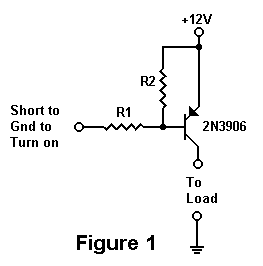
I've done this. A PNP transistor or PFET can be used to cut the +5v power to the servo.

Regarding the losing position, it depends if there is a load pulling on the servo (like gravity etc). If there is not much load, you can fix it in either of two positions using a circle (cam) with two detent positions or two small magnets.

It's a very common situation in things like electronic locks.
 

Thread Starter

NCH

Joined Feb 28, 2013
12
Well i tried the PNP transistor with a normal load and it seems to work fine(4.8v)
When i try with my servo it puts Vce to around 2 volts which i think is well over saturation so im having a bit of problems getting the right voltage to the servo.
Its only around 2 volts at the servo when its plugged in. Im not really sure why the difference is so big. Anyone?


So this is a picture of my circuit. for R1=4.7k
R2=100k

And as the load i've connected the servo.
Note that my voltage is 5 V instead of 12 V.
 

Alec_t

Joined Sep 17, 2013
15,118
The transistor probably isn't supplying enough current for the load. Try reducing R1 to 1k, or even 470 Ohms.
 

THE_RB

Joined Feb 11, 2008
5,438
As well as that, I would use a better transistor, like a BC327 which will only drop about 0.1v when turned properly on.
 

Thread Starter

NCH

Joined Feb 28, 2013
12
Well i try reducing R1 with a potentiometer to as low as 50Ω without any luck. Maybe i should try a different transistor i guess.:confused:
 

Thread Starter

NCH

Joined Feb 28, 2013
12
I'm using a Micro Servo SG90. I've gotten the right amount of voltage over the servo now, but when i try to use the servo it drops to 2 V over the servo again. Thinking about trying a p-Mosfet since im having such trouble with this configuration.
 

Alec_t

Joined Sep 17, 2013
15,118
I've heard the servo draws around 75-150 mAh.
Then the BJT base resistor needs to be ~330 Ohms.
Any MOSFET you get needs to be a 'logic level' type so that it can work with a 5V supply and be switched on fully by the PIC.
 

Thread Starter

NCH

Joined Feb 28, 2013
12
Yeah i've found some p-Mosfet of the logic level types, im not really sure how to draw the line "low" from the PIC though. Or do i have to keep it as a Pull-up from the PIC at all times and then just draw it low as i want to power the Servo?
 

Thread Starter

NCH

Joined Feb 28, 2013
12
but if i use a pnp-bjt i also have to gnd to activate the servo? so i have to use a pull-up from the PIC either way right?
 

Thread Starter

NCH

Joined Feb 28, 2013
12
Okey i'll give this a try and hopefully it will work! Thanks alot for the info, i really appreciate it and its great to learn something new!
:)
 

THE_RB

Joined Feb 11, 2008
5,438
What is the peak current your servo draws?
The stall current of those RC microservo's depends on the applied DC voltage (power supply).

On a 5v supply it will be about 150-200mA max.

That is a worst case situation, a normal load would be much less torque than a stall situation and they have enough gearing to be quite usable even on 50-100mA. For very light loads like turning a sensor they can be directly powered from a 25mA capable PIC output pin.
 
Top