Selecting right op amp for my circuit

Thread Starter

PaoloooP

Joined Dec 2, 2024
2
Hello everyone,
I'm building a variable costant current load to test batteries capacity but I don't know what components to use for high voltages like 50v.
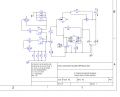
I'm using the below circuit to create a constant current load and it works fine, but when i tried to attach my ebike battery (42v) the op amp exploded :)
1733129229254.png
Looking online i haven't found anybody using such a circuit for high volage loads.
What kind of opamp should I use for this application? Is this a good idea or should I try some other way of drawing a constant current?
Thanks for the help.
 

ericgibbs

Joined Jan 29, 2010
21,390
Hi Pao,
Do you have a complete circuit you could post, showing all the component types/values and battery connections?
E
 

Thread Starter

PaoloooP

Joined Dec 2, 2024
2
Hi Eric,
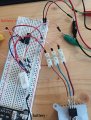
this is the circuit I've built.
Sorry if the picture is not the best, I'll try to explain all the connections.
The power supply on the breadboard delivers 5V, to the positive and negative pins is attached a 10 turns 10k ohms potentiometers with the variable end (green wire) connected to the non inverting input of the op amp (LM324N powered with 5v/ground).
The output of the opamp goes to the gate of the IRF540N, the source is connected to the inverting input of the op amp and to a 1ohm resistor connected to ground.
The positive of battery is connected to the drain pin on the transistor and the mininus is connected to ground.
IMG_20241202_103643.jpg
 

Sensacell

Joined Jun 19, 2012
3,768
Draw a schematic - words are not the language of electronics.

The opamp needs to be a rail-to-rail input and output type.

For any current over 1 amp- the solderless breadboard is a fail.

Try an MCP6024.
 

dl324

Joined Mar 30, 2015
18,219
I'm using the below circuit to create a constant current load and it works fine, but when i tried to attach my ebike battery (42v) the op amp exploded

What opamp were you using and what was its supply voltage? What is the part number for the MOSFET?
 

BobTPH

Joined Jun 5, 2013
11,463
Pretty much any opamp will do. Just use a separate supply for it, 12-15V and connect the grounds of the two supplies. The MOSFET should have threshold above 2V if you don’t use an opamp that can output close to the negative rail.
 

Alec_t

Joined Sep 17, 2013
15,101
1) You could use a voltage divider (e.g. resistor plus zener diode) to drop the voltage below 42V (or whatever) to give a suitable supply voltage to the opamp.
2) Unused inputs of the LM324 should not be left floating.
3) You haven't specified the maximum current you want, but note that the IRF540 needs a gate-source voltage of about 10V to turn on fully and its source will be above ground potential because of the current-sense resistor.
 

jaclement

Joined Apr 15, 2009
60
I have used this circuit for driving strings of LEDs for hydroponic plant lights before I discovered MEANWELL current sources. I would use a switching power supply to give a voltage about 2 volts above my string of LEDs and use this circuit to adjust the current.Current Sink With Preregulator.png
 

jaclement

Joined Apr 15, 2009
60
Note FET and zener diode pre regulates the High voltage input for the LP2951 regulator to be 3 volts above its output. The zener diode is fed from a high resistance from the HV source ,and keeps the input off theLP2951 high enough to regulate up to the desired output as a low drop out regulator The TLV27x series have a low enough input to sense down to zero and theoutput MOSFETS are low threshold.
 

crutschow

Joined Mar 14, 2008
38,316
Power the op amp from a separate low-voltage supply and the circuit should work fine as long as the MOSFET is rated for at least 100V..
 

sparky 1

Joined Nov 3, 2018
1,218
I looked at several active load testers for 18650 batteries. The open source was available.
The microcontroller type was better for all the bells and whistles needed for LiPo leaving the analog circuits lacking.

As the circuit is scaled up the op amp is less important than the sensing and feeding of the microcontroller
to achieve accurate control and cooling of a Constant Resistance load (CR).
The MCP6024 mentioned is a type that lends itself to current sense source and sink. Is there more than which boot strapping method?
What is between the microcontroller CC+CR mode output and the 50V active load. The right battery charging data, no red herring.
Careful consideration of all the features and options and cost and the tradeoffs, Did I miss something important?
Which features and options are most important to maintain best performance during the reasonable expected life of the battery?
Probably would take more than one simulation, but in the end it will be the chips that satisfies the right criteria.
Here is a practical load tester probably based on electric bicycles of urban China. East Tester ET5410
The display in section 2.4 shows precision level. I am not sure about the accuracy specified last page maybe 5% ?
The list test, pass and fail might be the moment of truth as reliability and quality are needed as a serious test instrument.
电子负载标准型
 
Last edited:
Top