Seeking advice on signal demultiplexing for High-Voltage Current Source

Thread Starter

massimoPerdigo

Joined Nov 7, 2024
11
Hello everyone!

I’m currently working on a project and need some guidance regarding signal switching.

In my design, I have a current source capable of delivering up to 100 mA with a signal amplitude ranging from +150V to -150V. I need a switch that can commute this signal between two outputs.

Does anyone know of an integrated circuit that can handle this kind of high-voltage demultiplexing? Or would designing a discrete circuit be the more practical solution for this scenario?

Any suggestions or recommendations would be greatly appreciated!

Thank you in advance for your help!
 

MrSoftware

Joined Oct 29, 2013
2,273
Can you give more information? If you just need to send the signals one way or another, it seems a couple of diodes might do the trick. What exactly do you need on the output side? i.e. if the input is +150V and output A shows +150V, then when the input is -150V do you want output B to be -150V, or +150V?
 

Thread Starter

massimoPerdigo

Joined Nov 7, 2024
11
Thank you for your quick response!

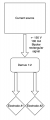
To clarify, the output of the current source is connected to a pair of electrodes. My goal is to switch between the two electrodes, so the current source can deliver the current to one electrode or the other as needed. The switching speed doesn’t need to be fast since the application is not time-critical in that regard.

I’ve attached a schematic for reference to help visualise the setup.
1733751225979.png
 

MrSoftware

Joined Oct 29, 2013
2,273
So are you swapping signals on the outputs? Electrode 1 is +150V and Electrode 2 is -150V, then swap and Electrode 1 is -150V and Electrode 2 is +150V? The desired output is still not clear.
 

Thread Starter

massimoPerdigo

Joined Nov 7, 2024
11
So what would a typical switching speed be?
The current source has a single output that swings between +150V and -150V.

Does the current source have one output that switches between plus and minus 150V, or two outputs?

The purpose of the switching is to select which electrode (out of the two available) receives the current during a therapy session. For example, during the first therapy, one electrode is connected to the current source for a session lasting at least 30 minutes. If another type of therapy is required afterward, the switch selects the other electrode.

This approach allows me to use a single current source to feed two different types of electrodes, optimising the design and reducing hardware redundancy.
 

Thread Starter

massimoPerdigo

Joined Nov 7, 2024
11
So are you swapping signals on the outputs? Electrode 1 is +150V and Electrode 2 is -150V, then swap and Electrode 1 is -150V and Electrode 2 is +150V? The desired output is still not clear.
Thanks MrSoftware for the follow-up!

No, I am not swapping signals between the electrodes like that. The current source has a single output that swings between +150V and -150V, but at any given time, I only need one of the electrodes connected to the current source. The other electrode will be disconnected.

For example:

  1. During one therapy session, Electrode 1 is connected to the current source and receives the full signal (+150V to -150V).
  2. During another session, I switch to Electrode 2, and it alone receives the full signal (+150V to -150V).

There is no simultaneous connection or swapping between the electrodes during a single session. The switching is simply to select which electrode is connected to the current source.
 

MisterBill2

Joined Jan 23, 2018
27,159
It certainly appears to me that without a return path that has not been mentioned, you do not have a circuit and so there would be no current flow.
So something is missing here.
The "One Wire Only" scheme only works in fairy tales and cartoons
 

Thread Starter

massimoPerdigo

Joined Nov 7, 2024
11
LOL. Of course, there is a return path! Electrodes have two parts: anode and cathode. Naturally, I would need to implement a switch for the anode and another for the cathode to properly route the current. I didn’t mention it earlier because I thought it was obvious from the context.

Thanks for pointing that out, though!
 
Top