Secondary winding resonance?

Thread Starter

AngryGecko

Joined Jul 7, 2017
44
If you place a capacitor on the secondary winding of a transformer, will it resonate with the leakage inductance of the secondary, mutual inductance of the secondary or both? Can the mutual inductance of the secondary be completely ignored and seen as a power source instead (as long as there is nothing external powering the secondary winding)?
Thanks in advance!
 

MrAl

Joined Jun 17, 2014
13,707
If you place a capacitor on the secondary winding of a transformer, will it resonate with the leakage inductance of the secondary, mutual inductance of the secondary or both? Can the mutual inductance of the secondary be completely ignored and seen as a power source instead (as long as there is nothing external powering the secondary winding)?
Thanks in advance!

Hello there,

[still editing, i'll add to this again asap]

Since some of the things are you talking about are interrelated, we can derive different forms for this which will make it look like either mutual inductance is at play or leakage inductance, and either the primary inductance and secondary inductance or just one of the two.

In simple resonance with no resistances we have:
w0=1/sqrt(C*L)

and here we just have to figure out what the equivalent inductance L is.

With that in mind, i end up with this:
w=1/(sqrt(C)*sqrt(L3+(1-k^2)*L2))

where L3 is the leakage inductance and where we can either choose to make L3=0 and use k, or make k=1 and use L3 as the leakage. If we choose to use L3 then we have:
w=1/(sqrt(C)*sqrt(L3))

and so now we see the resonance depends on the secondary leakage inductance alone.

If we choose to use k instead of L3 then we have:
w=1/(sqrt(C)*sqrt((1-k^2)*L2))

and here we see that the resonance depends on the secondary and the coupling constant k. This implies that L3=L2*(1-k^2).

[i'll be back to this a bit later do run some numbers just as a check]
 
Last edited:

Thread Starter

AngryGecko

Joined Jul 7, 2017
44
Hello there,

Since some of the things are you talking about are interrelated, we can derive different forms for this which will make it look like either mutual inductance is at play or leakage inductance, and either the primary inductance and secondary inductance or just one of the two.

In simple resonance with no resistances we have:
w0=1/sqrt(C*L)

and here we just have to figure out what the equivalent inductance L is.

To include the mutual inductance i came up with this:
w0=1/sqrt(C*(L2-M^2/L1))

and you can see that this has the mutual inductance M in it. You can also see that the equivalent inductance is L2-M^2/L1. L1 is primary inductance, L2 secondary inductance.

Changing the form to contain leakage inductance (reflected to the secondary), we get this:
w0=1/sqrt(C*(Ls+k^2*L2))

and here we have the equivalent inductance being partly the leakage inductance Ls reflected to the secondary which is:
Ls=L2-k^2

where k is the coupling factor and L2 the secondary winding inductance.

So one way of looking at it is that the leakage inductance reflected to the secondary possibly combined with part of the secondary inductance causes a resonance with the capacitor, but we also have to know the secondary winding inductance. There would be other forms too depending on what we wanted to use.

You can see from the last form though that if k=1 (ideal coupling) then both leakage and secondary inductances play a role, but if k is small then mostly the leakage inductance plays the role in creating the resonance. If k is intermediate then the leakage inductance plays a larger role than the secondary, but they are both still involved.

You should check this out using a simulator program.

As to the second question, i am not sure what you mean by "power source". If something emits energy it can be viewed as a power source, but the efficiency always comes into question. The output would be closely related to the coupling factor as with a factor of 1 it would be very good but with lower k it may act more like a low pass filter.
Im a bit new to transformer theory... but is mutual inductance of the secondary + leakage inductance of secondary = total inductance of secondary? If so what i meant by replacing the mutual inductance of the secondary with a power source, is that the mutual inductance is completely ignored (leakage inductance only left) and instead replaced by an ac voltage source (resulting in an equivalent to leakage inductance in series with an ac voltage source). Also doesn't a coupling factor of 1 mean zero leakage inductance?
 

MrAl

Joined Jun 17, 2014
13,707
Im a bit new to transformer theory... but is mutual inductance of the secondary + leakage inductance of secondary = total inductance of secondary? If so what i meant by replacing the mutual inductance of the secondary with a power source, is that the mutual inductance is completely ignored (leakage inductance only left) and instead replaced by an ac voltage source (resulting in an equivalent to leakage inductance in series with an ac voltage source). Also doesn't a coupling factor of 1 mean zero leakage inductance?

Hello,

Note i had to edit my original post for accuracy and clarity.

What do you mean by the "total secondary inductance"?

The secondary inductance is considered separate from the leakage inductance. If you use the coupling factor then you might consider part of the secondary inductance (L2) to be the leakage inductance, but it is probably better to think of it as a separate isolated inductor that is not part of the ideal transformer.

So we have two ways to look at this.
1. Consider the leakage inductance to be a separate isolated inductor connected in series with the secondary.
2. Consider the leakage inductance to be part of the secondary which depends on the coupling factor k.

I think #1 is the clearest view because that way we have the leakage inductance as a separate entity which can then be drawn on a schematic as such. If we choose #2 then we dont draw a separate inductor and so the effect of the leakage inductance is not as apparent by looking at a drawing.

Note that i spelled this out a little more clearly in my first post in this thread. I edited that to make it more accurate and more clear.

Yes a coupling factor of 1 would mean zero leakage inductance unless you use a separate inductor to represent the leakage inductance.

Keep in mind that leakage inductance is just the effect of flux generated from the primary that does not link with the secondary. If all the flux did link, then the coupling factor would be 1 and there would be no leakage inductance. The mutual inductance would be the effect from the flux that does link.

Also interesting is if the coupling factor is 1 then there would be no resonance, so it takes at least some leakage inductance to cause resonance. Without that leakage inductance, the capacitor looks like it is being driven by an ideal voltage source.

You seem to be saying you want to replace the Mutual inductance with a voltage source? In that case, if i understand you right, is you end up with an ideal transformer with an external inductor that represents the leakage inductance, as i had been talking about above.

To repeat the formula for w0:

w=1/(sqrt(C)*sqrt(L3+(1-k^2)*L2))

and here you can either choose to use L3 or k. If you use L3 then you make k=1, and if you use k then you make L3=0. Note when L3=0 and k=1 we dont have resonance anymore, so k must be less than 1 to see resonance, and if k=1 then L3 has to be non zero to see resonance.

Note that formula is in the form w=1/sqrt(LC) which is resonance for an LC circuit.
So basically we have an ideal transformer and an L and C which is just like a voltage source and L and C.
 
Last edited:

Thread Starter

AngryGecko

Joined Jul 7, 2017
44
Hello,

Note i had to edit my original post for accuracy and clarity.

What do you mean by the "total secondary inductance"?

The secondary inductance is considered separate from the leakage inductance. If you use the coupling factor then you might consider part of the secondary inductance (L2) to be the leakage inductance, but it is probably better to think of it as a separate isolated inductor that is not part of the ideal transformer.

So we have two ways to look at this.
1. Consider the leakage inductance to be a separate isolated inductor connected in series with the secondary.
2. Consider the leakage inductance to be part of the secondary which depends on the coupling factor k.

I think #1 is the clearest view because that way we have the leakage inductance as a separate entity which can then be drawn on a schematic as such. If we choose #2 then we dont draw a separate inductor and so the effect of the leakage inductance is not as apparent by looking at a drawing.

Note that i spelled this out a little more clearly in my first post in this thread. I edited that to make it more accurate and more clear.

Yes a coupling factor of 1 would mean zero leakage inductance unless you use a separate inductor to represent the leakage inductance.

Keep in mind that leakage inductance is just the effect of flux generated from the primary that does not link with the secondary. If all the flux did link, then the coupling factor would be 1 and there would be no leakage inductance. The mutual inductance would be the effect from the flux that does link.

Also interesting is if the coupling factor is 1 then there would be no resonance, so it takes at least some leakage inductance to cause resonance. Without that leakage inductance, the capacitor looks like it is being by an ideal voltage source.

You seem to be saying you want to replace the Mutual inductance with a voltage source? In that case, if i understand you right, is you end up with an ideal transformer with an external inductor that represents the leakage inductance, as i had been talking about above.

To repeat the formula for w0:

w=1/(sqrt(C)*sqrt(L3+(1-k^2)*L2))

and here you can either choose to use L3 or k. If you use L3 then you make k=1, and if you use k then you make L3=0. Note when L3=0 and k=1 we dont have resonance anymore, so k must be less than 1 to see resonance, and if k=1 then L3 has to be non zero to see resonance.

Note that formula is in the form w=1/sqrt(LC) which is resonance for an LC circuit.
So basically we have an ideal transformer and an L and C which is just like a voltage source and L and C.
Thank you for clearing this up for me! (had a lot of frustrating time on google not finding the answer...)
 

MrAl

Joined Jun 17, 2014
13,707
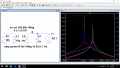
Did you notice my drawing? It shows three resonances! The resonance frequency depends on the internal resistance of the signal source!

Hi there,

Thanks for the simulations. The assumptions i made in my post went with the assumptions that there was no resistance anywhere (primary nor secondary nor any load) so we were dealing with an ideal transformer with some leakage inductance. Since you brought up the issue of resistance of the source, i'll investigate that next and maybe add a little load resistance too.
 

MrAl

Joined Jun 17, 2014
13,707
Hello again,

Taking a quick look if we use an ideal transformer and separate inductor in series with the secondary to represent the leakage inductance, and also reflect the source resistance to the secondary, then we seem to end up with a simple series RLC circuit, with the output taken from across C.
The solution then becomes:
w^2=1/(C*L)-R^2/(2*L^2)

where L is the leakage inductance and R is the source resistance reflected to the secondary.
We can see that R will affect the resonant frequency, but because we might get an imaginary value for 'w' for certain values of R, L, and C, when R becomes larger we probably see resonance cease and the circuit become perhaps a low pass filter with no resonance.
 

Thread Starter

AngryGecko

Joined Jul 7, 2017
44
Hello again,

Taking a quick look if we use an ideal transformer and separate inductor in series with the secondary to represent the leakage inductance, and also reflect the source resistance to the secondary, then we seem to end up with a simple series RLC circuit, with the output taken from across C.
The solution then becomes:
w^2=1/(C*L)-R^2/(2*L^2)

where L is the leakage inductance and R is the source resistance reflected to the secondary.
We can see that R will affect the resonant frequency, but because we might get an imaginary value for 'w' for certain values of R, L, and C, when R becomes larger we probably see resonance cease and the circuit become perhaps a low pass filter with no resonance.
The source resistance on the primary can be seen as an in series resistance on the secondary right?
 

MrAl

Joined Jun 17, 2014
13,707
The source resistance on the primary can be seen as an in series resistance on the secondary right?
Hi,

Yes, the primary resistance Rp reflects to the secondary as:
Rs=Rp/a^2

where 'a; is the turns ratio primary to secondary.

For a numerical example, if the primary is 100v and secondary 10v and no leakage inductance then the turns ratio is 10:1 which would be taken as 10 here so a=10. If the primary resistance Rp=5 ohms then that reflected to the secondary is 5/a^2=5/10^2=5/100=0.05 ohms.

Checking, if we have 1 amp in the primary with 5 ohms that would drop 5 volts, and with 100v input that would be 5 percent of the input. Since the turns ratio is 10:1 the secondary would have 10 amps at 10 volts, and with 0.05 ohms that would drop 0.5 volts, and since the output before the resistance would be 10 volts, that's 5 percent of the secondary voltage, so after the resistance we would see 9.5 volts. If we drop 5 volts in the primary that leaves 95 volts that gets to the primary winding, and with the 10:1 turns ratio that's 9.5v on the output and that is 5 percent less than 10 volts. So in either case we get 9.5v output so this checks out ok.

I provided the numerical example and the checking because there is sometimes a variation in the way the turns ratio is portrayed. Sometimes it is given as "10" and sometimes as "1/10" for a transformer that is made for 100v in and 10 volts out. We should always get the same secondary voltage after we apply the resistance either to the primary or the secondary. If it is a step down transformer then the resistance of the secondary comes out lower than the primary resistance, and if step up then vice versa.
If you drive the secondary instead of the primary then you should swap the names "primary" and "secondary".
 
Last edited:
Hello,

Note i had to edit my original post for accuracy and clarity.

What do you mean by the "total secondary inductance"?

The secondary inductance is considered separate from the leakage inductance. If you use the coupling factor then you might consider part of the secondary inductance (L2) to be the leakage inductance, but it is probably better to think of it as a separate isolated inductor that is not part of the ideal transformer.

So we have two ways to look at this.
1. Consider the leakage inductance to be a separate isolated inductor connected in series with the secondary.
2. Consider the leakage inductance to be part of the secondary which depends on the coupling factor k.

I think #1 is the clearest view because that way we have the leakage inductance as a separate entity which can then be drawn on a schematic as such. If we choose #2 then we dont draw a separate inductor and so the effect of the leakage inductance is not as apparent by looking at a drawing.

Note that i spelled this out a little more clearly in my first post in this thread. I edited that to make it more accurate and more clear.

Yes a coupling factor of 1 would mean zero leakage inductance unless you use a separate inductor to represent the leakage inductance.

Keep in mind that leakage inductance is just the effect of flux generated from the primary that does not link with the secondary. If all the flux did link, then the coupling factor would be 1 and there would be no leakage inductance. The mutual inductance would be the effect from the flux that does link.

Also interesting is if the coupling factor is 1 then there would be no resonance, so it takes at least some leakage inductance to cause resonance. Without that leakage inductance, the capacitor looks like it is being driven by an ideal voltage source.

You seem to be saying you want to replace the Mutual inductance with a voltage source? In that case, if i understand you right, is you end up with an ideal transformer with an external inductor that represents the leakage inductance, as i had been talking about above.

To repeat the formula for w0:

w=1/(sqrt(C)*sqrt(L3+(1-k^2)*L2))

and here you can either choose to use L3 or k. If you use L3 then you make k=1, and if you use k then you make L3=0. Note when L3=0 and k=1 we dont have resonance anymore, so k must be less than 1 to see resonance, and if k=1 then L3 has to be non zero to see resonance.

Note that formula is in the form w=1/sqrt(LC) which is resonance for an LC circuit.
So basically we have an ideal transformer and an L and C which is just like a voltage source and L and C.

Hello MrAI,

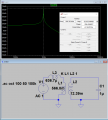
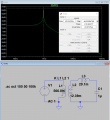
I have the same doubt like AngryGecko. I have simulated and also tested practically a circuit with a capacitor connected on the secondary side of the transformer.

My circuit:

Primary inductance, L1 = 12.39 mH
Secondary inductance, L2 = 566.8 mH
(Turns Ratio 1:6.76)
Leakage inductance (pri) = 636.7 uH (shorting the Secondary and measuring inductance on primary)
Leakage inductance (sec) = 29.1mH (shorting the Primary and measuring inductance on secondary)

Capacitor connected across secondary, C1 = 1uF

I have two different observations.

- In Simulation I have added an extra inductor L3 as a leakage inductor.
First time I put it in series of the primary winding with a value 636.7 uH and second time I put that in the series with secondary winding with the value 29.1 mH. I am getting 958 Hz and 929 Hz respectively.
(Please suggest me if I am doing something wrong)
I have attached both the results with this post.


- When testing practically, I connected the primary to the square wave output of Signal Generator and an oscilloscope across capacitor on the secondary side to see the waveforms.
I saw that the resonance frequency is 156 Hz. (Output is maximum only at this frequency with a pure sine wave).

I am very confused that the capacitor is resonating with which inductance value? Because practical results are closer to the value which we get, if we take secondary inductance in the Formula below,

w0=1/sqrt(C*L).

And if I see the results of the Simulation, it is close to the value which we get if we take leakage inductance in the formula above.

Am I wrong somewhere?

If I want to check the resonance frequency of this kind of circuit practially (with capacitor across secondary winding), how should I do it? Was my way of checking correct?

Unbenannt1.PNG Unbenannt.PNG Unbenannt1.PNG
 

MrAl

Joined Jun 17, 2014
13,707
Hi,

You probably should have started a new thread as this one is a year and a half old now.

How far off is your calculation if you assume w=1/sqrt(LC) ?
Check what inductance you get from that calculation knowing w and C.
The resonance will be determined by the combination of any inductances present. Looking at a theoretical model that includes your capacitor should yield something usable, but be aware that if the measurements are not accurate for any reason the results will never match the lab results. You could do a comparison and figure out the ratio of theoretical results to lab results and get a feel for the percentage error, and if you get less than 10 percent that might be as good as you can get. Remember with a real life construction we get effects that are not always modeled in the theoretical rendering.

The method of shorting out one of the windings and measuring leakage inductance from the other winding is not a perfect way to do it. It's hard to say how far it is off although we might look into this. Alternately, look on the web and see if you can find a better way to measure the leakage inductance.
 
Top