Schematic analysis for voltage drops

screen1988

Joined Mar 7, 2013
310
Jony,
I learn so slow, sometime I don't see obvious things because my slow brain... lol.
:eek:
I think I can work hard to improve it, though.
How much time needed for me to understand these circuits like that one?:)
 

Jony130

Joined Feb 17, 2009
5,598
Don't be so hard on yourself. Most of the people need a lot of time before they start to feel the electronic intuitively. So don't worry too much and don't give up.
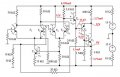
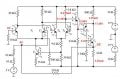
I try to analyze the circuit you post from "negative feedback" point of view.
I remove the 3V source from the circuit. And if assume that "negative feedback" work correct here. This means that we will have a 0V at the output.
So we can easily find current and voltage in T6, T7 and T8.
But I have to end my analysis at T4 and T5. Because there is something wrong with the circuit.
Ic7 = 0.789mA so voltage droop across 9.8K and 30K is equal.

0.789mA * 39.8K = 31V so there is something wrong with this circuit.
And I stop my analysis here.
 

Attachments

screen1988

Joined Mar 7, 2013
310
Thanks Jony,
My initial intention is only want to be illustrated how the method "divide large into subcircuit" work.
I remove the 3V source from the circuit. And if assume that "negative feedback" work correct here. This means that we will have a 0V at the output.
I am curious to know that how can both you and Brownout know to remove 3V source from the circuit.
And how can you know 0V at output here?
That may be an obvious thing!:)
Uhm... one more: how can you get 3.75mA at upper part?
At the bottom, I think you ignore 10Ω and then we have 15/4kΩ = 3.75mA
 

Jony130

Joined Feb 17, 2009
5,598
Thanks Jony,
My initial intention is only want to be illustrated how the method "divide large into subcircuit" work.
I doubt that we can divide this amplifier into subcircuit. Because we have a DC negative feedback loop.


I am curious to know that how can both you and Brownout know to remove 3V source from the circuit.
And how can you know 0V at output here?
That may be an obvious thing!:)
Because we have a negative feedback amplifier. So I treat this as a op amp.

So if vin = 0V the negative feedback attempts to do whatever is necessary to make the voltage difference between the inputs (T1 base and T2 base) zero. But in this case this assumption don't help as much. Because I was unable to find T4, T3 and T1,T2 currents.

For Vin = 3V---> Vout ≈ 3V * -(20K/10k) = -6V

And we have this situation


So I'm still uneatable to solve this circuit. I'm curious is there any way to solve this circuit without involving shockley equation and iterative method?
Anyone ?

Uhm... one more: how can you get 3.75mA at upper part?
At the bottom, I think you ignore 10Ω and then we have 15/4kΩ = 3.75mA
Well I assume Ie = Ic and since Ic8 ≈ 0.6V/1M = 600nA.
Ie7 = Ic7 = 3.75mA.
 

Attachments

Jony130

Joined Feb 17, 2009
5,598
Well but they use a numerical method. So it is just like using circuit simulation.
This circuit will be much easer to solve if we replace 15K resistor in T3 emitter with a Zener diode.

Also it is much easer to design such a circuit then to find his DC operation point.
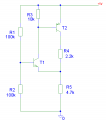
As a example try to find a DC operation point for this simply circuit.
 

Attachments

screen1988

Joined Mar 7, 2013
310
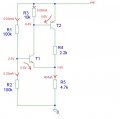
Here are informations that I can find from this circuit.

Also, I am not sure about the voltage 2.5V at the point between R1 and R2. With ignoring Ib (T1), then it is simply a voltage divider.
Just curious, I don't know what the circuit is used for. Assuming that you didn't know about the circuit, what you would do next? Draw small signal model and analyse gain, input and output impedance?
 

Attachments

WBahn

Joined Mar 31, 2012
32,829
Ask if the answer makes sense!

You have 2.5V across 100kΩ and get a current of 0.25mA.

You then have 1.9V (i.e., a large fraction of the 2.5V) across a 4.7kΩ resistor and you only get 404μA.

So the resistance is more than 20 times smaller but you don't even get twice the current?

Whenever you start seeing 100kΩ resistors in a base circuit, start suspecting that the base current may not be just a negligible fraction of it. It may be, but you need to verify.
 

Jony130

Joined Feb 17, 2009
5,598
Here are informations that I can find from this circuit.

Also, I am not sure about the voltage 2.5V at the point between R1 and R2. With ignoring Ib (T1), then it is simply a voltage divider.
Good work.
In this case we can ignore Ib1. Why? Because Ic1 is only in 60μA range.
So T1 Ib1 is in range 600nA. But what about Ic2?
We can easily find Ic2 for this circuit.

Just curious, I don't know what the circuit is used for. Assuming that you didn't know about the circuit, what you would do next? Draw small signal model and analyse gain, input and output impedance?
If BJT work in active region, you can bet that you are dealing with the amplifier. Finding the voltage gain using small signal model is very hard.
It is much easer to use a feedback theory and find the voltage gain.
 

WBahn

Joined Mar 31, 2012
32,829
Good catch.
And it's worthwhile to note that I didn't catch it by seeing that this answer was wrong. In fact, I looked at the values and missed that the answer was off by a factor of ten and so thought that this was correct. What I caught was that the answer here didn't make sense relative to the answer on the other side. I initially thought that the other answer was wrong -- and I still haven't checked it any further.

The point is that by developing the engrained habit of asking if the answers make sense, you can catch discrepancies that let you know that something is amiss without having to even verify the actual correctness of any of the quantities involved.
 

screen1988

Joined Mar 7, 2013
310
Ask if the answer makes sense!
Yes, you are right! Maybe I need to sleep.
But what about Ic2?
We can easily find Ic2 for this circuit.
I get it now by applying KCL at nodes A, B.
Then from Ie, I can calculate Ic = α* Ie.

It is much easer to use a feedback theory and find the voltage gain.
Can you tell me where I can learn the method? Seem attractive!
 

Attachments

Last edited:

WBahn

Joined Mar 31, 2012
32,829
If you are neglecting the base current, then you generally assume that the collector current is equal to the emitter current. You can generally make this approximation even in cases where you have to consider the base current's effect on the base circuit.

You need to find the voltage on the collector of the PNP transistor so that you can confirm that it is, indeed, turned on. This turns out to be about 2.66V, so the assumption that it is on is a good one. But if R4 had been, say, 9.1kΩ then it would not have been a good assumption.

A good exercise would be to redo the analysis but this time make R4 22kΩ.
 

screen1988

Joined Mar 7, 2013
310
You need to find the voltage on the collector of the PNP transistor so that you can confirm that it is, indeed, turned on. This turns out to be about 2.66V, so the assumption that it is on is a good one. But if R4 had been, say, 9.1kΩ then it would not have been a good assumption.

A good exercise would be to redo the analysis but this time make R4 22kΩ.
Yes, if R4 = 9.1kΩ then the T2's collector voltage = 1.9 + 0.344*9.1 = 5.0304V
=> Vcollector > Vemitter => T2 should be OFF
if R4 = 22kΩ then the T2's collector voltage = 1.9 + 0.344*22 = 9.468V
=> Vcollector > Vemitter => T2 should be OFF
By the way, how can you know that ignore Ib will not have big effect to the result?
I am not confident about it, maybe a small current has important role to other part.
 

Thread Starter

uriahsky

Joined Apr 27, 2009
43
I appreciate the feedback on this question of mine that I have asked it off and on for years to myself and others. I must say I am becoming a bit obsessive about the whole thing. Perhaps after I fully understand things and actually see how this can be done on different devices I will just give up on doing this sort of thing but I may have to actually travel that route a few times to get to that place. At one time I really wanted a in-circuit tester that could test IC's in circuit. They were all pretty expensive but after many years I found an older one and after using a few dozen times I realized that it wasn't best suited for daily repair stuff. So I guess sometimes I have to learn things the hard way.

The reason why I keep coming back to wanting to see a whole schematic of pretty much any device like a power supply, LCD Monitor, CRT monitor, controller boards, Embedded system designed device; things that still get serviced is because I keep thinking in the back of my mind the reason no one does anything like this is because the gab between the average service persons knowledge about this subject and engineers is too large and there haven't been enough attempts to try and close that gab so that this information is more easily obtained.

People who service things mostly just need DC voltage tests. Just enough to show a problem. Now that won't show every problem but it would help an awful lot. But no one studies circuit analysis to just learn voltage test points. But what if they did? Would that make the subject easier to learn? That is what I am wondering. That is why I want to see someone walk me through a schematic so that I can ask questions about DC Voltages. Perhaps I can learn some shortcuts that would enable me to apply the knowledge in the books to the schematics I am seeing. But what good is knowing about a simple circuit if you don't know the voltages getting into the circuit because it is buried deep inside a large system?

I have gone to some websites where you pay people to help you problems like this and I must have sent out 12 emails or more. I only got two people who said they could help but when I showed them a circuit and asked them to start with the AC in and figure the voltages they gave up after a few components and I never heard back from them. Now I could only afford so much money an hour and I knew this would take some time so I wasn't able to hire the high priced engineers which I am sure would have made a difference but I only have so much money to spend on this.

Last thing: The first thing I turned to to help me with this were books on electronic Troubleshooting. Over the years I have purchased close to a hundred books on this subject hoping to find one that would figure voltages from the schematics. I found two that were close but still left to many unanswered questions, but the rest just glossed over the subject. So I guess that is why I get a little exasperated over this subject.


If there is someone who can do this for me I am willing to pay some money either by the hour or by the email. I don't have a lot of money but can do 15-20 an hour.


Thanks very much,
Russ
 

WBahn

Joined Mar 31, 2012
32,829
Post the schematic that you have in mind and lets see what can be done right here on the forum. Who knows, perhaps this thread might become a common reference point for folks.
 

MrChips

Joined Oct 2, 2009
34,809
You say you have purchased hundreds of books and only two have come close. That is because you are still missing the point. I bet all of the books have covered it, only you are looking for the wrong thing and therefore cannot see it, like looking for love in the wrong places.

You keep saying no one does it.

I will do it for you. I charge $500/hour.
 

WBahn

Joined Mar 31, 2012
32,829
You say you have purchased hundreds of books and only two have come close. That is because you are still missing the point. I bet all of the books have covered it, only you are looking for the wrong thing and therefore cannot see it, like looking for love in the wrong places.

You keep saying no one does it.

I will do it for you. I charge $500/hour.
:eek: Wow! I'm not even THAT high! :D

I'll do it for my normal charge-out rate of $125/hr.

But, I warn you, going through an unfamiliar schematic and performing a complete DC analysis (assuming it is even DC stable) will take a lot of time, as in many, many hours. The more information you provide about what the circuit is supposed to do and how it is supposed to go about doing it, the more those hours can be trimmed back because I don't have to play detective as much on someone else's design.

Perhaps now you start to glimmer a key point. It isn't that no one CAN do it. It's that it is extremely expensive to do it and that you almost never need to do it. So why waste your time and your customer's money if you can focus on just the part of the circuit that is relevant to the issue at hand? Almost never is the entire circuit the issue at hand and, if it is, then it is a poorly designed circuit and the money may well be better spent designing a decent one.

This is not to say that lunatic fringe cases don't exist where an entire large circuit has to be analyzed and characterized in detail. Today that is done with simulation. In days past, it was done manually but at great expense.

But let's stop talking about generalities. Post a schematic of the type that you are looking for the analysis for.
 

MrChips

Joined Oct 2, 2009
34,809
The op gave some examples:

The reason why I keep coming back to wanting to see a whole schematic of pretty much any device like a power supply, LCD Monitor, CRT monitor, controller boards, Embedded system designed device; things that still get serviced
I'll do an Apple II or a Mac for you.
 
Top