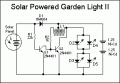
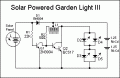
Scaling up this circuit

Thread Starter

iONic

Joined Nov 16, 2007
1,662
Refer to the Solar Powered Garden Light section and the simple solar powered garden light, at Dick Cappels website http://www.cappels.org/dproj/ledpage/leddrv.htm

My question is... how can you scale this up to run two, three, or more LEDs.
Would you build a separate circuit for each LED or can you achieve this with less parts.

Or, by adding one more battery can you use the same blocking oscillator principal to power two parallel LEDs in series with another two parallel LEDs?
 

Attachments

Last edited:

HarveyH42

Joined Jul 22, 2007
426
A few of the garden lights I've taken a part, have holes for 2-3 LEDs, but are in parallel. Guess it depends on what color, and how quickly you want to drain the battery. The solar panels are kind of puny, adding batteries kind of depends on where you live. Works fine here in Florida. Even get some charge, and we've been having a tropical storm past two days, couple more in the forecast.

The 'Joule Thief' circuit works well with 2 white LEDs, and have added a diode and capacitor to run a ATtiny13 microcontroller, which ran an RGB fader program (blue dies kind of quick). There was a simple modification to inhibit the oscillator during daytime, but don't remember off hand. There is a website with a dozen or so different ways to mutate the Joule Thief, will check my bookmarks...

http://wiki.waggy.org/dokuwiki/electronics/joulethief

The schematics are in ASCII, annoying, but it simple stuff, so not too bad. Should be of some help.
 

DickCappels

Joined Aug 21, 2008
10,661
Attached is a simple solar powered garden light, compliments of Dick Cappels at
http://www.cappels.org/dproj/ledpage/leddrv.htm

My question is... how can you scale this up to run two, three, or more LEDs.
Would you build a separate circuit for each LED or can you achieve this with less parts.

Or, by adding one more battery can you use the same blocking oscillator principal to power two parallel LEDs in series with another two parallel LEDs?
Only one of those circuits is from my site, though the second one looks like an improvement to my circuit. Please do not post my circuits on other sites. A link to my we page (as you did) is sufficient.

Just adding LEDs to the circuit, in theory will have little effect on the total light output because the power available to the LEDs is primarily a function of the driver circuit.I n general: Use a larger ferrite core, use a higher battery voltage (as you did), use larger wire use a lower base resistor for the oscillator, and a higher gain transistor for the oscillator.

Cheers and all...
 

Thread Starter

iONic

Joined Nov 16, 2007
1,662
Only one of those circuits is from my site.

Cheers and all...
Sorry Dick, I'll remember that next time. It's a nice site!

Do you think a Darlington transistor in place of Q2 is a good choice??

And I am at a loss with respect to how to wind the core, you wrote "The cores have 40 turns, 20+20 (wind 20 turns, pull out the center tap, then wind 20 turns more)". The way I have wired them was to take a piece of wire, fold it in half, then use center of the wire to thread the ferrite beed 20 times. This leaves 20+20. then I cut the bent half and match up the wires. Then I'd arrange them so that the start of one winding is at the source and the start of the second one is at the collector of the transistor(in this case the darlington).

...and thanks for the tips.
 

Attachments

Last edited:

DickCappels

Joined Aug 21, 2008
10,661
A Darlington might improve things in some circuits. How's that for avoiding sticking my neck out?

An experimenter asked about this a month or two back, and upon trying two 2N4401's connected as a Darlington, I notices a drop in light output of a few percent. I was pretty busy with some other things and didn't have time to investigate further, but I suspect that the reason the Darlington gave less light is because the Base-Emitter voltage is higher on a Darlington than on a single bipolar B-E junction.

Most likely, with more turns on the base winding, and perhaps a little bit lower base resistor to compensate for the lower voltage drop across the base resistor, the Darlington would have given more light output.

One thing to watch out for when using higher gain transistors, and Darlings in particular, is that the higher the gain, the slower the turn-off. As the transistor turns off more slowly, it absorbs more of the energy that was stored in the inductor, reducing efficiency and light output. (Antonis Chaniotis in Greece, devised an optimized his 2.4 volt version of the circuit by including an extra transistor, diode, and capacitor just to turn the oscillator transistor off in a hurry.)

I think I understand what you did in winding the inductor, and if I understand it correctly, then your procedure would be an improvement because the bent end would be easier to push through the center of a core, and your result is electrically equivalent.

If in doubt, you should be able to confirm with the pictures on this page, in case you haven't seen it yet:
http://www.cappels.org/dproj/Toroid_winding/Toroid_Winding.html

:)
 
Top