Maybe it would make economical sense to manufacture these things at sea. Imagine that, a mobile floating manufacturing plant. It could set off across the sea at a couple of knots, and build the thing en route, then install it upon arrival. The first floating manufacturing operation that I'm aware of.
Of course it would burn millions of tons of coal and seal hides, fueling the fire of industry along the way.
The 2 big problems with wind turbines (other than the noise and killing of birds) that no one wants to talk about is their limited lifespan and energy costs (not to mention monetary costs) to produce the turbines. New estimates for effective life span are 15 years with as little as 10 year life span.
New materials and technologies could some day improve that lifespan for offshore turbines but onshore turbines will still suffer from one of man's oldest enemies, the insect. Insects build up on the blades decreasing there aerodynamic effectiveness.
Imagine that, a mobile floating manufacturing plant. It could set off across the sea at a couple of knots, and build the thing en route, then install it upon arrival. The first floating manufacturing operation that I'm aware of.
My understanding is that the Japanese have factory ships off the Oregon/Washington coast. They buy US and Canadian timber, make it into plywood, and sell it back to US customers.
At Altamont Pass in California is one of the world's oldest wind farms. It has been operating since the 1970's and produces 1.1 trillion watt-hours per year. Bird kills are a problem, and so older 70's era turbines are being replaced with newer designs that have been shown to be more wildlife friendly. Newer turbins sould last 20-25 years.
The new blades are bigger and spin slower. The old 'turbines' from the 70s were tiny and high speed with knife-like blades. They are also mounted higher where fewer birds fly. If I remember correctly, the new Samsung turbine will have the blade tips more than 150 to 200 feet off the ground. This leaves (mostly) only high-flying migratory birds during their migration runs and some soaring birds of prey. The nacelle on new turbines is also high enough (350 - 450 feet) to discourage birds of prey from nesting on them.
Nope, that rear section is self powered with a small internal combustion engine and hydraulic powered wheels, and usually has it own driver on a pendant (who often walks) who can steer it in any direction. They use them for big moves, it's pretty cool technology. It's not a high speed operation.
Yes, it is like that. Displacement is usually done at about 30 Km/h. All rear section drivers I know are quite calm people, evidently used to that boring job.
I frequently work in the discharge of parts for eolic generators (windmills) at Puerto Madryn in Patagonia. Length of blades reaches 50 m. They look heavy but are light things: their weight is close to 10 MT.
My job, amongst other things is conduct the crane drivers to bring those things safely on the truck.
The last blades we discharged this year had a pronounced shape that required careful positioning on the truck because of the center of gravity risking to end greatly displaced from above the apron.
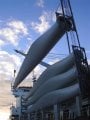
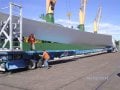
Up to this length you still can use a long common truck as shown in picture No. 6.
From experience, discharging in a windy day, you make sure that the securing to the truck is completed before releasing the slings to go on board and pick up the next. A sudden gust could sweep badly the blade with awful results. Trailing edges are damaged too easily. Believe me.
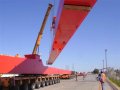
I cannot match the OP impressive picture but added some for reference.
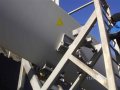
No. 2 shows the articulated tool allowing the handling in 2-cranes lift. Simple and effective. It is a necessity because is not easy to keep both cargo runners up and down during the whole displacement.
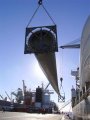
The last picture, taken when discharging parts of a post-Panamax gantry crane shows an arrangement with two HMTs able to maneuver independently. Similar but lighter and longer arrangements are used to move pretensed frames for bridges.
It is a negative to start with and the environmental return on investment is surprisingly long - as stated earlier, if the wind speed is too low in an area, the payback will never happen.
It is a negative to start with and the environmental return on investment is surprisingly long - as stated earlier, if the wind speed is too low in an area, the payback will never happen.
From what I understood, the speed by itself is not the parameter but the percentage of time along the year that a certain speed is available, what counts.
Moreover, there is an upper limit where the machine changes the pitch of the blades to stop the spinning completely.
Every manufacturer has different techniques to assemble the cone (nose) hub and blades.
One of the ways is with the hub already in place. Each blade is lifted in vertical position and moved upwards until connecting the root with its respective flange in the hub.
According to what I was explained, the blades of each set of 3, are matched in weight to have a difference not higher than 15 Kg between any of them. They come properly identified as such and they care to not mix them for delivery to the site.
They are also balanced to have their center of gravity in similar position by adding / displacing a small weight inside, along its length. Blades are esentially hollow bodies.
Finally they are added with strange plastic strips to damp / minimize vibrations.
Yes, I also heard that not only birds but bugs of any kind also disapear from certain areas. Since they belong to the ecosystem, I think that a certain prejudice is the outcome.
Here they talk of a lifespan of 20 years in full production.

 Facebook
 Google
 GitHub
 Linkedin