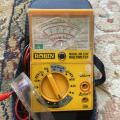
Robin OM 22SF multimeter

Thread Starter

knowVeryLittle

Joined Oct 9, 2026
3
Hello, I have an old Robin OM 22SF multimeter that my Dad gave me years ago. I'm pretty useless with it, I only used it for checking batteries and ultra simple circuits I put together for night lights and keeping slugs away from some garden plants. The other day I foolishly broke it by misusing the DCA setting. I got a basic LAP meter to replace it, but is there any way I can figure out what I overloaded in the Robin? I replaced the fuse and started checking resistors for continuity. Some of them work and some don't, and on the left side of the picture it looks like some components are burnt out, so is there a way for me to approach figuring out what damage I've done and fix it? I know it sounds dopey to bother with it but that's sentimentality for you.
Thanks for any advice,
Gerard
 

Attachments

Last edited:

MrChips

Joined Oct 2, 2009
35,220
The first to to check is the meter movement.
Get a 1.5 V battery and test the battery with the meter set to DCV.
Does the meter needle move on any or all of the DCV ranges?
What is the meter reading with the meter set to 2.5 DCV?

1791575322469.png
 

Thread Starter

knowVeryLittle

Joined Oct 9, 2026
3
The meter is dead, no movement. So far I have replaced the fuse and checked the resistors. I think some of the resistors are dead. It looks to me that some of the components on the left side of the picture may be fried, I think I wasn't sure how to check them, I'll have to remove the circuit board and look at the back.
 

MrChips

Joined Oct 2, 2009
35,220
Use your working test meter to test the bad meter movement.
(Meter movement refers to the actual needle on the test meter, not the whole test meter.)

Get some resistors that cover three ranges, 1 kΩ, 10 kΩ, 100 kΩ.

Set the good meter to measure resistance, high resistance scale. You are going to use the good meter as a current source. You don't need to watch at the reading on the good meter. Even a 1.5 V battery will do instead of the good meter. Do not connect any battery directly to the meter movement. Doing so will destroy the movement.

If using the good meter as a current/voltage source, is the good meter a digital or an analog meter?
If the meter is digital, the RED probe will be the positive voltage source.
If the meter is analog, the BLACK probe will be the positive voltage source.

Start with the highest value resistance placed in series with your good meter (or 1.5 V battery).
1.5 V / 100 kΩ will supply about 15 μA. Connect this directly to the meter movement (red and black wires, M+ and M-) at the back of the meter. Keep +ve source on red M+.

Watch to see if the bad meter needle moves. If the needle moves, then the meter movement is ok. Then we can proceed with more trouble shooting.

If the needle does not move, use the next lower value resistor.
 

Thread Starter

knowVeryLittle

Joined Oct 9, 2026
3
That was excellent, I used a 1.5V battery and a 1K resistor and when they were connected to the Robin's meter it jumped right away. It was more fun than you'd expect it to be :)
 

MrChips

Joined Oct 2, 2009
35,220
Now that we know that the meter movement is working, the real fun begins. We have to trace through the circuit to find out why the movement is not receiving any current.

For this, we need a copy of the meter's circuit diagram. Without this, the last resort is to reverse engineer the circuit ourselves. What you need to do is to take photos of the front and back of the circuit board so that we can see all the board traces and can identify the value of the resistors. Fortunately, there are no active electronic components such as transistors on the board.

For testing, you can set the meter to 2.5 DCV range. Then you need a battery holder so that you can connect the meter leads to a 1.5 V battery. You will use your good test meter on DCV range to trace where the voltage is going.

Alternatively, you can insert a battery into the meter and set the meter to measure resistance. Connect the meter leads together and trace the voltage as before. More on this to follow.
 
Top