Facebook
 Google
 GitHub
 Linkedin
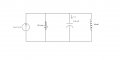
Find ic(t) for t>0.
ok, so this is what I've done so far.
1) I evaluated at t=0- and found current across the inductor to be 2A because the capacitor is open and the inductor is short so all the current will go across it rather than go across the resistor. That also means that the current across the capacitor is 0.
2) I evaluated at t=0+. Now the original current source is off but the inductor is acting as a 2 A current source. The current flows through the inductor rather htan the resistor so Il is still 2A but Ic is now -2 A. Vc(0+) is still 0 V.
3) use the forumala α=1/(2*R*C) and ωo=1/sqrt(L*C). α=4000 and ωo=4472.14. Since α<ωo we have to use the formula:
ic(t)=e^(-α*t)*(B1cos(ωd*t)+B2*sin(ωd*t)) where ωd=sqrt(ωo^2-α^2)
4) I use this formula at t=0+ and everything cancels out down to ic(0+)=B1 and ic(0+) was found to be -2 A so B1=-2.
5) I take the derivative of this equation to get:
di/dt=α*e^(-α*t)*(cos(ωd*t)*(B2*ωd-α*B1)-sin(ωd*t)*(B1*ωd+α*b2))
di/dt is also = Vc/L
6) By using this formula at t=0+ I get the formula α*(2000*B2-4000*B1)=Vc/L where Vc is =0. After plugging in values for α and B1 I get B2=-4.
7) By plugging all these values back into the base equation for ic(t) I get:
ic(t)= e^(-4000t)(-2cos(2000t)-4sin(2000t))
The answer at the back of the book is ic(t)= e^(-4000t)(-2cos(2000t)+4sin(2000t))
I can't figure out why B2=4 rather than -4... help please :/
ok, so this is what I've done so far.
1) I evaluated at t=0- and found current across the inductor to be 2A because the capacitor is open and the inductor is short so all the current will go across it rather than go across the resistor. That also means that the current across the capacitor is 0.
2) I evaluated at t=0+. Now the original current source is off but the inductor is acting as a 2 A current source. The current flows through the inductor rather htan the resistor so Il is still 2A but Ic is now -2 A. Vc(0+) is still 0 V.
3) use the forumala α=1/(2*R*C) and ωo=1/sqrt(L*C). α=4000 and ωo=4472.14. Since α<ωo we have to use the formula:
ic(t)=e^(-α*t)*(B1cos(ωd*t)+B2*sin(ωd*t)) where ωd=sqrt(ωo^2-α^2)
4) I use this formula at t=0+ and everything cancels out down to ic(0+)=B1 and ic(0+) was found to be -2 A so B1=-2.
5) I take the derivative of this equation to get:
di/dt=α*e^(-α*t)*(cos(ωd*t)*(B2*ωd-α*B1)-sin(ωd*t)*(B1*ωd+α*b2))
di/dt is also = Vc/L
6) By using this formula at t=0+ I get the formula α*(2000*B2-4000*B1)=Vc/L where Vc is =0. After plugging in values for α and B1 I get B2=-4.
7) By plugging all these values back into the base equation for ic(t) I get:
ic(t)= e^(-4000t)(-2cos(2000t)-4sin(2000t))
The answer at the back of the book is ic(t)= e^(-4000t)(-2cos(2000t)+4sin(2000t))
I can't figure out why B2=4 rather than -4... help please :/
Attachments
-
 11.8 KB Views: 28