Resonance and impedance matching

Status
Not open for further replies.

Thread Starter

The Electrician

Joined Oct 9, 2007
2,986
Xl2=- (Xc² - 8Xc +52) / (4 - Xc )
Xl2= - (409.9855- 162.1232+52)/ -16.2654
Xl2= 18.4355
Yes. I get 18.4637, but I am carrying 12 digits for the calculation.

Congratulations!!!

So Xc = -20.2481
Xl2 = 18.4637

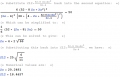
Here's the result from Mathematica:

Series Res 17.png

After all this work I hope you understand why we did each step of the calculation. This was the brute force way to solve the problem. "Brute force" is an English phrase that means "the most difficult way".

You can imagine that somebody that designs a lot of impedance matching networks would want a simpler way to make the calculations.

If we were to leave the source and load resistances in symbolic form, we could derive a formula for each case that would be much easier to use.

The conventional formulas are derived in these two resources:

http://www.ece.ucsb.edu/~long/ece145a/Notes5_Matching_networks.pdf
http://rfic.eecs.berkeley.edu/142/pdf/book_chap7.pdf

To show you how easy it is to use the formulas, let's do the calculation for this network.

First, the system Q is given by Q = SQRT(tratio-1), where tratio = transformation ratio = 50/6

So we get Q = SQRT(50/6-1) = SQRT(66)/3

The source resistance Rs = 6, and the load resistance Rl = 50

The definition of Q for a series branch is Q = Xc/Rs, so Xc = Q*Rs =-SQRT(66)/3 * 6 = -2*SQRT(66) = -16.2481

But, remember there is a small inductive reactance of 4 ohms in series with Rs, so we need to subtract 4 to compensate our calculated value. Thus Xc = -2*SQRT(66) - 4 = -20.2481

The definition of Q for a parallel branch is given by Q = Rl/Xl2 so Xl2 = Rl/Q = 50/(SQRT(66)/3) = 18.4637

This is much easier than all that work we did for the hard way, isn't it?

But, by having done it the hard way, you have a permanent appreciation for the standard formulas.

Congratulations for hanging in there, RRITESH. You earned it.
 

RRITESH KAKKAR

Joined Jun 29, 2010
2,829
First, the system Q is given by Q = SQRT(tratio-1), where tratio = transformation ratio = 50/6

So we get Q = SQRT(50/6-1) = SQRT(66)/3

50/6-1 =7.333 not 66/3
The definition of Q for a series branch
what is this?
 

Thread Starter

The Electrician

Joined Oct 9, 2007
2,986
First, the system Q is given by Q = SQRT(tratio-1), where tratio = transformation ratio = 50/6

So we get Q = SQRT(50/6-1) = SQRT(66)/3

50/6-1 =7.333 not 66/3
The definition of Q for a series branch
what is this?
Be careful. There's a difference between SQRT(66)/3 and SQRT(66/3)

Have a look here: https://en.wikipedia.org/wiki/Inductor (near the bottom of the page)

Also here: https://en.wikipedia.org/wiki/Q_factor (near the bottom of the page)

The Q of an inductor or a capacitor is a number that gives us an idea of how lossy the inductor or capacitor is.

In case of a series R and L, the Q = ω L/R. For a parallel R and L, Q = R/(ω L)
 

JohnInTX

Joined Jun 26, 2012
4,787
Absolutely fantastic work!
@RRITESH KAKKAR You should refer back to this entire thread several times to further firm up the process so that you can apply it yourself to solve problems.
@The Electrician I am locking this thread since the problem is complete. If you decide to fire up another problem you can start another thread OR if it suits your purposes, PM a mod and we will reopen this one for you.
 
Status
Not open for further replies.
Top