Resistor Lead Forming

AnalogKid

Joined Aug 1, 2013
12,129
Evidently nobody else has ever done anything subject to constant vibration.
OR - and I'm just spit-balling here - that has nothing to do with the question that was asked.

MIL-STD-810F has over 70 pages on vibration parameters and requirements. If you give us more details about the vibration environment you are concerned about, I can recommend ways to mitigate.

ak
 

MisterBill2

Joined Jan 23, 2018
27,514
OR - and I'm just spit-balling here - that has nothing to do with the question that was asked.

MIL-STD-810F has over 70 pages on vibration parameters and requirements. If you give us more details about the vibration environment you are concerned about, I can recommend ways to mitigate.

ak
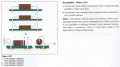
The design used the proper arrangements and as a result passed all of the vibration tests. It was released to production and had a good product life of several years. Alternator voltage regulators and three generations of electronic ignition modules on cars one of the "big three". All components flat mounted and encapsulated. The proper method was well known internally.
 

Tonyr1084

Joined Sep 24, 2015
9,744
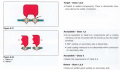
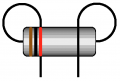
Here's one I've seen from time to time: Note that one lead passes in front of the resistor while the other passes behind.
1677532432452.png
Just don't stress the lead directly against the body. IF you go with version A be sure to hold the resistor body up out of the molten solder. In IPC 610 and JSTD that's a reject on classes 2 & 3. Class 1 is for junk stuff like kids toys that you know are going to get broken before the week is out.
 

Tonyr1084

Joined Sep 24, 2015
9,744
Closest to what I could find: The loop bend I drew is a deviation from the 610 standard, but I have seen that used as stress relief AND for fitting the wrong size component into a shorter geometry hole locations. As long as the leads do not short to anything and there is sufficient electrical clearance between any leads and/or framework.
1677533398002.png

1677533423623.png
 

Thread Starter

djsfantasi

Joined Apr 11, 2010
9,237
OR - and I'm just spit-balling here - that has nothing to do with the question that was asked
It has nothing to do with MY question but I didn’t comment because someone else reading this post may find this information useful.

If you give us more details about the vibration environment you are concerned about, I can recommend ways to mitigate.
@AnalogKid Are you asking me? There is no concern about the vibration environment. My PCBs will be mounted on 1/16” foam double-sided tape in a 1:160 scale plastic model building on a model railroad. I expect vibration to be minimal.
 

MisterBill2

Joined Jan 23, 2018
27,514
Unfortunately it seems that in a lot of instances the demand for reliability rises along with the vibration levels. Consider the electronics in a new F35 fighter. (which I am not involved with at all)
 

MrSalts

Joined Apr 2, 2020
2,767
Evidently nobody else has ever done anything subject to constant vibration.
Again, how much inertia or torque do you expect from a tiny 1/8W resistor that's mounted "A" style. Much less than any electrolytic capacitor - vibration would not be a valid concern unless it is a few 100 Gs of acceleration. Your gut-feeling is not meeting the smell test.
 

Tonyr1084

Joined Sep 24, 2015
9,744
The only drawback I see to "A" is the long length of exposed lead that could short to another like resistor. So to be proactive one could add a length of sleeving to prevent such a short.
The limiting factor is the height of the mounted TO-22 2N7000s. I had an issue when multiple PCBs were mounted horizontally and the resistors could short to the board above. (The PCBs are meant to be modular and the number required depended on the specific installation).

With the combination of 1/8 W resistors and the 2N7000s, this problem is minimized. (bold edited into comment)
There are flaws with both "A" and "B", which are vibration susceptability leading to lead failure.
If you give us more details about the vibration environment you are concerned about, I can recommend ways to mitigate.
There is no concern about the vibration environment
Apparently djsfantasi has stated both that there is no shorting issues and no vibration issues. Why are we continuing to bang that drum? Shorter, smaller component means even less concern of shorting or "torquing" (vibration damage). And IF vibration were a concern, a little silicone (RTV) would support an eighth watt resistor nicely. The only concern I'd have with mounting "A" style is if the component body were to enter into the solder and interfere with good, complete wetting of the lead. At the very least, component body in the solder prevents inspection of whether the joint is full and wetted. Or not.
 

Tonyr1084

Joined Sep 24, 2015
9,744
NO!!!! Not even thinking about that. I was commenting on the vast array of complex electronic stuff that must be reliable in a high vibration environment. Read the articles and look at the block diagrams!!
Thank you. I know.

I'm wondering why even after DJ's comments about clearance and no need for vibration concerns have been clearly stated everyone is still talking about shock and vibration as well as electrical shorts.

I've worked for companies that were very concerned about shock and vibration. Our shaker table would not only shake parts it would shake the whole building. The environment these electronics had to live in were in an oil well drilling string, drilling at depths of approaching 8 miles deep. Tremendous pressure, temperature, shock and vibration. Back then oil rigs would run the drill string at a cost of about $2,000 per hour. Making a drill string stop for a failed logging tool not only meant a loss of data it also meant an expensive trip out of the well, replacing the failed tool, then restringing the drill string. To say the very least, I'm familiar with shock and vibration. This thread isn't about shock and vibration. So I wonder why the discussion continues to center around the concern. I'm paying attention. Perhaps you should review the thread. " ! ! "
 

Juhahoo

Joined Jun 3, 2019
302
Both are equally good, only thing that you should remeber is that never bend the wires too close to the body of the resistors, and use pliers on the body side while making the bends.
 

Tonyr1084

Joined Sep 24, 2015
9,744
The thought occures to me that djsfantasi may not be the sole person to use this technique.
Yup! I've used technique A myself in a number of projects. The one on top of the freezer has two standing resistors in that exact configuration. No fears of shorts, no problems with vibrations. The circuit remains inactive until the freezer door is opened. Then an RC circuit times out and switches on a Sonalert. Close the door and it goes off. Wife has about 30 to 40 seconds to get what she wants before it starts squawking. And it squawks loudly. We're older folks and hearing has faded. I have squeaky stairs coming down into the basement. I used to know when she was approaching. I can no longer hear the squeaking stairs. I don't think the squeaking has stopped.
 
Top