Replace Potentiometer with fixed resistor

Thread Starter

sab201

Joined Nov 18, 2023
297
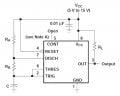
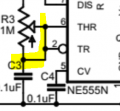
I would like to replace this potentiometer R3 in this 555 astable multivibrator circuit with a fixed resistor with a value of 719 kOhm resistance to get a 0.1 Hz pulse frequency with 50 percent duty cycle. I use a 10 Ohm Resistor for R2 and 10 uF capacitor.
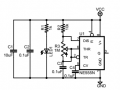
1713635719342.pngHow to replace this potentiometer with 3 terminals to the resistor. In the circuit pins 2 and 3 of the pot are shorted together.

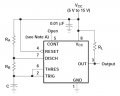
I have wired this circuit and it works fine with a potentiometer. But then I used a perf board and soldered all components and replaced the potentiometer with a fixed resistor based on this circuit from the 555 timer manual with values according to requirements.
Screenshot_20240605-225148_Adobe Acrobat.jpg
Screenshot_20240605-225242_Adobe Acrobat.jpgRa = 10 Ohm
Rb = 719k Ohm
C = 10 uF

I dont understand why it works with a potentiometer and when I use fixed resistors it doesn't. I need some help on this.

Edit: I added a 10 uF capacitor in the above circuit from 555 timer manual as in the first circuit in addition to the 0.1 uF capacitor from source to gnd. But I dont think this makes a difference.

Thanks.
 
Last edited:

Thread Starter

sab201

Joined Nov 18, 2023
297
How can we help if we don't know what "it doesn't" means?
Apologize for not being clear. My problem is this circuit from the 555 timer manual here:
Screenshot_20240605-225148_Adobe Acrobat.jpg

When I made it on perf board, there is no output from the pin 3 of 555 timer. The values are:

Ra = 10 Ohm
Rb = 719k Ohm
C = 10 uF

So this is my problem. As you explained I will replace the 10 Ohm resistor with a 1 kOhm resistor and see if it works. Thanks for your valuable input. Any other suggestions are welcome.

In the potentiometer circuit I used more than 1 k Ohm for Ra. So this must be the problem.

I want to use minimum value for Ra to keep the duty cycle 50 percent.
 

Thread Starter

sab201

Joined Nov 18, 2023
297
That's too low a resistor value for the DIS input.
I would use no lower than 1kΩ.
Thanks crutschow. That fixed the problem. Now it is working fine. I am now getting output from the timer.

Good I dont have to go into the potentiometer stuff that has nothing to do with this in my case I just got a bit confused.
 

dl324

Joined Mar 30, 2015
18,224
When I made it on perf board, there is no output from the pin 3 of 555 timer. The values are:

Ra = 10 Ohm
Rb = 719k Ohm
C = 10 uF

So this is my problem. As you explained I will replace the 10 Ohm resistor with a 1 kOhm resistor and see if it works. Thanks for your valuable input. Any other suggestions are welcome.

In the potentiometer circuit I used more than 1 k Ohm for Ra. So this must be the problem.
The recommended minimum value for Ra is 5k. This is because the current in the discharge transistor is internally limited and you want the majority of the discharge current to come from the timing cap.
 

Thread Starter

sab201

Joined Nov 18, 2023
297
The recommended minimum value for Ra is 5k. This is because the current in the discharge transistor is internally limited and you want the majority of the discharge current to come from the timing cap.
Thanks that's good information. I used 1 kOhm and it seems to work fine at 12 Volts supply Voltage Vcc. Should I change it to 5 kOhm. I already made 7 of the perf boards with fixed resistor combinations in series for Rb. Changing all values to adjust to the frequency and duty cycle will be hectic. If 10 Ohm is repaced with 1 kOhm it doesn't seem to make much of a difference in values but what sort of problems could it pose. Can I continue with 1 kOhm value for Ra.
 

ElectricSpidey

Joined Dec 2, 2017
3,313
The only good reason for using a really low value at that resistor is trying to maintain a near 50/50 duty cycle as you change the other timing resistor, other than that there is no use.

Yes, you can keep the 1k in place.
 

schmitt trigger

Joined Jul 12, 2010
2,035
You can play around with resistor values.
Just be aware of the discharge pin’s absolute maximum current of 200 mA (*) but if you don’t want early failures, I would not exceed 100 mA.
Please note that the discharge current is the sum of RA and RB currents.

(*) this limit is for the bipolar version. The CMOS version is only 150 mA.
 

crutschow

Joined Mar 14, 2008
38,331
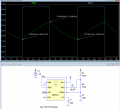
Below is the LTspice sim of a 555 astable, that can have 50% duty-cycle output with no added diodes (which are typically used for that purpose).
R3 slows the discharge time of C2 slightly to make the charge and discharge times equal.
You can tweak the value of R3 (or use a Pot) to adjust to 50%, if necessary.
Note that the ratio of R1 to R2 to R3 should be kept as shown if changed to adjust the frequency.

1717641066780.png
 
Last edited:

Thread Starter

sab201

Joined Nov 18, 2023
297
It affects discharge timing, so the off time will be longer than the formula gives, but your cap is probably 10-20% tolerance.
Sure. But it's going to affect duty cycle.
Yes you are right duty cycle is getting affected at 0.1 hz frequency I meassured voltage for ON state and OFF state, initially they are 5 seconds and 5 seconds but as it goes on it goes out of sync. I am not using an oscilloscope just with meter and running counter. ON state and OFF state has difference but I suppose I can see that it could be affected by this 1 k Ohm resistor. Also on the process I damaged one 555 timer IC. Considering all this I will use a 5.5 kOhm resistor and make changes.

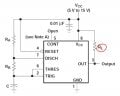
Could anyone tell me me the purpose of the R L resistor in this circuit. Do I need to add this resistor between Vcc and OUT pins. If so what value should I use.
sketch-1717656541977.jpg
 
Last edited:

ElectricSpidey

Joined Dec 2, 2017
3,313
Could anyone tell me me the purpose of the R L resistor in this circuit. Do I need to add this resistor between Vcc and OUT pins. If so what value should I use.
RL is the load, you replace that resistor with your load.

In the example the 555 is switching low side, you can switch high or low side depending on which rail you connect the load to.
 

AnalogKid

Joined Aug 1, 2013
12,055
Below is the LTspice sim of a 555 astable, that can have 50% duty-cycle output with no added diodes (which are typically used for that purpose).
OR - replace R1, R2, and R3 with a single resistor from the output to pins 2 and 6 (ignore pin 7). With a CMOS 555 the output is almost perfectly 50/50. This circuit is in the LMC555 datasheet.

ak
 
Last edited:

crutschow

Joined Mar 14, 2008
38,331
the purpose of the R L resistor in this circuit.
That's not the load, it's a pull-up resistor so the output of a standard BJT 555 goes all the way to the plus supply.
Normally the output only goes to about 1.5-2V below the supply voltage, due to the NPN Darlington high-side driver on its output (Q21 and Q22 below).
1717683912034.png
 

crutschow

Joined Mar 14, 2008
38,331
With a CMOS 555 the output is almost perfectly 50/50.
Just make sure the output load is a high enough resistance to not significantly affect the 555's output voltage.

The shown pull-up resistor in post #11 should also give a near 50% output duty-cycle with that circuit for a BJT 555 as long as there's no significant output load.
 

Thread Starter

sab201

Joined Nov 18, 2023
297
The shown pull-up resistor in post #11 should also give a near 50% output duty-cycle with that circuit for a BJT 555 as long as there's no significant output load.
So for my case I am connecting the load to the output of the 555 timer and ground. What I am understanding is that after I connect the load, if I want the output voltage to near the supply voltage, or I need to increase the output voltage of the 555 timer to its maximum value then I connect this resistor R L of suitable value between Vcc and Output Pin. I hope I am not mistaken here.
 
Top