Relay coils affected by LED placement

Thread Starter

titch2k6

Joined Feb 26, 2019
8
So, this is probably something real simple, but I can't get my head around this one. I know the theoretical side, but sure I am missing something so obvious, I'll laugh about it.......

I have a circuit supplied from a 12vAC transformer that passes through a rectifier and filter circuit to give me a clean 12vDC supply. A switch operates two 12vDC non-latching relays, which in turn operate external circuitry through NC and NO operation.

The operation of the relay is crucial, so I have placed a LED indicator lamp in series on the outgoing side of the coil (theory is, if the LED does not light, potentially the relay has failed and the action being undertaken past this stage must not continue further).

Testing the circuit with a jumper wire across where the indicator lamp is usually positioned, the circuit operates and works as intended. However, when I fit the LED indicator lamp in place instead of the jumper, the LED indicator operates, but the relay fails and does not operate at all (presuming due to failure of coil energizing?). LED indicator lamp has been checked and placed correctly for 'flow' (i.e. anode and cathode are in correct orientation).

What am I missing? Should I have another component between the coil and LED indicator?

Appreciate any pointers.
 

mvas

Joined Jun 19, 2017
539
How many milliamps passes through the Coil with and without the LED in series?
A Red LED will drop nearly 2 Volts, which is 2 Volts less for your Coil.
Is that OK ?

Does the LED need to be in SERIES with the coil?
If yes, then a large capacitor in parallel with the LED may allow enough inrush to energize the coil.

Would it be OK to add a "LED + series 500 ohm Resistor" in parallel with the coil ?
But a parallel LED will still ( falsely ) illuminate, if the relay Coil itself were to fail OPEN.
 
Last edited:

Thread Starter

titch2k6

Joined Feb 26, 2019
8
Hi mvas,

I very much appreciate your input.

I will get the load across the coil with and without the indicator later today. All I do know at this point is that the LED indicator draws 20mA and 12vDC rated. The coil of the relay resists at 360 ohms so draw should be around 33.3mA according to Ohm's Law.


This is my circuit - in basic form - of what I need to do. The LED must light on the coil operation as this is a safety feature to prevent unwanted actions in the greater scheme of the project, and as such, in series on the outgoing side of the coil as previously explained - it is not placed before the coil.

This is the bit that has thrown me - because the LED is actually after the coil. If it was before, then I could look at resistance issues as described by yourself. The only other option is to look at trying to take a feed through the NO contacts of the relay to feed the LED, that way if relay does not operate, then indicator does not light. Only issue is that I am already using the NO contacts for other services :)
 

pmd34

Joined Feb 22, 2014
529
Hi titch26, the LED will not be able to let enough current pass through it to power the relay as well. You either need to put the LED in parallel with the relay coil, or use the relay contacts to activate it. You should also use a current limiting resistor in series with LED to prevent over powering it and burning it out.
 

Ya’akov

Joined Jan 27, 2019
10,226
Yeah - I kinda figured that was the way I was going to have to go with this.

I appreciate everyone's input :)
I was thinking about this and you might want to consider monitoring the current going to the critical equipment rather than passing through (or across) the really coil. You can use a current transformer (of the miniature variety) or a high impedance circuit to detect if power is on the critical equipment input from the relay.

This checks everything about the relay and the power supply instead of only one thing that may not show what you need to know.
 

Tonyr1084

Joined Sep 24, 2015
9,744
- it is not placed before the coil.
Before or after, the current is the same no matter what.

Relay coils seldom fail. And by seldom I mean very rarely. Unless you're pumping more voltage through it than it's designed to handle.

Alternative approach: Can you use a different relay? Say a DPDT relay so that you have an extra set of contacts. That way if the relay actuates - the second set of contacts turns on the LED. If not - perhaps adding a small resistor between the coil and ground so that it forms a voltage divider large enough to turn on a FET. The FET in turn can turn on the LED.
 

Thread Starter

titch2k6

Joined Feb 26, 2019
8
I was thinking about this and you might want to consider monitoring the current going to the critical equipment rather than passing through (or across) the really coil. You can use a current transformer (of the miniature variety) or a high impedance circuit to detect if power is on the critical equipment input from the relay.

This checks everything about the relay and the power supply instead of only one thing that may not show what you need to know.
Thanks for the input Yaakov.

First issue is that one of my relays actually controls a 230V AC supply. The second relay controls a LV critical system signal. I would not be able to monitor the equipment as an alternative to monitoring the relay coil for operation. Sorry to be a bit vague, but this is a new product being worked on for the Fire Industry and not wanting to plaster the idea all over web - lol :)

Basically, the relays are acting as an isolation switch - a) forming an open circuit in a NO circuit, so if our equipment activation switch closes, the circuit cannot operate and prevents 'circuit A' from operating, and b) forming a safe 'short circuit' on a NC circuit, so that if our equipment activation switch opens, 'circuit B' continues to operate.

We need to know with certainty that the relay is operational (by indicating the coil is 'live') and the isolations are in effect before working on equipment, otherwise we could evacuate sites (and shut down critical services), and as most are conducted within the late evening, or the early hours, this is not an option :)

We NEED to know that the relay has operated. My theory was to go on coil output to prove it was powered. Only other way now, as said, is to try and go off relay NO contacts, but again, these are being used for circuit control.
 

Thread Starter

titch2k6

Joined Feb 26, 2019
8
Before or after, the current is the same no matter what.

Relay coils seldom fail. And by seldom I mean very rarely. Unless you're pumping more voltage through it than it's designed to handle.

Alternative approach: Can you use a different relay? Say a DPDT relay so that you have an extra set of contacts. That way if the relay actuates - the second set of contacts turns on the LED. If not - perhaps adding a small resistor between the coil and ground so that it forms a voltage divider large enough to turn on a FET. The FET in turn can turn on the LED.
I'm already using DPDT relays. My other option is a TPDT relay - but then I gotta reproduce my PCB, but may be a simpler fix for my issue.

The joys of product design and prototyping :)
 

pmd34

Joined Feb 22, 2014
529
You could put a small mains neon bulb across the relay contacts, this would light when the contacts were open. The current through the neon indicator would not be enough to power any of the circuits but technically the contacts would not be isolating the system any more.

I think to be a fool proof system you really need to have indication on the things connected to the output of the relays. (Maybe an opto isolator).
If its just on the coil, then there is no guarantee the coil is not faulty, if it is just on one set of contacts, there is no guarantee that the other contact has not actually gotten stuck.. eg welded due to sparking or over powering the contacts.

I wonder also, if for such a system you need to truly isolate it and switch both the 230V lines, as for example in europe they are a little interchangeable!
 

Tonyr1084

Joined Sep 24, 2015
9,744
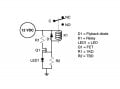
Here's what I'm thinking (drawing below). I'm NOT the expert on FETS and I've drawn an incomplete FET. May have even gotten it backwards - IDK. Nevertheless, my premises is that you can create a voltage divider depending on the relay coil resistance. Use the divider to turn on an FET which in turn turns on the LED. IF the coil fails then the divider network will not turn on the FET and in turn the LED will not light up. At least I believe this will work. Others here who have much more experience and knowledge may be able to fill in the details AND correct any errors in my drawing.

Note: D1 is a flyback diode meant to protect the control circuit that is providing the 12 volts. It's always a good idea to include a flyback diode to protect things. R1 value is given as 1KΩ which will limit the current through the FET and LED to 12 mA (0.012 amps). If the LED is not bright enough at that level you can change R1 to a lower value. The FET should probably be a logic level FET meaning it turns full on at just 5 volts. Dropping your 12 volts by 5 may prevent the relay from turning on. You may want to add a capacitor between the coil and ground (calling it ground but that just means the negative side of your 12 volt source) to give the relay a kick to get it to pull in. I bet 7 volts will probably be sufficient to hold the relay in once it has pulled in. I've operated 24 volt relays on as little as 13 volts and they pull in and hold, so I think 7 volts will be sufficient. But the value of R2 is dependent on the coil resistance. You'll need to do the calculations.

Z Relay Indicator.jpg
 

BobTPH

Joined Jun 5, 2013
11,501
You could use a neon indicator on the 230V circuit. Running the indicator off the NO relay contacts will catch more cases of failure than running it in series with relay coil, since detecting current on the coil does not prove that the contacts have operated correctly.

Bob
 

Tonyr1084

Joined Sep 24, 2015
9,744
Late entry: Perhaps a Hall Effects Transistor (HET) placed close enough to the coil will detect the magnetic field when the coil is energized. May require a slight modification to the relays but I've done that before (modifying the relay). The position and orientation of the HET will be important, but won't add any load to the existing circuitry. Replace the FET with the HET and eliminate R2 and you should be OK.
 

mvas

Joined Jun 19, 2017
539
I will get the load across the coil with and without the indicator later today.
All I do know at this point is that the LED indicator draws 20mA and 12vDC rated.
You say, the LED is 20ma and is 12 volt DC Rated ?
"... 12 volts DC Rated ..."
HUH?

So, your "LED" also has a built-in / internal ( ~500 ohm ) CURRENT LIMITING RESISTOR ?
That would explain your problem.
Try using a raw Red ( 1.7 Vfwd ) LED in series with your Relay Coil ...
 
Last edited:

eetech00

Joined Jun 8, 2013
4,705
Hi

To do this safely, use an energized relay to prove the circuit is functioning correctly and a dedicated NO contact (a contact that is closed when the relay is energized) from the energized relay to light the LED.

When it comes to safety, dedicating a relay contact to an indicator shouldn’t be an issue.

JMO...

eT
 
Last edited:

Tonyr1084

Joined Sep 24, 2015
9,744
A device like this • • • can passively monitor your 230VAC supply.
That'll monitor current. If a line is energized but not in use it can kill. For a current monitor to work it needs to see current. Imagine having a current monitor on an extension cord plugged into a wall but nothing plugged into the cord. You have to realize there's still a potential at the other end of the cord; meaning you could get zapped if you touch the wrong thing. Or worse.
To do this safely, use an energized relay to prove the circuit is functioning correctly and a dedicated NO contact from the energized relay to light the LED.
You don't need an LED on a 12 volt circuit. You can use a large enough resistor to drop the current from 230 volt line all the way down to 12 mA. And it doesn't need to be DC. But you WILL need a diode in the circuit to keep from exceeding the LED's reverse voltage rating.

[ADVISORY] Discussions of LED's on mains is a prohibited conversation. If you should decide to go in that direction you need to understand the extreme danger you're putting yourself into when dealing with mains voltages.

Mains voltages is different from high voltages. Mains are referenced directly to ground, and if you contact the mains voltage YOU can become the conductor to ground. Whereas with isolated high voltages (not grounded) your risk is less. Still, when working with ANY high voltages BE DAMNED CAREFUL. We'd like to keep you around a while.
 
Last edited:

Tonyr1084

Joined Sep 24, 2015
9,744
Yes it will. It the problem is monitoring voltage, a high impedance circuit would do it easily. I must admit I am not clear about the nature of the TS's constraints. They seem to contradict his goals. I guess I'll just watch...
Perhaps a NCVD would serve the same purpose.

A quick Google turned up this. Saw another one for little over $300 but that's a bit pricy.
 

Thread Starter

titch2k6

Joined Feb 26, 2019
8
You say, the LED is 20ma and is 12 volt DC Rated ?
"... 12 volts DC Rated ..."
HUH?

So, your "LED" also has a built-in / internal ( ~500 ohm ) CURRENT LIMITING RESISTOR ?
That would explain your problem.
Try using a raw Red ( 1.7 Vfwd ) LED in series with your Relay Coil ...
So, although does not deal with the issue of monitoring the actual relay contacts working, your solution mvas works and the unit functions as expected and indicates the coils energized.

Thank you.

As for LEDs on mains - I'm a qualified electrician, having worked on 230V up to 11Kva systems and, having seen some scary stuff in my career, I would not even play with the idea - so you are all safe :)
 
Top