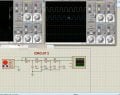
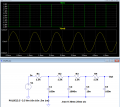
Rectangular pulse to sine wave.

crutschow

Joined Mar 14, 2008
38,316
I want it to be as similar to a normal sin wave
A pure sine-wave has no distortion, by definition.
You sine-wave will have some, depending upon how much filtering you do.
Your modified circuit I posted generates a sine-wave with about 3.2% harmonic distortion for a 1kHz square-wave.

What do you intend to do with the sine-wave?
 

Thread Starter

moonlystar1111

Joined Feb 1, 2024
106
A pure sine-wave has no distortion, by definition.
You sine-wave will have some, depending upon how much filtering you do.
Your modified circuit I posted generates a sine-wave with about 3.2% harmonic distortion for a 1kHz square-wave.

What do you intend to do with the sine-wave?
It worked. Thanks for that.

Actually I want the pulsating input to be detected by a current transformer. A transformer does not work on dc that is why I want to convert it to the sin wave.
 

MrChips

Joined Oct 2, 2009
34,628
It worked. Thanks for that.

Actually I want the pulsating input to be detected by a current transformer. A transformer does not work on dc that is why I want to convert it to the sin wave.
You don't need to convert it to a sine wave. It depends on what you mean by DC and AC. Is this for power conversion or simply signal detection? Pulse transformers will detect square pulses.
 

Irving

Joined Jan 30, 2016
4,996
Given the huge losses in that filter - 7v p-p in 200mV p-p out I'm not sure a current transformer would work anyway. Do you actually need the isolation of a transformer?
 

Thread Starter

moonlystar1111

Joined Feb 1, 2024
106
What is the nature of the "pulsing input"?
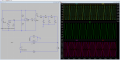
This pulsing input comes from a comparator (U3) circuit, whenever charge at capacitor (c2) is greater than the reference voltage (R14 & R15), there is a high output pulse . Amplifier Q1 is used to amplify this pulse. It is then input to the main supply circuit. Two inductors (L1 & L3) are connected in opposite polarity and their difference is measured by L2 and thus acting as a clamp meter (measures current differential).
Though still there are some complications left in this circuit.
I want that current at L2 should be ~ 4- 5mA which depends on Vout ( which depends upon voltage divider), wider the pulse at Vout, more current at L2.
But here L2 current is independent to any of the parameters, it only depends upon the cascaded filter circuit.
 

Attachments

Thread Starter

moonlystar1111

Joined Feb 1, 2024
106
You don't need to convert it to a sine wave. It depends on what you mean by DC and AC. Is this for power conversion or simply signal detection? Pulse transformers will detect square pulses.
Okay.. but can we make this dc transformer work like a clamp meter / current transformer ?
I want to do signal detection.
 

Thread Starter

moonlystar1111

Joined Feb 1, 2024
106
Given the huge losses in that filter - 7v p-p in 200mV p-p out I'm not sure a current transformer would work anyway. Do you actually need the isolation of a transformer?
Yes it is having loses. But how can we reduce it?
Yes I want the isolation of transformer.
 

Irving

Joined Jan 30, 2016
4,996
Yes it is having loses. But how can we reduce it?
Yes I want the isolation of transformer.
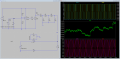
I don't get it.... You're injecting a small sine-wave post the current transformer but to what purpose? Can you explain what you're trying to achieve?

In any case this circuit isn't doing what you expect. The current in R1 is simply due to the imbalance caused by connecting the RC network to one side of the load, irrespective of the drive from the oscillator. Remove that connection and there's no residual.

1709135480528.png
1709135828146.png
 
Top