Reading battery voltage with ads1115 adc

Thread Starter

benassve

Joined Nov 1, 2023
10
Not going to get into the issues of 24bit v 16bit, other than to say there will be noise in the system, and the average over several readings will be needed to reduce the impact of that.

However I do question the value of sorting cells into voltage groups without knowing the actual SoC. These cells have a nominal voltage of 3.7v, which is the approx voltage they tend to drop to on-load after initial discharge at the 20C rate (from around 4.1 - 4.2v at 100% SoC). They will sit at or near that voltage for a considerable period of time until down to around 20% SoC when the voltage drop starts to increase rapidly until around 3v at <5% SoC. The only way this selection makes any useful sense is, after fully charging using a correct CC/CV process to establish 100% SoC, they are discharged accurately, at a known fixed rate for a specific period of time and under carefully controlled environmental conditions, to establish a known SoC, eg 70% at which to evaluate them. Even then I don't see the benefit of sorting into 5mV groupings - what purpose does that solve?
It needs to be done when you are making battery packs from batteries connected in parrarel
 

Ian0

Joined Aug 7, 2020
13,158
The effect of contact resistance at zero load current is zero. I would be more concerned with contact potential with dissimilar metals.
Whatever the mechanism, a good contact is essential. Large lead-acid batteries (48V 1kAh or so) have a plastic nut to fasten the cell links to each cell, and the nut has a hole in it just big enough for a multimeter probe. Not getting a good connection for the meter probe result in erroneous readings even for a 10MΩ meter, but the readings can easily be within the 1.8V to 2.5V range which could potentially be valid.
 

Thread Starter

benassve

Joined Nov 1, 2023
10
Do you have evidence of the efficacy of doing this?
When making for example hundreds of packs from 7 cells conected in parrarel, every pack wont be in same voltage group. If correctly grouped, battery packs wont need balancing which require battery management systems to balance them. It is done where i work to ensure quality of product
 

Irving

Joined Jan 30, 2016
5,144
It needs to be done when you are making battery packs from batteries connected in parrarel
Yes, but you don't need millivolt precision. Before I started using 180Ah and 240Ah LFP prismatic cells I built 75Ah and 150Ah packs from Headway 40152 15Ah cylindrical cells in 4S-5P and 4S-10P configurations. I'd charge all the cells at constant C-rate 15A to 3.6v, then soak at CV of 3.6v until charge current dropped to C/100 (150mA). Then put them in a box for a month to self discharge and finally group into groups of 5 or 10 where OC volts were within 50mV. Never had any issues with sparking due to cross-over currents when building the packs. Most of those packs are 10y old now and still hold up at 95% of rated capacity after a hard life as traction batteries for wheelchairs.
 

Irving

Joined Jan 30, 2016
5,144
When making for example hundreds of packs from 7 cells conected in parrarel, every pack wont be in same voltage group. If correctly grouped, battery packs wont need balancing which require battery management systems to balance them. It is done where i work to ensure quality of product
I've never been convinced of that. If I watch my older cylindrical packs charging its very clear that without balancing some individual parallel groups would exceed the recommended 3.65v max for those cells, What I do see is that if you regularly partially charge the pack individual parallel groups adopt different voltages and this leads to problems at high discharge rates. The active balancing is done in my off-board charger, there's no on-board BMS, just a simple cell voltage monitor to warn if a particular group drops below 3v. More recently with the prismatic cells, charging at 50 - 75A, I've not used a balancer as my charger is actually 8 individual floating chargers each at 3.65v.
 

Thread Starter

benassve

Joined Nov 1, 2023
10
i have one more quaestion about differencial mode adc. If i conect to Ain3 VTC6 battery which for example has 3.6 volts through voltage divider or opamp which scales down voltage to 1.8V. Then i connect voltage reference of 1V to Ain2 pin. So now i can get differencial readings between 1.8V and 1V. Am i right? i was reading about common mode voltage, but cant quite understant is it same in differencial mode adc or this is other mode. Sorry if this is dumb question. Could you give some kind of simple example how adc should be configured (hardware part)
 

nsaspook

Joined Aug 27, 2009
16,344
i have one more quaestion about differencial mode adc. If i conect to Ain3 VTC6 battery which for example has 3.6 volts through voltage divider or opamp which scales down voltage to 1.8V. Then i connect voltage reference of 1V to Ain2 pin. So now i can get differencial readings between 1.8V and 1V. Am i right? i was reading about common mode voltage, but cant quite understant is it same in differencial mode adc or this is other mode. Sorry if this is dumb question. Could you give some kind of simple example how adc should be configured (hardware part)
I don't think you should try that method (voltage offset) if you need to measure very small changes in a voltage source. Just connect the diff inputs as normal across the measurement resistance of your divider with a ADC measurement system of sufficient resolution, accuracy and precision for the requirements.
 

Thread Starter

benassve

Joined Nov 1, 2023
10
I don't think you should try that method (voltage offset) if you need to measure very small changes in a voltage source. Just connect the diff inputs as normal across the measurement resistance of your divider with a ADC measurement system of sufficient resolution, accuracy and precision for the requirements.
Thanks
 

Irving

Joined Jan 30, 2016
5,144
Common mode voltage is that which is applied to both inputs - usually due to ground offsets. It shouldn't be an issue here., Here's an example... using an ADC to monitor battery current by measuring the voltage across a shunt resistor. While the differential voltage may only be 100mV or so, both inputs see the full 24v of the battery which would probably fry most common ADC. The solution here is to put the shunt in the ground side of the battery or use a specialist 'high-side' device.

1703015421652.png

Your situation is different, a typical arrangement being...

1703015849382.png
 

Thread Starter

benassve

Joined Nov 1, 2023
10
Common mode voltage is that which is applied to both inputs - usually due to ground offsets. It shouldn't be an issue here., Here's an example... using an ADC to monitor battery current by measuring the voltage across a shunt resistor. While the differential voltage may only be 100mV or so, both inputs see the full 24v of the battery which would probably fry most common ADC. The solution here is to put the shunt in the ground side of the battery or use a specialist 'high-side' device.

View attachment 310367

Your situation is different, a typical arrangement being...

View attachment 310368
Thank you!
 

nsaspook

Joined Aug 27, 2009
16,344
...
Your situation is different, a typical arrangement being...

View attachment 310368
I don't really like the Vref circuit because it introduces more analog error into the system measurements. With proper design (filtering out the AC components and noise of the signal) and ADC resolution you will be able to resolve the needed small voltage without a input pin Vref offset and without wasting the CMR of a good differential measurement. Why you would need this level of resolution by either method to sort batteries is for the OP to explain.

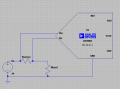
For a quick example:
The battery can be floating as a isolated voltage source. No need to connect one battery terminal to ADC ground.
https://www.ni.com/en/shop/data-acq...tals/measuring-direct-current-dc-voltage.html

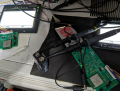
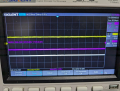
A dual channel scope of a 9V battery using the math function for differential input operation.
1703031574753.png
1703032393920.png
White line is the math trace. Each input reads half the total battery voltage from a 'virtual' ground ref in the middle of the battery electric field.
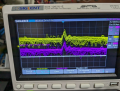
1703032419110.png
Touching the battery case generates a nasty common-mode signal that's eliminated/greatly reduced by the differential input function.
 
Top