Whose thumb?
The highest reverse voltage the diode has to withstand is the supply voltage.
When the diode suppresses the spike it is conducting not blocking.
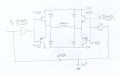
You can either use 470k/1uF and the 74LVC1G17 schmitt trigger (as drawn) and yes, the 74LVC1g17 needs a 3.3V supply and ground;
or you can delete the schmitt trigger and use 10k instead of 470k, and 47u instead of 1u, connecting the junction of the 10k and 47u directly to pin 2.
I can't find any US sources for either A4953 or DRV8870. All give back order to 1H22. I can find them on Amazon in lots of 10 but they ship from China and won't arrive until Mid August (better than next year).
Is there a difference between DRV8870DAR and DDAR versions? Do these things fit on a breadboard?
Whose thumb?
The highest reverse voltage the diode has to withstand is the supply voltage.
When the diode suppresses the spike it is conducting not blocking.
It is in the absence of a suppression diode!
With a suppresion diode the relay's back EMF is limited to the forward voltage drop of the diode. The diode is reverse biassed most of the time, so it's PIV has to withstand no more than the supply voltage.
I can't find any US sources for either A4953 or DRV8870. All give back order to 1H22. I can find them on Amazon in lots of 10 but they ship from China and won't arrive until Mid August (better than next year).
DAR comes in tubes of 75, DDAR comes in reels of 2500. That's the only difference.
There's not many other choices - you're back to two relays or four transistors. Solenoids are nasty things to drive with relays - they like to draw an arc and vaporise the relay contacts when the relay switches off.
Here's the same circuit in easy-to-get components which will fit a breadboard.
The four diodes can be a 2A bridge rectifier, or four 1N5400.
All those parts are what is inside the DRV8870!
They are tricky to get at the moment! (What isn't?) I've just had to swap from the Allegro to the Texas - that's how I know that they are equivalent.
No, because they have heatsink connections on the back that have to be soldered down.
DAR comes in tubes of 75, DDAR comes in reels of 2500. That's the only difference.
There's not many other choices - you're back to two relays or four transistors. Solenoids are nasty things to drive with relays - they like to draw an arc and vaporise the relay contacts when the relay switches off.
Here's the same circuit in easy-to-get components which will fit a breadboard.
The four diodes can be a 2A bridge rectifier, or four 1N5400.
All those parts are what is inside the DRV8870!View attachment 244349
They are tricky to get at the moment! (What isn't?) I've just had to swap from the Allegro to the Texas - that's how I know that they are equivalent.
No, because they have heatsink connections on the back that have to be soldered down.
DAR comes in tubes of 75, DDAR comes in reels of 2500. That's the only difference.
There's not many other choices - you're back to two relays or four transistors. Solenoids are nasty things to drive with relays - they like to draw an arc and vaporise the relay contacts when the relay switches off.
Here's the same circuit in easy-to-get components which will fit a breadboard.
The four diodes can be a 2A bridge rectifier, or four 1N5400.
All those parts are what is inside the DRV8870!View attachment 244349
I got the parts, I'll put it together this weekend. A question - the 1 uF capacitor connects to ground - is that the same as the 0V above the cap? Might be a stupid Q but just want to make sure. Thanks,
I got the parts, I'll put it together this weekend. A question - the 1 uF capacitor connects to ground - is that the same as the 0V above the cap? Might be a stupid Q but just want to make sure. Thanks,
They are tricky to get at the moment! (What isn't?) I've just had to swap from the Allegro to the Texas - that's how I know that they are equivalent.
No, because they have heatsink connections on the back that have to be soldered down.
DAR comes in tubes of 75, DDAR comes in reels of 2500. That's the only difference.
There's not many other choices - you're back to two relays or four transistors. Solenoids are nasty things to drive with relays - they like to draw an arc and vaporise the relay contacts when the relay switches off.
Here's the same circuit in easy-to-get components which will fit a breadboard.
The four diodes can be a 2A bridge rectifier, or four 1N5400.
All those parts are what is inside the DRV8870!View attachment 244349
I have the parts. Just need to find time to put together.
Can someone please explain how this operates? It will help trouble shoot when I screw up as well as expand my knowledge. I'm curious how it converts a steady high input into a pulse and likewise when the input goes low, how it sends an opposite polarity pulse. Thanks
The top end of the solenoid is at 0V when it should be open and at V+ when it should be closed.
So is the other terminal of the solenoid, but it is delayed.
Most of the time, both terminals of the solenoid are at exactly the same voltage, so there is no voltage across the solenoid.
The important bit is what happens during the delay.
The top end goes to V+, but the bottom end is delayed, it is at 0V, so there is positive voltage across the solenoid, briefly, until the bottom end catches up.
When the top end goes back to 0V, the bottom end is delayed, and remains briefly at V+, so there is negative voltage across the solenoid.

 Facebook
 Google
 GitHub
 Linkedin


 and won't arrive until Mid August (better than next year).