Question about RC charging time

Thread Starter

Knid

Joined Aug 28, 2020
20
Watch your units!
On the left side you have amps. On the right side you have volts.

Actually, for the moment, I am looking for actual current values at a certain time.
Let us use t1 is the time taken for point-A to reach 2.5V.
t0 = time when switch is closed.

What is the actual (calculated numerical value) current at t0?
What is the actual (calculated numerical value) current at t1?

Furthermore, how much charge has accumulated in C2 and C3 at time t1?
OOpsss...Sorry I forgot to divide by R.
At t0, I should get 99.256 uA.
At t1, how can I calculate without knowing exact time. What I can get is:
i1 = i2+i3
i2 from i2t = (470x10^-12)(2.5-1500i2)
i3 from i3t = (10470x10-12)(2.5-1500i3)
 

Thread Starter

Knid

Joined Aug 28, 2020
20
Doesn't the answer depend on the nature of the switch and how fast the voltage rises across the switch and if the switch bounces or not. With a sub microsecond risetime and no bounce the transition through 2.5 V is so fast you can't see it, and point A is at 10V pretty quick?
I have a calibration for this. It is measured once at when there is no C, that I want to measure. I have 200MHz clock. I am counting time from that clock.
 

Thread Starter

Knid

Joined Aug 28, 2020
20
OOpsss...Sorry I forgot to divide by R.
At t0, I should get 99.256 uA.
At t1, how can I calculate without knowing exact time. What I can get is:
i1 = i2+i3
i2 from i2t = (470x10^-12)(2.5-1500i2)
i3 from i3t = (10470x10-12)(2.5-1500i3)
Oh. I got it
i1 = (10-2.5)/100k
 

MrChips

Joined Oct 2, 2009
34,814
Ok. Here are my calculations.

At t0
i1 = 10V / ( 100kΩ + 750Ω) = 99.256μA

At t1
i1 = (10V - 2.5V) / 100kΩ = 75μA

What is the voltage v2 at C2 and v3 at C3 at t1?
 

Papabravo

Joined Feb 24, 2006
22,082
If the dv/dt of the switch is fast enough it'll get there faster. what would a reasonable value be, because I can simulate just about any value you care to name.
Now I'm with you I get about 320 usec with a simulation that does not involve a switch with a finite risetime. V(n002) in the plot is point A.

.Cap Charge.png Cap Charge_PLT.png
 

Attachments

Last edited:

Thread Starter

Knid

Joined Aug 28, 2020
20
Ok. Here are my calculations.

At t0
i1 = 10V / ( 100kΩ + 750Ω) = 99.256μA

At t1
i1 = (10V - 2.5V) / 100kΩ = 75μA

What is the voltage v2 at C2 and v3 at C3 at t1?
I think I will have to use 2 equations:
1) (10470p)V3/i3 = (470p)V2/i2 ---> (10470p)(2.5-1500i3)/i3 = (470)(2.5-1500i2)/i2
2) i2+i3 = 75uA
Am I right?
 

MrChips

Joined Oct 2, 2009
34,814
Now, I am trying another way and get: V2+V3 = 4.8875
That is actually very good. How did you arrive at that result?
How does knowing V2+V3 = 4.8875V help you?

At time t1
i2 = 0
What is the value of V2?
What is the value of V3?

What is the charge accumulated in C2?
What is the charge accumulated in C3?
 

Thread Starter

Knid

Joined Aug 28, 2020
20
That is actually very good. How did you arrive at that result?
How does knowing V2+V3 = 4.8875V help you?

At time t1
i2 = 0
What is the value of V2?
What is the value of V3?

What is the charge accumulated in C2?
What is the charge accumulated in C3?
I got it from
2.5 = V2 + 1500i2
2.5 = V3 + 1500i3
75uA = i2 + i3

if i2 = 0 at t1, V2= 2.5 and V3 = 4.775.
Could I ask why i2 = 0 at t2, since C2 is not fully charged?
 

MrChips

Joined Oct 2, 2009
34,814
That is interesting.
V2 + V3 = 5V - (75μA x 1.5kΩ) = 5V - 0.1125V

The time-constant related to C2 is R x C2.
The time-constant related to C3 is R x C3.
C3 / C2 = 10470 / 470 = 22
In other words, C2 is going to charge 22 times faster than C3.
We can take the approximation that at t1, i2 = 0, V2 = 2.5V, V3 = 2.5V - 0.1125V = 2.3875V

What is the accumulated charge on C2?
What is the accumulated charge on C3?
 

Thread Starter

Knid

Joined Aug 28, 2020
20
That is interesting.
V2 + V3 = 5V - (75μA x 1.5kΩ) = 5V - 0.1125V

The time-constant related to C2 is R x C2.
The time-constant related to C3 is R x C3.
C3 / C2 = 10470 / 470 = 22
In other words, C2 is going to charge 22 times faster than C3.
We can take the approximation that at t1, i2 = 0, V2 = 2.5V, V3 = 2.5V - 0.1125V = 2.3875V

What is the accumulated charge on C2?
What is the accumulated charge on C3?
Thank you so much for a nice trick of approximation, MrChips!!!:D
In this case:
Q2 = (470p)(2.5) = 1.175 x 10^-9 Coulomb
Q3 = (10470p)(2.3875) = 2.5 x 10^-8 Coulomb

I think after I get V2 = 2.5V and V3 = 2.3875 V, I can apply Vc=Vs(1-e^(-t/RC))??
Where: for TimeConstant2 = (101.5k)(470p) = 4.77 x 10^-5, Vc = 2.5V, and Vs = 10V
for TimeConstant3 = (101.5k)(10470p) = 1.06 x 10^-3, Vc = 2.3875V, and Vs = 10V

Correct me if I am wrong in the next statements...
I think I can also apply Qt = CV in this case, since I am taking a look at 2.5 V, which is almost linear in that range. But If I am taking a look at 9 V, Qt = CV might not be suitable because it is not a constant current source.

Back to your good approximation part... For example, if I have 690pF instead of 10470pF in C3. I believe this approximation might not be valid, since there should be not-close-to-zero current flowing through both paths. What are we going to do in this case?

Sorry for so many questions, but I really want to understand it.
 

MrChips

Joined Oct 2, 2009
34,814
Before I answer your question let us look at some numbers to give us a baseline.
At this point, we have not determined the exact solution since it involves two exponentials.

For R = 100kΩ, C2 = 470pF, τ = 47μs
For R = 101.5kΩ, C2 = 470pF, τ = 47.7μs

For R = 100kΩ, C3 = 10470pF, τ = 1047μs
For R = 101.5kΩ, C3 = 10470pF, τ = 1063μs

For C2 to charge to 2.5V, R = 101.5kΩ, time = 13.7μs
For C3 to charge to 2.5V, R = 101.5kΩ, time = 305.7μs
For C3 to charge to 2.3875V, R = 101.5kΩ, time = 289.9μs

If we were to lump C2 into C3, i.e. make C3 = 10940pF, R = 101.5kΩ, time = 302.9μs

Hence we expect the answer to lie somewhere between 290 and 303μs.
 

Thread Starter

Knid

Joined Aug 28, 2020
20
Before I answer your question let us look at some numbers to give us a baseline.
At this point, we have not determined the exact solution since it involves two exponentials.

For R = 100kΩ, C2 = 470pF, τ = 47μs
For R = 101.5kΩ, C2 = 470pF, τ = 47.7μs

For R = 100kΩ, C3 = 10470pF, τ = 1047μs
For R = 101.5kΩ, C3 = 10470pF, τ = 1063μs

For C2 to charge to 2.5V, R = 101.5kΩ, time = 13.7μs
For C3 to charge to 2.5V, R = 101.5kΩ, time = 305.7μs
For C3 to charge to 2.3875V, R = 101.5kΩ, time = 289.9μs

If we were to lump C2 into C3, i.e. make C3 = 10940pF, R = 101.5kΩ, time = 302.9μs

Hence we expect the answer to lie somewhere between 290 and 303μs.
OK. I am following you now.
I can also see that 1.5kOhm (even it is 100 times smaller than 100kOhm) will have more impact when I am measuring larger capacitor.
 

MrChips

Joined Oct 2, 2009
34,814
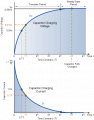
Let us look at it from charge accumulation perspective.

The charge on C2 is 2.5V x 470pF = 1175 x 10^-12 C
The charge on C3 is 2.3875V x 10470pF = 24997 x 10^-12 C
(Same as what you have.)

Total charge is 26172 x 10^-12 C

Current i1 at t0 = 10V / 100.75kΩ = 99.26μA
Current i1 at t1 = (10V - 2.5V) / 100kΩ = 75μA

If we take a linear approximation, the average current = 87.13μA
If you look at the current vs time chart in the second chart below, the charge delivered from t0 to t1 is the area under the curve.
If we take the average current, our estimate of the current would be too high. Our time estimate would be too low.

Let's see what we get.

Time = Charge / current = (26172 x 10^-12 C) / (87.13 x 10^-6 A) = 300.4μs

Therefore, we can expect the correct answer to be greater than 300.4μs and less than 303μs.
That gives you about 1% accuracy.


1598749213697.png
 

Thread Starter

Knid

Joined Aug 28, 2020
20
OK. I am following you now.
I can also see that 1.5kOhm (even it is 100 times smaller than 100kOhm) will have more impact when I am measuring larger capacitor.
I can also see that my measurement resolution will be reduced.
and
Sorry for my typo in my previous reply also. I mean to type it = CV, not Qt = CV.
 

MrChips

Joined Oct 2, 2009
34,814
To answer your question, we can make this assumption because C3 is very much larger than C2.
If C2 and C3 were within a factor of 10 of each other then that would make the calculation very difficult.
 

Thread Starter

Knid

Joined Aug 28, 2020
20
To answer your question, we can make this assumption because C3 is very much larger than C2.
If C2 and C3 were within a factor of 10 of each other then that would make the calculation very difficult.
Yes, but still I am interested in that difficult part. You gave me a really clear picture and reacall me many things.
 
Top