Question about 555

dendad

Joined Feb 20, 2016
4,637
It is a bit hard to get accurate timing from a 555, especially long timing.
This would be a good project for you to start on an Arduino. Then is is easily modifiable to add a real time clock, temperature sensor..... many other tinngs.
Have you looked at Arduinos at all?
 

Audioguru again

Joined Oct 21, 2019
6,826
20 minutes would need about a 1M resistor and a 1200uF no-leakage capacitor. The old 555 also has leakage so if you find a 555 and capacitor that work then the time duration will be far from accurate.

Use a higher frequency oscillator and Cmos digital divider, maybe in a CD4060.
 

ronsimpson

Joined Oct 7, 2019
4,691
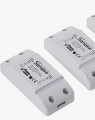
I am using this. sonoff There are many different versions. This is good for 110 to 220V up to 10A. It might not be large enough.
There is an "inching" mode where you can set the timer to 20 minutes. Every time it is turned on it will turn back off in 20.
1667170009308.png
There are some that work to 15A.
 

LowQCab

Joined Nov 6, 2012
5,101
If we knew more about why You are pursuing this project,
and more details about your Pump and what it's supposed to do,
You might get a more detailed response,
or even a completely different way to solve the problem.
.
.
.
 

dendad

Joined Feb 20, 2016
4,637
The Sonoff devices are quite hackable. Look for web pages for help.
BUT!!! make sure you disconnect them from the mains while programming! The processor is not isolated from the mains supply.
 
Last edited:

ronsimpson

Joined Oct 7, 2019
4,691
You can reprogram them, but for those of us who are short on ability, I have used them the way they come.
That Sonoff device is turned on/off from phone or PC. There are other versions that respond to button pushes.
 

Thread Starter

mohsen 2012

Joined May 15, 2014
31
It is a bit hard to get accurate timing from a 555, especially long timing.
This would be a good project for you to start on an Arduino. Then is is easily modifiable to add a real time clock, temperature sensor..... many other tinngs.
Have you looked at Arduinos at all?
I dont want accurate 100% but 20 minutes or 21 or 118will be good
 

Thread Starter

mohsen 2012

Joined May 15, 2014
31

MisterBill2

Joined Jan 23, 2018
27,508
Given that the 220 volt water pump uses an AC motor and that there is a starting current inrush that is not trivial, as well as a few amps of running current, using a 555 timer would require a whole lot of additional circuitry that would need to be suitably packaged. Likewise an arduino device. In addition, I am guessing that the control scheme needs to be reliable.
If those guesses are correct, then the requirements are for elements that have not been mentioned. A relay, or contactor made for motor starting service is the first item, and then an interval timer that can be used to control the run time and rest time separately.
Those devices can be found in the catalogs of many supply organizations,
The TS has made no mention of the motor size, and current draw, and so it is not possible yet to suggest an adequate but not over rated motor relay. OMRON is one company that makes interval timers and that brand is widely available.
 

WBahn

Joined Mar 31, 2012
32,823
Hi guys
I want to make an automatic on off switch with 555 timer , i want to use it to power on my 220ac water pump for 20 minutes , and turn it off for 5 minutes .
I found this circuit :

Https://www.circuits-diy.com/wp-content/uploads/2020/07/Automatic-ON-OFF-Relay-Circuit-768x432.jpg

But it need a modification to work fine with my time .
Please help me guys and thank you
This is really pushing the realistic limits of a 555 if used directly.

As others have said, this would be a good project for something like an Arduino, provided you are interested in committing to the upfront efforts associated with the learning curve. If you are interested in doing other projects, this would probably be time well spent. The same could be said for a number of MCU (microcontroller unit) alternatives, including PICs.

If you want to keep in basic, one way to do that is to use a counter IC that is clocked by a free-running 555.

You are looking for something that is ON 80% of the time and OFF 20% of the time, but have indicated that this isn't too critical.

If you use a decade counter such as the 7490, then as it counts the MSB is HI 20% of the time and LO 80% of the time. This, along with a tiny amount of interface circuitry, can drive your relay with the desired duty cycle.

You want the period of this to be 25 minutes, which means the clock running it needs to have a period of 2.5 minutes, which is much more reasonable within the range of a 555. But even better would be to use another counter to divide the clock down further. If you just used another 7490, your 555 now needs a period of 15 seconds, which is quite comfortably within the 555's range. You could use a 4060 14-bit counter and eliminate the 555 because it has it's own oscillator built in (you use a couple external components to set the timing). If you set the oscillator for about 11 Hz and then AND the final two outputs, you will get something that is HI 25% of the time and LO 75% of the time. If that's good enough, then you have very close to a one-chip solution.
 

MisterBill2

Joined Jan 23, 2018
27,508
Note that the relay shown in post #1 is not even rated for 220 volts AC. so very likely that the contacts do not open far enough to switch off a motor load at 220 volts.
AND I am guessing that the TS is hoping for some arrangement to be reliable and to keep functioning for more than a day or two.
Which I do not predict with that relay, especially with the diode connected to slow the release action.
Given that the mains supply is 220 volts, I am guessing that the frequency is 50 Hz and so both the starting current and the switch off spike will be a fair bit more.
And like LQC stated, if we had a clue about the application a better control solution may be suggested.
 

Tonyr1084

Joined Sep 24, 2015
9,744
If you set the oscillator for about 11 Hz and then AND the final two outputs, you will get something that is HI 25% of the time and LO 75% of the time. If that's good enough, then you have very close to a one-chip solution.
I think the TS wants it the other way around; High for 25% of the time and Low for 75% of the time. Or something there close.

I don't get the impression the TS wants any real kind of accuracy. So a 555 could be in the ballpark of what the TS is after. But there ARE far better suited chips such as the CD4060.

Also, on the matter of operating a pump would necessitate use of a relay or contactor of some as yet unknown capability. 220VAC @ X amps. To make such a recommendation we would need to know the startup current or the stall current of the motor in order to recommend a suitable relay or contactor.

Does the TS (mohsen 2012) know what a contactor is?
 

WBahn

Joined Mar 31, 2012
32,823
I think the TS wants it the other way around; High for 25% of the time and Low for 75% of the time. Or something there close.
Polarity really doesn't matter. This is just a logic signal that has the (approximately) right duty cycle. It still has to drive something, such as a relay or contactor or an SSR, that is suitable for the load. That will require buffering and incorporating inversion as part of that is easily accomplished.

I don't get the impression the TS wants any real kind of accuracy. So a 555 could be in the ballpark of what the TS is after.
At 20 minutes, the issue with the 555 isn't so much accuracy, but whether or not it will stall because the charging current ends up being equal to the leakage current in the capacitor.
 

ThePanMan

Joined Mar 13, 2020
918
Polarity really doesn't matter. • • • It still has to drive something, such as a relay or contactor.
Contactors I'm familiar with do not have NO & NC points.
power on my 220ac water pump for 20 minutes , and turn it off for 5 minutes .
I think the TS wants it the other way around; High for 25% of the time and Low for 75% of the time.
Must disagree with @Tonyr1084. High for 20 minutes, low for 5 minutes. However, that means that whatever is going to be driving the pump must be able to withstand the current and the temperature increase over time. If it doesn't like being on for 20 minutes at a time then it's eventually going to overheat.

In the case of using a contactor, holding it on for prolonged periods of time, as long as the source (24VAC from what I'm familiar with) has to be AC powered. Haven't heard of, nor looked for, a 5VDC or 12VDC contactor. I bet they exist. Just make sure it matches the voltage and type (AC or DC) control coil. The voltage the contacts controls is less critical. But don't take that to mean you can simply use it for high voltage / high current AC or DC. Always follow the switch manufacturers ratings and never exceed them.

However, as yet we still don't know anything about the load other than it's just a 220VAC water pump.
 

MisterBill2

Joined Jan 23, 2018
27,508
I think the TS wants it the other way around; High for 25% of the time and Low for 75% of the time. Or something there close.

I don't get the impression the TS wants any real kind of accuracy. So a 555 could be in the ballpark of what the TS is after. But there ARE far better suited chips such as the CD4060.

Also, on the matter of operating a pump would necessitate use of a relay or contactor of some as yet unknown capability. 220VAC @ X amps. To make such a recommendation we would need to know the startup current or the stall current of the motor in order to recommend a suitable relay or contactor.

Does the TS (mohsen 2012) know what a contactor is?
The circuit shown in post #1 includes a picture of a relay that may work for a few cycles. then the contacts will fail. They are not rated for 220 volt service.
This is another instance of the TS only providing a minimum of details, and so the result is that all want to help with the timer function and not much advice for the motor control.
 

WBahn

Joined Mar 31, 2012
32,823
Contactors I'm familiar with do not have NO & NC points.
When solving the logic part of the problem, the logic signal is HI or LO doesn't really matter at this point, nor whether the final actuator is a relay, contactor, or solid state relay or FET or whatever.

Problem decomposition.

This problem naturally breaks down into three parts:

1) Generation of a logic-level control signal with the correct 80/20 (or acceptably close) proportions between levels.
2) Specification or selection of a suitable actuator.
3) The interface between the control signal and the actuator.

#1 and #2 are independent and can be solved separately without regard to the other.
Once #1 and #2 are solved, #3 is likely very straight forward.

For #1, we just need to generate a control signal that is in one state for, nominally, 80% of the time and in the other state for the rest. We don't care about the voltage levels or the drive capabilities, as these are part of the interface to whatever actuator is chosen. If we need to shift the voltage levels, invert the signal, increase the current drive capability, all of that can be taken care of in Step #3.
 
Top