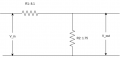
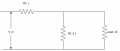
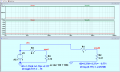
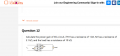
Question 11 and 12 from Decibel Measurements worksheet

MrChips

Joined Oct 2, 2009
34,629
Decibel is a measure of ratio. Hence, there are no dimensional units. It is independent of voltages.

For example, 2:1 is a ratio. The input is 2 times that of the output.

In Q12, a load is given. Hence, V_out is the voltage across the load.
 

Thread Starter

Ldaxar

Joined Feb 27, 2025
14
Okay so for Q12:

I assume that \(V_\text{in}\) is the total voltage drop across the circuit.

Gain is a ratio: $$A_V = \frac{V_\text{out}}{V_\text{in}} = \frac{I_\text{Load}R_\text{Load}}{I_\text{Total}R_\text{Total}}$$

$$\text{Total resistance: }R_T = R_1 + R_2 || R_3 = 4.38\text{k}\Omega$$
Substituting for voltage:
$$A_V = \frac{10*I_\text{Total}}{4.38*I_\text{Load}}$$

We don't know the current, so I guess it's a dead end. Any other ideas?
 

ericgibbs

Joined Jan 29, 2010
21,395
hi Lda,
As stated the answer is in decibels, for the circuits show it is the Attenuation Ratio of the signal [Vin]. from the Input to Output.
E
 

ericgibbs

Joined Jan 29, 2010
21,395
hi Lda,
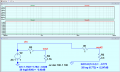
As you are not registered as a Student and this is not Homework, perhaps this image will help you understand.

E
EG 1580.png
 

Thread Starter

Ldaxar

Joined Feb 27, 2025
14
@ericgibbs thanks for the illustration. It's very helpful in general and now I got it.
Gain for Q11:
$$A = \frac{1.75}{1.75+8.1}=0.178$$

As for Q12 I still don't get it. I've tried to simplify load and R2 into a single resistor with \(3.38 \text{k}\Omega\) resistance but then the ratio is:

$$A = \frac{1}{1+3.38}=0.228$$
The answer is 0.261. Any other tips?

@crutschow we don't have voltages either. Resistances are the only input. I'm afraid that I don't understand your suggestion.
- LD
 

ericgibbs

Joined Jan 29, 2010
21,395
Hi Lda,
Ref Q12.

The output voltage is across the 3.4R, not the 1R.
A= 3.4/(1+3.4)= 0.772

E


BTW: how do you get 3.38R and not 3.4R for the parallel combination?
 

WBahn

Joined Mar 31, 2012
32,707
@ericgibbs thanks for the illustration. It's very helpful in general and now I got it.
Gain for Q11:
$$A = \frac{1.75}{1.75+8.1}=0.178$$

As for Q12 I still don't get it. I've tried to simplify load and R2 into a single resistor with \(3.38 \text{k}\Omega\) resistance but then the ratio is:

$$A = \frac{1}{1+3.38}=0.228$$
The answer is 0.261. Any other tips?

@crutschow we don't have voltages either. Resistances are the only input. I'm afraid that I don't understand your suggestion.
- LD
Resistance is not an input. The input is a voltage. The fact that we don't know what the specific voltage is doesn't matter.

The voltage gain tells us the ratio of the output voltage to the input voltage. If I tell you that the voltage gain of a circuit is 0.6, then if I later tell you that the input voltage is 10 V, you can immediately tell me the output voltage is 6 V. If I change the input voltage to 8 V, you can immediately tell me the output voltage is 4.8 V. Similarly, if I tell you that I'm measuring 1.2 V at the output, you can immediately tell me that the input voltage is 2 V.

Consider how you managed to determine that the voltage gain of Problem 11 was 0.178 despite not knowing what the input voltage was.

I have a feeling that you got it by throwing numbers at an equation that you don't really understand. So let's walk through it from the top.

Start from the definition of voltage gain:

\(
A_V \; = \; \frac{V_{out}}{V_{in}}
\)

The voltage at the output is, by Ohm's Law, the product of the resistance R2 and the current flowing through R2 (let's call that Io).

\(
V_{out} \; = \; I_0 \cdot R_2
\)

So now we just need to find Io.

Since it is a series circuit, the total resistance is the sum of the two resistors.

\(
R_{tot} \; = \; \left(R_1 \; + \; R_2 \right)
\)

The total current that flows from the input voltage is given by Ohm's Law. Let's call that current Io.

\(
I_0 \; = \; \frac{V_{in}}{R_{tot}}
\)

Now it's just a matter of substituting things in.

\(
\begin{align}
A_V & \; = \; \frac{V_{out}}{V_{in}} \\
& \; = \; \frac{I_0 \cdot R_2}{V_{in}} \\
& \; = \; \frac{\frac{V_{in}}{R_{tot}} \cdot R_2}{V_{in}} \\
& \; = \; \frac{\frac{V_{in}}{\left(R_1 \; + \; R_2 \right)} \cdot R_2}{V_{in}} \\
A_V & \; = \; \frac{R_2}{R_1 \; + \; R_2}
\end{align}
\)

Do you see how Vout was written in terms of Vin and then how Vin canceled out of the result entirely?

Now see if you can walk through a similar chain of reasoning for Problem #12.
 

WBahn

Joined Mar 31, 2012
32,707
Hi Lda,
Ref Q12.

The output voltage is across the 3.4R, not the 1R.
A= 3.4/(1+3.4)= 0.772

E


BTW: how do you get 3.38R and not 3.4R for the parallel combination?
The parallel combination of 10 Ω and 5.1 Ω is 3.4 Ω if you only use two sig-figs. But if you are going to use it in subsequent calculations, you should carry at least one more (and preferably two) sig-figs than you eventually want to keep. So that's 3.377 Ω, or 3.38 Ω if you settle for three sig figs.
 

WBahn

Joined Mar 31, 2012
32,707
$$A = \frac{1}{1+3.38}=0.228$$
The answer is 0.261. Any other tips?
You are throwing numbers at an equation without understanding it.

Why do you have 1 Ω in the numerator?

What does the resistance in the numerator represent? Does the 1 Ω resistor satisfy that?

You are then comparing a voltage gain to what the question asked for, which was the power gain.

Start from the definition of power gain, which is the ratio of the power delivered by the output to the power consumed from the input.
 

ericgibbs

Joined Jan 29, 2010
21,395
hi Lda,
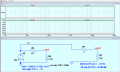
Re- Plotted the sim for || @ 3.38R, to correct for the staggering error of 0.001 in the final result !
A=3.4/(1+3.4) = 0.7727
A= 3.38/(1+3.38) =0.7717

But I do agree I should have been more precise.:rolleyes:

E
EG 1586.png
 

crutschow

Joined Mar 14, 2008
38,325
we don't have voltages either. Resistances are the only input. I'm afraid that I don't understand your suggestion.
That what is V_in if not the input voltage?
You don't need an actual voltage to solve the equations for attenuation (V_out / V_in) since the attenuation ratio is independent of the actual voltage, just use the variables V_in and V_out.
 
Last edited:

Thread Starter

Ldaxar

Joined Feb 27, 2025
14
I'll reference @ericgibbs 2nd plot as it has parallel resistor simplified. BTW assume that R3 and R4 doesn't exist so \( I_\text{In} \) flowing into R1 is not split.

Gain equation:
$$A_V = \frac{V_\text{vout2}}{V_\text{vin}} = \frac{I_\text{In} * 3.37 k \Omega}{I_\text{In} * (1k \Omega+3.37 k \Omega)} = \frac{3.37}{4.37} = 0.771$$

Not sure what to do after that. Question is asking about power gain, but it looks to me that current is the same for both I_in and I_out2.
$$ A_P = A_V * A_I = A_V * 1 = A_V $$
If we split R2 back into load and another resistor (called R2 as well \facepalm) I can calculate through current divider formula that approximately 25.1% of current flows through the load.
$$I_\text{Load} = \frac{3.37 k \Omega}{3.37 k \Omega + 10 k \Omega} *I_\text{In} = 0.252I_\text{In}$$
If we take this number as I_output then the power gain for the load will be 0.194, which is still wrong:
$$A_I = \frac{I_\text{Load}}{I_\text{In}} = \frac{0.252I_\text{In}}{I_\text{In}} = 0.252$$
$$A_P = 0.771 * 0.252 = 0.194$$
I must have messed up somewhere. Further tips?
 

WBahn

Joined Mar 31, 2012
32,707
Where is your equation that you are using to determine I_load coming from?

It is NOT the current divider formula for how much current would flow in a 10 kΩ resistor when it is split between that resistor and a 5.1 kΩ resistor.

You still seem like you are using equations that you don't understand what they mean and where they come from. As a result, you are misusing them by essentially throwing whatever convenient values are at hand without regard to whether they are the correct values.

You should be able to pull out a piece of paper and, without referring to anything else, derive the voltage and current divider formulas from the basic fundamentals.

If you have a current, Io, flowing into the parallel combination of two resistors, R1 and R2, how much current will flow in R1?

Let's call the current in R1 and R2 I1 and I2, respectively.

From KCL, we know that

Io = I1 + I2

Since they are in parallel, they have the same voltage across them:

Vo = V1 = V2

From Ohm's Law, we know that

I1 = V1/R1 = Vo/R1
I2 = V2/R2 = Vo/R2

From this, we can solve the second equation for Vo:

Vo = I2·R2

And substitute this back into the first equation:

I1 = I2·(R2/R1)

Using the KCL requirement, we have

I2 = Io - I1

which yields

I1 = (Io - I1)·(R2/R1)

Solving for I1 gives us

I1·(1 + R2/R1) = Io·(R2/R1)

I1·(R1 + R2) / R1 = Io·(R2/R1)

I1 = Io·[ R2 / (R1 + R2) ]

This makes the current gain

A_I = I1/Io = R2 / (R1 + R2)

Notice that, at no point, did we need to calculate the equivalent resistance of R1 and R2, though we could have gone that route, too.

The equivalent resistance is

Req = (R1·R2)/(R1+R2)

This makes the total voltage across the resistors

Vo = Io·Req = Io·(R1·R2)/(R1+R2)

The current in I1 is simply

I1 = V1 / R1 = Vo / R1 = [Io·(R1·R2)/(R1+R2)]/R1 = Io·[ R2 / (R1+R2) ]

Which is the same as the other way. If we want to leave it with Req, we can do that, as well.

I1 = V1 / R1 = Vo / R1 = Io · (Req / R1)

This makes the current gain

A_I = I1/Io = Req / R1

Both results are equivalent, but they are different equations using different resistances. You can use either one, but you have to know what resistances to use. You can't through Req = 3.37 kΩ and R1 = 10 kΩ, the values needed for the second form, at the first equation, which needs the two resistances in the denominator and the resistance of the other resistor in the numerator.

While you can calculate A_P as the product of A_V and A_I, I strongly recommend that you take a step back and do it starting with the definition of power gain:

A_P = P_out / P_in

and go step by step. You will learn a LOT more as a result.
 

ericgibbs

Joined Jan 29, 2010
21,395
Not sure what to do after that. Question is asking about power gain, but it looks to me that current is the same for both I_in and I_out2.
Hi Lda,
The current In/Out is the same, BUT what Power is developed in the 3.37k resistor, compared to the Input Power to the complete circuit ???

If you consider it in actual current values, assume an Input current of 1 amp.
Remember, the answer is a Power ratio of the Power Input compared to Power Output across the 3.37
ie; Units are dB's
E

EDIT:
Refer to Post #20 for correct Load Resistor ID.
 
Last edited:

WBahn

Joined Mar 31, 2012
32,707
Hi Lda,
The current In/Out is the same, BUT what Power is developed in the 3.37k resistor, compared to the Input Power to the complete circuit ???

If you consider it in actual current values, assume an Input current of 1 amp.
Remember, the answer is a Power ratio of the Power Input compared to Power Output across the 3.37
ie; Units are dB's
E
But the output power is NOT the power delivered to the 3.37 kΩ resistor, which is the effective resistance of the 10 kΩ load resistor and the 5.1 kΩ resistor that is part of the attenuator circuit. The output power is ONLY the power that is delivered to the load resistor.
 
Top