Pull Up Resistor voltage values ?

Thread Starter

usmansa1

Joined Jan 22, 2017
40
Hi,

May be this is the most basic question, but I don't understand the concept of pull up resistor and how they maintain the voltage value. For example lets take an example of below circuit. There is 5 volts battery and then there is 10K resistor which is further connected with the Vout which is most probably the load.
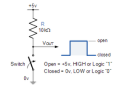
upload_2018-10-29_11-53-34.png

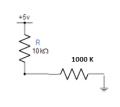
If we replace the load (Vout) with the resistor and see the voltage or make the load 1000K ohm to get the 5 volts then the circuit will be something like this.
upload_2018-10-29_12-0-17.png

So if we use the KVL to find the voltage across the load 1000K there will be less voltage. I dont understand how the pull up resistor can supply the voltage of 5 volts or how this pull up resistor is used.
 

ebp

Joined Feb 8, 2018
2,332
You are right about the relationship between the pullup resistor and the load resistance. Pullup resistors are normally calculated to be sure that the voltage produced meets the requirement. The requirement can vary considerably depending on what is being driven and the input may be specified in terms of resistance (rare) or current. The diagram you showed is an oversimplification.

Here's an example with a TTL (almost completely obsolete now) input:
A TTL input requires a minimum input voltage of 2.0 V for HIGH, but 2.4 V is better because it gives some "noise margin" so we'll use 2.4 V. In order to raise the input to that voltage the spec's say we need to be able to source current of 40 µA into the input (this means that "conventional current", which is considered to flow from positive to negative must be made to flow into the input).

If we have 5 V for the "top end" of our pullup resistor, the voltage across the resistor for 2.4 V at the bottom end (the TTL input) would be 5 - 2.4 V = 2.6 V. For 40 µA we would require a resistor of 2.6 V / 40 µA = 65000 ohms. If the pullup had to serve several inputs then we would calculate it based on the sum of the currents from all the inputs. Often the pullup resistor actually used is lower value than calculated. A 10k pullup might be used. The current through the pullup when something is making the input logic 0 must be considered. You wouldn't want to use a 100 ohm resistor, for example, because you'd have 50 mA flowing through it if the input was switched to 0 V. That isn't a huge current, but it is high in comparison to something like the current required for a small to medium capability microprocessor. A digital output or a small transistor circuit driving the input with the pullup resistor probably would not be able to get the voltage low enough for a good logic 0 level if it had to "sink" (make flow to circuit common - 'ground") 50 mA. A TTL output, for example, can only sink 16 mA while guaranteeing a good logic 0 voltage.

---
With CMOS inputs, there is only a very tiny (microamperes at most) DC "leakage current" to be concerned with so a pullup resistor can be very high in value. However there is also some capacitance at the input and if it is necessary to make the voltage rise very rapidly we would need to consider the capacitance in calculating our pullup resistor.
 
Top