Project in need of a simple Short Circuit Detector

Thread Starter

Aya_84

Joined Jun 16, 2024
11
Hello,

I'm working on a project for connecting 120V AC loads to run some tests. This device was going to be fairly simple, but as I'm trying to grow I decided to integrate an MCU IC. I also have a tendency to add complication and that's how I'm at this end of the Rabbit Hole. I would like to design a simple (if possible) sensor to check the load for short circuits. The sensor would ideally work while the system is live, and I'm thinking a DC pulse of some sort, so it doesn't interfere with the AC supply.

I'm thinking this is possible with some sort of arrangement of inductors and capacitors (to filter each signal out), as well as optocouplers to isolate the controls from mains power.

If some of you could shed some light here for me I would greatly appreciate it. At the very least I would need a signal to my MCU if there is a short/ fault condition. If I had a magic wand, perhaps it would also give me some feedback on what it "sees" (ie linear resistance etc).

Thank you for your time.
P.S. Another consideration is, my main circuit will be measuring current, AC voltage, calculating power (W), and PF. This sensor should not interfere with those readings, or be capable of being factored in for calculations at the micro controller.
 

twohats

Joined Oct 28, 2015
606
Hi,
Working with high voltage is dangerous.
If you connected a suitable filter to you AC supply, so that you ended up with 5 volts DC to trigger your mcu?
A bulb, led or buzzer would serve the same purpose.
Good luck.............
 

Thread Starter

Aya_84

Joined Jun 16, 2024
11
Right, so I'll need a power supply on the HV side, and then run the signal back through the Optocouoler. I don't think I'll even be concerned with measurements... but it would be nice if it could register weather any load was attached or not.
 

Pyrex

Joined Feb 16, 2022
501
Hi
I did not understand what task you are solving? Current transformers are good for measuring current.
A general purpose 120/6V transformer can work as a current transformer by reversing it.The measurement accuracy is not very high, but the short circuit can be detected easily
 
A very simple overcurrent detector can be done with shunt placed in series with load. Once the voltage across shunt is >2V you can detect it with optocoupler and disconnect the load by relay. This should be relatively safe.
Of course, it can have a delay of one period until overcurrent is detected.

IMG_0855.jpeg
 

Thread Starter

Aya_84

Joined Jun 16, 2024
11
I appreciate the contributions.

So the above two mentioned solutions are essentially the same, with respect to measuring current flow. This method will not be sufficient I'm afraid. I do already have a CT that I'm utilizing to measure the current flowing thrive the load when it is turned on. What I need is a circuit that will evaluate a short circuit regardless of whether there is current flowing or not, regardless of if the circuit is live or not. Regardless if the load device is powered on or in standby. Also as I mentioned, it would be nice to detect whether a load is connected or not.

I don't see how the latter is possible without some sort of micro switch inside the Receptacle, but that's partly why I am here.

Thank you for the diagram. If needed I can provide an illustration of what I'm thinking might work.
 

k1ng 1337

Joined Sep 11, 2020
1,038
I appreciate the contributions.

So the above two mentioned solutions are essentially the same, with respect to measuring current flow. This method will not be sufficient I'm afraid. I do already have a CT that I'm utilizing to measure the current flowing thrive the load when it is turned on. What I need is a circuit that will evaluate a short circuit regardless of whether there is current flowing or not, regardless of if the circuit is live or not. Regardless if the load device is powered on or in standby. Also as I mentioned, it would be nice to detect whether a load is connected or not.

I don't see how the latter is possible without some sort of micro switch inside the Receptacle, but that's partly why I am here.

Thank you for the diagram. If needed I can provide an illustration of what I'm thinking might work.
Hi, the statement in bold is a fallacy. By definition, a short circuit is a live connection with current flowing so it would be helpful to try to explain yourself better. The easiest way I know to measure current is a shunt resistor (Post #5) or with a coil of wire wrapped around the high current wire.

The coil of wire method is pretty simple. Wrap several turns of insulated wire around the high current wire and solder to an LED and resistor in series. This creates a mini transformer which will couple some of the energy to the LED provided current flows in the (primary) high current wire. You'll have to do some math to size the resistor to where the LED only lights when there is many amps flowing in the primary. Instead of an LED, you can use a peak-detector circuit and micro-controller to monitor when a fault occurs.
 

Thread Starter

Aya_84

Joined Jun 16, 2024
11
Okay, let me try this...

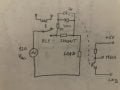
So I have a device I am building. This device has a low voltage side (controls & microchips), a well as a high voltage side (120V 15A AC 60hz). The high voltage side (circuit 1 "C1") is designed to power a load (another device that plugs into a 15A Receptacle), this is in order to run some tests and examine the circuit/ device properties - the details of which are not pertinent here. The low voltage side runs the microcontroller that is coded to measure and evaluate the input data, as well a control the output on the HV side. (hopefully that is clear thus far)

What I am looking to do, is have a separate sensor circuit that will connect to the load via the same Receptacle connection (circuit 2 "C2"). This circuit would obviously have to be integrated in the HV side of the board, and thus will utilize optocouplers (or the like) in order to signal the MCU. I would be needing to provide a separate DC power supply (I'm thinking 5V DC would be fine), in order to Power C2, which would interface between C1 and the MCU.

C2's purpose is to examine for fault conditions (safety feature), and specifically a short circuit fault condition. It wouldn't need to be continuous, I'm thinking a square pulse every so many ms would suffice. I would have to buffer and isolate the C1 and C2 from each other, and my thoughts were using inductors and capacitors to do so. C1's state would be then irrelevant, weather energized or not, the load could be on/ active, or off/ inactive, either way, C2 would ideally work as intended.

So I'm sorry that I'm not an engineer, but that's why I'm here, if you would please help me. The CEC does not define the term "short-circuit", so I'm just not as smart as you.

I have attached a crude circuit design/ tester image to attempt to illustrate further. Please note the purpose of the image is strictly to illustrate my question/ search for assistance, as it completely negates the entire device as designed, and is not a Blueprint schematic. The external load would plug in in the location where I marked "LOAD". The values are mostly default, and R1 is merely there to prevent an actual short-circuit on C1 for demonstration and testing.

These are my thoughts anyhow, I am open to other suggestions that are better suited for this task, but if you simply know how to Calculate values and implement this variant I would be grateful.
(Also, keep in mind, In not sure how/ if this will affect the PF of C1, and thus, if you would be so kind to factor that into your responses I would appreciate that as well. I will have to add that to the code in the MCU to correct for Deviation. )

Thank you. Screenshot_20240618-200958_P R O T O.jpg
 

Sensacell

Joined Jun 19, 2012
3,767
Your attempt to explain has only made this more unclear and confusing.
You are mixing an assumed solution with the definition of the problem, this is messy and confusing.

Let's go back to the the simplest idea- walk through the assumptions step-by-step.

1) You have a 120VAC load, it's either faulty, or not, yes?
2) A faulty load draws excessive AC line current when powered, yes?
3) If the load is shorted, it must trip a circuit breaker, yes?

Do you need an electronic circuit breaker with an output that sends a signal to the microcontroller when it trips?
Do you need the Microcontroller to be able to reset this breaker?


Are you trying to detect a fault BEFORE power is applied to the device?
What is the load exactly?
 
Last edited:

Thread Starter

Aya_84

Joined Jun 16, 2024
11
I'm sorry, I thought my explanation was detailed, clear, and concise.

Let's not go off on tangents please. So I'm going to assume you can see the image I posted.
Can you see that there are two circuits (C1 & C2)?
And that those circuits are 120V AC and 5V DC respective?

If you follow those circuits, you can hopefully see that they both connect to the rectangle titled "LOAD". Well I need a way to connect those two circuits without blowing anything up. AC and DC to live harmoniously on the same conductors. And then I need a way to filter out each of the other signals from one another (ie be able to separate them).

So if you think of a boat and a car, I need a way to merge a boat and a car on the same road for a determined distance, and then separate the boat and the car at the finish line. Maybe you can help me build a trailer and a couple boat ramps.

If you don't understand just let me know. I'll find another way to explain.

Thank you for your time.

P.S. I absolutely know for a fact that this is possible (sounds impossible - isn't). I have done it before, in real life, with 12V DC and high frequency AC. I've seen it, I've done it... I just have not engineered it. I do not know the science and all the calculations, that's what I need help with.
 

Ya’akov

Joined Jan 27, 2019
10,226
Welcome to AAC.

You seem to be getting frustrated because you don’t understand why people just can‘t do the part of solving this problem that you can’t. You plead ignorance concerning that part of the problem as if it can just be bolted on to what you’ve already decided on. It would be very helpful if you’d consider what seems to you to be irrelevant—because you have a very basic problem with your process and it’s a little off-putting for you to ignore advice from genuine experts.

First, you have what has come to be known as an XY Problem, that is, you have a problem X and propose a naïve solution Y. This replaces X as the problem and you are no longer solving the problem you ostensibly set out to solve. Instead you are struggling to do something that won’t solve X even if you make Y “work”.

So, you need to back up. If you want real help, you’ll need to drop the simplified scenarios and pronouns like “a device” and “a load” and start naming them with specifics. The actual application is also important. You aver that you are ignorant of aspects of engineering solutions to this sort of problem so your “simplified case” is also a naïve one that will be missing all sorts of important information. This will lead to a game of 20 questions trying to drag out the relevant information from you.

If you plead confidentiality about the details of the problem then you need to hire an engineer under NDA and get help that way—otherwise you are going to have to be more forthcoming with details principally:

• The identity of the device
• The problem your “safety” circuit is trying to solve
• The nature of the load
• What you consider a “short circuit”

The CEC doesn’t define short circuit but you are going to have to in order to detect one. What does the term mean in this context? Is the load resistive or inductive? How much current does normal operation require? How fast do you need to detect a fault condition and what are you going to do about it when you do?

You really can’t expect self respecting professionals to be siloed into your make-believe version of the problem and told to solve it for you—particularly on a volunteer basis. For us to help you, you will need to do your part: describe the problem you are trying to solve in real terms, put it into the context of the real conditions, and be open to abandoning your first impulse at a solution because there’s always at least a 50% chance you’ll have to go a different way.

By the way, even if you end up doing what you propose as part of the solution, you need to use a different frequency of superimposed on the mains as if it were a carrier. The DC route is extremely problematic. Any DC blocking will fail during the change in voltage which is indistinguishable from AC. Adding the complexity of extra filtering, etc. when you can just use AC instead makes little sense. You’d still have an LPF and an HPF but they’d be simplified.

Good luck with your project, I hope you find an optimal solution.
 

Alec_t

Joined Sep 17, 2013
15,101
Couldn't you use a change-over relay/contactor to connect the load initially to a test set-up and then connect the load to a mains power supply if the test indicates there is no 'short-circuit'?
 

WBahn

Joined Mar 31, 2012
32,702
Okay, let me try this...

So I have a device I am building. This device has a low voltage side (controls & microchips), a well as a high voltage side (120V 15A AC 60hz). The high voltage side (circuit 1 "C1") is designed to power a load (another device that plugs into a 15A Receptacle), this is in order to run some tests and examine the circuit/ device properties - the details of which are not pertinent here.
You may be being a bit premature to assume that the details of the load are not pertinent. Since we have no idea what the load is or what, for your purposes, a "short circuit" is, that's impossible for us to say.

So let's start with what you NEED. You say you want to detect a short circuit fault condition. What, for your purposes, defines a short circuit? I could build you a load that draws almost no current at DC and 50 A at 120 V / 60 Hz, or I could build you a load that draws 50 A at DC and almost no current at 120 V / 60 Hz. Which of those would you need your circuit to flag as being a short circuit fault condition? Neither? One but not the other? Both?

There's no point trying to design a circuit to solve a problem until you have been able to adequately define just what the problem actually is.
 

Thread Starter

Aya_84

Joined Jun 16, 2024
11
Ya'akov, your last paragraph is the answer I'm looking for. You said DC won't work. I've seen it before as I stated, but I can't explain the discontinuity.

WBahn, I would define a short-cuircuit fault condition as a low impedance path other than intended. So for example, if I plug a 12AWG wire into the Receptacle, that's a dead short.

So what I need is a circuit to detect if there's continuity between L1 and the identified, or L1 and GND.

That's why I don't understand why this is so complicated. I understand everyone's curriculum, but I'm trying to keep this simple. It would take me hours to describe everything in the circuit and the complexity of why. From my perspective it shouldn't matter if I'm plugging in a toaster oven or a Hot Tub, I don't need a specialized system that caters to one device, I need a catch all that will tell me if Pin A connects to Pin B. The challenge, is it would be nice if I could do this independent of whether the device is energized or de-energized.

I'm sorry that I'm not explaining well enough. I promise I am trying my best, this is why I hate forums, no one understands me - so I know what the problem is.

Thank you for bearing with me.
 

Thread Starter

Aya_84

Joined Jun 16, 2024
11
Hi Alex,

Obviously that is the simple solution, however I already have a few relays in the project, and I'm trying to keep the costs down. Additionally, I would like it to be continually active, and function in both energized and de-enrrgized states; plus, less mechanical components to fail, and less weight.

Thank you.
 

BobTPH

Joined Jun 5, 2013
11,463
It sounds to me like you think you can have two currents flowing through the same load and keep them separate. That is not physically possible.

The circuit you posted powers the load through two 10uF capacitors and a 10Ω resistor. That is an equivalent resistance of approximately 530Ω. So at 240V, a that is an RMS current of 225 mA into a short circuit. You also show powering a 7805 regulator from a pulsed 170V DC source with no filtering. It will not last long. Forget about anything you designed and give us the information we need to help. I have very little hope that is going to happen (based on a multitude of prior threads.)
 

WBahn

Joined Mar 31, 2012
32,702
If you are only interested in detecting a low DC impedance and don't care what the impedance is at 60 Hz (or other frequencies), then you can just connect a DC source to the load terminals via a current sensing resistor and a suitable inductor (though you might not like the size of the inductor needed).

Let's throw around some rough numbers.

You don't want to trigger on something that draws less than 15 A at 120 V and 60 Hz. So that means legitimate loads can have an impedance, at that frequency, of as low as 8 Ω.

The question then becomes, how much less than this do you NEED to have it trigger on? 7.9 Ω? Or more like 1 Ω? Or even 10 Ω might be a better choice. Pros and cons to each of these choice, and since that decision depends on things that you insist we don't need to consider, we can't offer any guidance there. So I will arbitrarily pick 10 Ω, on the basis that I want my system to give me an indication that a load is getting close to the trip point even if it isn't quite there yet, instead of telling me everything is fine and then tripping a breaker when I send power to it.

The next big assumption, since we aren't allowed to consider the details that are needed to make informed decisions, is that the DC impedance at the trip point is the same as the AC impedance. That may or may not be anywhere close to a reasonable assumption. Plug a perfectly good unloaded heavy duty transformer that draws virtually no current at 60 Hz into a DC power supply and you will get a good example of when it can be a really bad assumption. On the other side, it only takes a tiny series capacitance to block all DC current, so your load might draw no DC current at all from your measuring circuit yet behave like a dead short at 60 Hz. But we can't address that since the details of your load can't be taken into consideration.

With these (probably poor) assumptions in place, we need to detect when a DC load of less than 10 Ω is connected while making sure that our measuring circuit represents a negligible load at 60 Hz. What constitutes negligible depends on how light of a load that you might want to measure would be. If you want to measure the current in a load that only draws a milliamp of current at 120 V at 60 Hz, then your short-circuit detector needs to draw no more than a 10 µA in order not to constitute no more than a 1% perturbation on your measurement. Let's say that your detector circuit uses a 12 V DC source, that means that you need an impedance at 60 of about 10 MΩ, but you need to be able to sense the difference in current draw at DC in the 10 Ω range. Let's assume that you can sense voltage change across a current sense resistor at the 1% level, so that means that your current sense resistor could be as big as about 1 kΩ. With no AC filter in place, that would cause a draw from your 120 V source of about 120 mA, which might be negligible for loads that normally draw at least an ampere. But to get into that 10 MΩ range, you would need a series inductor that is 26 kH. That's not going to happen. But we only needed that 10 MΩ because of assumptions about the range of legitimate loads you need to measure.

So perhaps it's time to give up this fantasy that the details of the load are not important. While we don't need to know the exact details of every load, we do need to know what scope of the range and types of loads being considered if we are to have any reasonable hope of helping you come up with a circuit that will do what you need.
 

Thread Starter

Aya_84

Joined Jun 16, 2024
11
WBahn, that is very long, I need to read through and absorb that.

BobTPH, yes, that is what I'm hoping for. So that's why I'm thinking you need DC so it will not interfere with the AC, and they can be filtered and separated. The bridge rectification and LM chip are just down and dirty to get the circuit tester software to work, the resistor is simply to allow the system to run without actually shorting out and failing. I was just trying to see how the variables affect the outcome, like a lab experiment (much safer in a computer program then on a real bench of you don't know what you're doing).

WBahn, yes, I'm not at all concerned with reactive impedance, merely the linear component. Obviously the reactive component will only exist with a flowing AC.

Thank you for not giving up, I'll check back with you once I've read through all of that.
 
Top