Project: How to make PCBs

Thread Starter

Wendy

Joined Mar 24, 2008
23,798
So THATS what the friggin problem is! Sheesh, I've read the writeups where they say "...and then set your Iron to about the middle setting, not too low, not to high..." and my toner didn't even begin to melt at that temperature. I had to set it all the way at the end, past all the settings and then leave it strapped to my board with bungees for about 15 min. I was thinking "man, I don't know what kind of Irons these guys are using, but mine sucks!"

I bought a Brother 2230 specifically for making PCBs. I guess I should have done a little more research. Other than the heat issue, it makes really nice prints.
That's what I bought my HP laser for too, and I still never got the iron (at max setting) to work quite right. Cheap irons have less wattage than expensive ones, around 200W more. Maybe that makes a difference, I don't know.

The laminator is a different story. I feed the package around 8 times, not letting the board cool down much (it does cool somewhat). Given the difficulty of getting the PCB/paper/transfer through the laminator I don't really expect it to last long. This is relative though, it could still be several years of service.

I'm debating a different scheme for beginners. If I can find a source of thick, smooth aluminum plates it may be possible to press them tight on a package and use C clamps, then bake the whole arrangement in the oven.

If you have a chance though, the laminator is the way to go. A high quality extra hot (think temperature adjust) unit. I really liked Fenris's Completed project, where he replaced the thermostat of a standard laminator to bump up the heat.
 

shortbus

Joined Sep 30, 2009
10,050
Some people have had success using the aluminum plates and a electric skillet too. They usually have a temperature control on them. If I remember right it takes about 420*F to melt most toners and 480*F for Brother toner.
 

Fenris

Joined Oct 21, 2007
288
Hi Bill

Great thread! I am still etching my own. I am using Ferric at the moment, because I was given it free, but have been looking at the chemicals you have used for the future.

The paper looks interesting to. Though as I go to a local printers to get my patterns done I'll have to wait to try it myself (I lack my own printer)

I've used 'The Gimp' to make some 19mm diameter PCB's with excellent results. On the actual PCB even the lettering has come out perfect. These were used to hold 7 super bright LED's. Resistors were sandwiched between the 2 PCB's and the LED's mounted on the top one. 3 blue, 3 green in antiphase driven by a 555 circuit and 2 White switched at will. Of course this was for the 'hot end' of a dalek gun :D

I to am gradually killing my laminator. But I think I can attach a cordless drill to drive the rollers when the AC motor gearbox dies!

Excellent article!!

regards

Fenris
 

Attachments

soda

Joined Dec 7, 2008
177
@ Bill,

I always enjoy it to see how other people make pcb's, but i still prefer my own way.My way is to use transparency's.Ok, i'm not really using transparency's but normal printing paper. After i print the lay out i use normal cooking oil and apply it with a kitchen sponge to the back of my printing.This make the paper transparent. The oil doesn't do anything to the positive resist and you any-way wash it off when you do the developing in the costic soda.

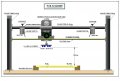
I use UV LED clusters with a MCD between 15,000 and 16,000 for the exposure. I build my own so called scanner, which i use to expose the pcb's. Have a look at the pic. Ok, it's not the real thing but if i had to take a pic i have to remove the gadget from the box i've placed it in.
 

Attachments

Thread Starter

Wendy

Joined Mar 24, 2008
23,798
How often do you etch? Me, once about every two months.

The fumes are not good, but I have a good sense of smell, and didn't notice anything during my etching. I did sniff the muriatic acid from the bottle (and regretted it). It is about 600% stronger than what your stomach uses, since it is just hydrochloric acid. My personal opinion is you have to worry about skin burns more than anything, and even then it is easy to prevent with simple precautions.

You mix it when you need it, then get rid of it. The total process lasts around 10-15 minutes. There is no real long time storage.
 

soda

Joined Dec 7, 2008
177
You might be interested in this thread. The one time I tried photographic the results were truly bad.

Project: LED based UV exposure box for PCBs
Bill, if you use the correct UV LED's then the boards came out quite good. The UV led's MCD need to be in the range of at least 15,000. I use this method for years now and never experience any problems.

I think it's because you didn't use real UV led's why the board came out so bad.
 

Thread Starter

Wendy

Joined Mar 24, 2008
23,798
When I tried it the newer generation of LEDs simply did not exist. The method I use now works, and that is all that is important to me.
 

Robotics Guy

Joined Mar 11, 2011
15
How often do you etch? Me, once about every two months.
Depends on how busy I am with school :D Sometimes I go a month or two without doing it, other times I do it a couple times a month..

The fumes are not good, but I have a good sense of smell, and didn't notice anything during my etching.
I use the same acid/peroxide ratio as you and have always smelled very strong fumes during etching?

You mix it when you need it, then get rid of it. The total process lasts around 10-15 minutes. There is no real long time storage.
Most people I've talked to moved from using ferric chloride to the HCl+H2O2 because it doesn't need to be thrown out; it can be reused indefinitely. Of course the problem with storing it is the fumes and that fact that the fumes cause things to rust.

How are you disposing of your etchant each time? AFAIK it's the copper in the etchant, not the acid, that is hazardous waste.
 

Thread Starter

Wendy

Joined Mar 24, 2008
23,798
I generally find a weed I don't like. The grass grows back promptly. I don't class copper as a hazardous waste either.

I've tried reusing FeCl with very little joy. Personally I don't think it is a good idea. It does help if you warm the solution up though.

I've serviced professional FeCl etchers. It used a titanium bar to couple a motor to a sprayer, which made the spray sweep up and down on both sides of the board. The solution was heated to a pretty high temperature. I have decided I don't like FeCl, though I've had good results with it, the fumes are just too destructive. I brought the fume issue under control by rolling a paper towel up tightly, and wrapping it tightly around the seam between the cap and the bottle and taping it in place. The paper towel tends to turn brittle, which suggests it is being eaten by the fumes.

The muriatic acid/H2O2 etchant is much faster, and I used much smaller quantities. I like the fact it is transparent, it makes tracking the progress of the etch much easier.

BTW, the professional FeCl etcher was used for prototypes at Alcatel.
 
Last edited:

R!f@@

Joined Apr 2, 2009
10,004
Hey bill.
Few questions.

I think I can get ferric chloride. Is this the best thing as an etching chemical?

The papers u sent can be used in any laser jet, am I right?

As I have hard time getting a thermal sort of thingy that u use, and the ironing may not be good, Is UV ex poser preferable?

If so, what is the required wave length for the UV led's?
Nobody seem to say anything about wavelength. As I have searched ebay, I saw two different types of UV led's & what brightness is preferable?

Any other tips I should be concerned about like what type of clad boards and such.
Any thing different from etching double sided Vs Single sided?

Any other things I should be concerned regarding Ink jet Vs Laser jet. Like DP settings ( 300dpi or 600dpi )?
 

Thread Starter

Wendy

Joined Mar 24, 2008
23,798
The wax paper is limp as a wet towel. You will need to use a regular piece of paper with wax paper wrapped around it to feed it through a laser printer, strategically placed scotch tape to hold it in place.

I can't help you with photographic, though lots of other folks can.

A really hot iron will work, but lately I had nothing but trouble with them. I suspect the plague of Chinese junk has ruined this. The laminator worked fine, see the early posts.

The difference between single sided and doublesided is alignment, it is a bear. It can be done, but I prefer not to on my projects.

Ferric Chloride (FeCl) works well, just heat it a little before using it. It will eat a lot of different metals, not just copper, but is fairly non toxic (I wouldn't recommend drinking it or anything).
 

Markd77

Joined Sep 7, 2009
2,806
If so, what is the required wave length for the UV led's?
Nobody seem to say anything about wavelength. As I have searched ebay, I saw two different types of UV led's & what brightness is preferable?
The "UV" LEDs I used are these:
http://cgi.ebay.co.uk/20-LEDs-Ultra...al_Components_Supplies_ET&hash=item518fe82608
It's hard to find data on the wavelength required but one type of photoresist spray said 340-420nm.
True UV LEDs are much more expensive than the ones I used which I think are really just violet.

Check that you can get PCB developer and photoresist boards as well as etchant.
Also use at least 600DPI.
Double sided is not much different from single sided although I haven't done it yet. You need to get the alignment perfect, expose one side then the other, making sure minimal light gets to the first side, then develop and etch. I think a good method is to drill 2 holes at opposite corners.
 

binbags

Joined Jul 7, 2009
12
Hi Bill

This is a great tuition lesson, I have not tried wax paper before. Any chance of turning your instructions on page 1 into a PDF download or text file with photos?:):) I dont want to try the copy and paste method, does not seem right as you have spent time compiling it.

Does the wax not damage the fuser drum????

If not, thanks anyway for the lesson.
 
That's a great write-up, thanks a lot!

For any Mac Users wanting to design PCBs — I had a quick flick through the free offerings, and Osmond Cocoa (Their latest version) is very clever and useful.

Thanks,
Barnaby
 

Thread Starter

Wendy

Joined Mar 24, 2008
23,798
Hi Bill

This is a great tuition lesson, I have not tried wax paper before. Any chance of turning your instructions on page 1 into a PDF download or text file with photos?:):) I dont want to try the copy and paste method, does not seem right as you have spent time compiling it.

Does the wax not damage the fuser drum????

If not, thanks anyway for the lesson.
I hadn't thought about it, but I see no reason not to. I'll attach it to the 1st post when (if) I get get it done.

IIRC, Brother brand laser printers use a different toner that needs to be heated to a much higher temperature to transfer, so I don't think those work.
It is a problem, but not insoluble. You just need better heat. The skillet method would work, for example. It is a simple matter to crank the heat up.

I'm still thinking of the metal plates and C-clamps, combined with a conventional oven. It wouldn't be quick, but it should work well.
 

binbags

Joined Jul 7, 2009
12
IIRC, Brother brand laser printers use a different toner that needs to be heated to a much higher temperature to transfer, so I don't think those work.

I have been told that the Toner powder in the Brother is "Resin" based, not plastic like HP. Not sure if this is correct.
 
Last edited:

R!f@@

Joined Apr 2, 2009
10,004
Hey Bill.
I think the package u sent arrived today. The post man came & gave me a slip. I have to pay the handling charge and collect it, and the tracking says US, so I presume it is the wax papers...right?
 
Top