problem in multistage amplifier

Thread Starter

refat

Joined Sep 16, 2012
7
hello Everyone,
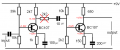
I am working on my project (multistage common Emitter amplifier) and am stuck with problem her when input signal from signal generator.......
no any amplifier signal in output........... is there any problem in the design of this amplifier???????!!!!!




Thread Starter

refat

Joined Sep 16, 2012
7
Put a capacitor between the signal generator and the input of the amplifier to block DC voltage.

thank u MrChips.....
also no amplifier output signal when i put a capacitor between the signal generator and the input of this amplifier.
 

Thread Starter

refat

Joined Sep 16, 2012
7
please any one .....
help me....... design this amplifier on any Electronic simulation program like Circuit Wizard or multisim.....etc
or by any calculation to check this amplifier.....
 

akis02

Joined Apr 30, 2011
57
Circuit will not work as is.

1) Remove the 100uF and the 200uF caps.
2) Remove the 2.2K between the two transistors - just connect the capacitor
3) on the second transistor replace the 10K with a 22K and the 2.2K with a 4.7K.
4) on the first transistor replace the 39K with a 100K and the 10K with a 33K.
 

absf

Joined Dec 29, 2010
1,968
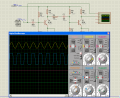
I tried your circuit on proteus and I found out that if the input signal if >2mV (2000Hz sin wave), the output is severly distorted on the tops and bottoms.

Below is the scope display comparing the input and output using a 10mV 2000Hz sin wave. The gain of the amplifier based on the scope amplitutde is roughly 1500.

Allen
 

Attachments

Last edited:

MrChips

Joined Oct 2, 2009
35,296
What are you trying to amplify?
I tested the circuit on a breadboard and it works ok.
The base bias may need slight tweaking. The two emitter bypass capacitors might be overkill. I used 10μF instead. You shouldn't notice much difference except at very low frequencies. I omitted the 2k2 series resistor.
 

Audioguru

Joined Dec 20, 2007
11,248
The transistors are biased properly so they should work.
The emitters are both bypassed to ground so the voltage gain is very high.
I calculated voltages. Measure the voltages of your circuit to see if your voltages are close.
 

Attachments

Thread Starter

refat

Joined Sep 16, 2012
7
What are you trying to amplify?
I tested the circuit on a breadboard and it works ok.
The base bias may need slight tweaking. The two emitter bypass capacitors might be overkill. I used 10μF instead. You shouldn't notice much difference except at very low frequencies. I omitted the 2k2 series resistor.

i want to:
1- Input 1 kHz signal from signal generator and display input and output on an oscilloscope. Adjust input amplitude to avoid any distortion.
2- Draw the input signal and the output signal and measure the amplitudes.
3- Calculate the voltage gain of the amplifier from the results obtained in 2.
4- Increase the input amplitude to a maximum value without causing significant distortion and record the value.
 

Thread Starter

refat

Joined Sep 16, 2012
7
The transistors are biased properly so they should work.
The emitters are both bypassed to ground so the voltage gain is very high.
I calculated voltages. Measure the voltages of your circuit to see if your voltages are close.


ok..... what about the resistor 2k2 (why u cancel this 2k2 )???
 

Audioguru

Joined Dec 20, 2007
11,248
I reduced the values of some capacitors because high values are not needed.
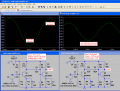
I simulated your amplifier using LTspice program.

The amplifier produces noticable distortion at high output levels because it has no negative feedback.

The 2.2k resistor is simply an attenuator that reduces the voltage gain.
 

Attachments

akis02

Joined Apr 30, 2011
57
As we have said before (at least 4 of us), with the bypass capacitors in place, there is so much gain that it clips heavily with just 2mV input. If you remove the bypass capacitors then the gain falls to about 6x and then you will be able to see something meaningful on the scope. How can you practically reduce a 1mV signal so as to see a clean output on the scope? 1mV is like noise, you'll breathe the wrong way and get 1 mV.
 
Top