Potentially fun math problem

Thread Starter

Raymond Genovese

Joined Mar 5, 2016
1,653
This originated in a homework thread (sort of) but was abandoned. I wrote up the answer intending to post it on some SAT/GRE site but I can't find it anymore. Thought some others might enjoy and I will stick a spoiler button. I thought it was kind of clever and thought others might like it.


The length of bolts made in factory Z is normally distributed, with a mean length of 0.1630 meters and a standard deviation of 0.0084 meters. The probability that a randomly selected bolt is between 0.1546 meters and 0.1756 meters long is between

a) 54% and 61%
b) 61% and 68%
c) 68% and 75%
d) 75% and 82%
e) 82% and 89%

Solve it without using any Z tables and if you don't have to be so clever as to solve the exact probability, just the correct choice.
 

WBahn

Joined Mar 31, 2012
32,704
The range is 1 std dev below and 1.5 std dev above the mean.

The probability that it is within 1 std dev of the mean is about 68%, so we know it is above that and hence not (a) or (b).

The probability that it is within 2 std dev of the mean is about 95%. So that puts (95%-68%)/2 in each lobe between 1 std dev and 2 std dev, or about 13.5%.

Between -1 std dev and +2 std dev would be 68% + 13.5% = 81.5%. So that rules out (e).

We know that significantly more than half of that 13.5% is between 1 std dev and 2 std dev, which means that the answer is noticeably more than 74.5%. That pretty well rules out (c).

Hence the only answer that seems plausible is (d).

Figure that about 2/3 of that is between 1 std dev and 1.5 std dev and that gets another 9% give or take, bringing it to about 77%.
 

Thread Starter

Raymond Genovese

Joined Mar 5, 2016
1,653
The range is 1 std dev below and 1.5 std dev above the mean.

The probability that it is within 1 std dev of the mean is about 68%, so we know it is above that and hence not (a) or (b).

The probability that it is within 2 std dev of the mean is about 95%. So that puts (95%-68%)/2 in each lobe between 1 std dev and 2 std dev, or about 13.5%.

Between -1 std dev and +2 std dev would be 68% + 13.5% = 81.5%. So that rules out (e).

We know that significantly more than half of that 13.5% is between 1 std dev and 2 std dev, which means that the answer is noticeably more than 74.5%. That pretty well rules out (c).

Hence the only answer that seems plausible is (d).

Figure that about 2/3 of that is between 1 std dev and 1.5 std dev and that gets another 9% give or take, bringing it to about 77%.
D#@3 you Bahn:)
To correctly answer this question you need to know how to calculate a Z score and you need to know certain characteristics of the standard normal curve.

1. First, calculate Z scores for 0.1546 and 0.1756.

Z= (X-mu)/ sigma, where X=raw score, mu=mean of the distribution and sigma=standard deviation of the distribution. The question gives you the information for the calculation as long as you know the formula.

For 0.1546, Z=(0.1546-0.1630)/0.0084=-1.00

For 0.1756, Z=(0.1756-0.1630)/0.0084=1.50

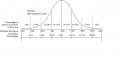
2. Recall the basic properties of the normal curve illustrated below.

f1.jpg

[Image from www.study.com]


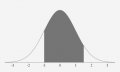
We want to know the area under the curve (AUC) between -1 and 1.5 SD units.
f2.jpg

[Image adapted from onlinestatbook.com]


3. We can now see that the AUC in question is 34.13% + 34.13% (accounting for the AUC between -1.0 and 1.0) + the AUC between 1.0 and 1.5.


The AUC between 1.0 and 1.5 can be estimated to the extent where we can identify the correct answer using only basic information about the normal curve. We know that the AUC between 1.0 and 2.0 = 13.59% and we are going one half of the distance between 1.0 and 2.0. If that area were bounded by a line parallel to the abscissa, we would know that the AUC=6.795% (13.59 x .5). That area however is bounded by the descending portion of the curve, so we know that the AUC between 1.0 and 1.5 has to be greater than the AUC between 1.5 and 2.0. That is, we know that the AUC between 1.0 and 1.5 is, in fact, greater than 6.795%. Exactly how much greater, we don’t know without a Z table or other calculations.


We also know that the AUC between 1.0 and 1.5 is less than 13.59% since that is the AUC between 1.0 and 2.0.


We can, therefore state that the AUC between -1.0 and 1.5 is greater than 75.055% (34.13% + 34.13% + 6.795%) and less than 81.85% (34.13% + 34.13% + 13.59%).


Looking at the choices:

a) 54% and 61%

b) 61% and 68%

c) 68% and 75%

d) 75% and 82%

e) 82% and 89%


The high value of the range for options a) (61%) and b) (68%) and c) (75%) are all below the minimum possible value (>75.055%) for the AUC we are interested in, so they can be eliminated.


Option e) can be eliminated because the low value of the range (82%) is greater than the maximum highest value for the AUC in question (<81.85%).


That leaves option d) 75% and 82% as the correct answer.

The actual AUC between -1.0 and 1.5 is 77.45%, but you do not need to calculate that probability to correctly answer the question.
 
Top