PNP & NPN Wiring and Position of Load

Thread Starter

alexfrey

Joined Feb 23, 2019
22
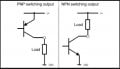
I attached an illustration of pnp and npn wiring and load position. My question is whether I can wire load between transistor's emitter and ground instead of between +u and collector in NPN switching. It seems to me it is the same If I wire load between emitter and ground in this way. And by wiring this way can I use npn sensor with a sinking input module ?
If no could you please explain why I can't ?
 

Attachments

ericgibbs

Joined Jan 29, 2010
21,437
hi alex,
It depends upon the drive voltage to the Base and the supply voltage , also the voltage required by the load.
Post some voltages.
E
 

KeithWalker

Joined Jul 10, 2017
3,604
I attached an illustration of pnp and npn wiring and load position. My question is whether I can wire load between transistor's emitter and ground instead of between +u and collector in NPN switching. It seems to me it is the same If I wire load between emitter and ground in this way. And by wiring this way can I use npn sensor with a sinking input module ?
If no could you please explain why I can't ?
You can connect the load between the emitter of a transistor and the supply (emitter follower) but the voltage drop across the transistor in the saturated condition will be higher than if the load was on the collector. The reason is that the base to emitter junction acts like a diode so when the transistor is turned on, the voltage on the emitter will about 0,7 volts lower than the input voltage. Depending on the transistor used and the current flowing, the power dissipation of the transistor could be exceeded.
 

dl324

Joined Mar 30, 2015
18,310
My question is whether I can wire load between transistor's emitter and ground instead of between +u and collector in NPN switching.
It depends on the signal that's driving the base.

Using an NPN transistor as a low side switch as in your picture, you only need about 0.7V on the base to turn the transistor on. To saturate the transistor, you need to provide sufficient base current.

If you use an NPN transistor, the voltage on the base needs to be about 0.7V above the voltage on the load.

That's why PNP transistors are typically used for high side switching.
 
Top