Peak detection problem

Thread Starter

Nick Long

Joined May 12, 2020
75
Hi guys. I am using a voltage comparator to detect the peak voltage of a source.
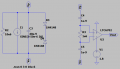
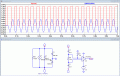
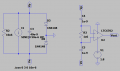
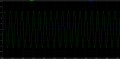
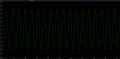
And I want to realize a correct peak detection (see Fig. 4) with the schematic below (Fig. 1). But it works wrong (see Fig. 2).
However, if I drop the GND between D3 and D4 (see Fig. 3), it comes the right waveforms (Fig. 4).
The schematic in Fig. 1 is a part of a more complex circuit. I need the GND between D3 and D4. So is there something I can improve in the peak detector module to fix this problem? The attached is the simulation file of LTSpice. Thx!
1592641662049.png
Fig. 1. Schematic with the GND between D3 and D4
1592641732012.png
Fig. 2. Wrong waveforms

1592641902026.png
Fig. 3. Schematic without the GND between D3 and D4
1592641954518.png
Fig. 4. The right waveforms
 

Attachments

ericgibbs

Joined Jan 29, 2010
21,439
hi Nick,
The 10K value could be changed to give the actual result required.
What is the purpose of the project.?
E
BTW: I guess you know that an OPA inputs should have DC path to Common.?
 
Last edited:

Thread Starter

Nick Long

Joined May 12, 2020
75
hi Nick,
The 10K value could be changed to give the actual result required.
What is the purpose of the project.?
E
BTW: I guess you know that an OPA inputs should have DC path to Common.?
Hi Eric. The purpose of the project is to improve the energy extraction efficiency from the energy harvester which produces AC voltage.
Currently, there is a passive configuration to achieve this goal, but the peak detection is not accurate. So I want to use the active peak detector to improve the peak detection for promote the efficiency.
However, there is still a problem in the active scheme I am simulating. I have checked many times, and I have no ideal why the output voltage cannot be charged to a level like that of the passive one.
The attached are these two circuits. Hope you can help me to find the problem. Thanks in advance.
 

Attachments

Thread Starter

Nick Long

Joined May 12, 2020
75
Perhaps it can if you leave the sim to run for long enough? It runs painfully slowly because of the relative complexity of your circuit.
I tried that for 60s. Still the output voltage is below 3V, where as the passive one can reach above 5V.

Perhaps it can if you leave the sim to run for long enough? It runs painfully slowly because of the relative complexity of your circuit.
And you can observe the current through D9 in active schematic. This current will decrease a lot after about 3s in active circuit, while that in passive circuit only drops a little duo to the increase of the output voltage.
 

MisterBill2

Joined Jan 23, 2018
27,508
NONE of the circuits shown are anything like the peak detector circuits that I am familiar with. ALL of them will be off by the value of the voltage drop across the non-linear element, which means that the voltage produced will not be the actual peak value. And the voltage drop certainly depends on both the source and load impeadance , because that affects the current.
So the first question is how accurate the measurement needs to be for this application. In addition, what I see as the output for the one circuit with an active device is what I would expect from a "zero crossing detector" circuit. So a second question is are you looking for the magnitude of the input waveform? Or the timing of the peak of the wave form? All that I have seen so far are circuits that look like zero crossing detectors.
 
Last edited:

Thread Starter

Nick Long

Joined May 12, 2020
75
NONE of the circuits shown are anything like the peak detector circuits that I am familiar with. ALL of them will be off by the value of the voltage drop across the non-linear element, which means that the voltage produced will not be the actual peak value. And the voltage drop certainly depends on both the source and load impeadance , because that affects the current.
So the first question is how accurate the measurement needs to be for this application. In addition, what I see as the output for the one circuit with an active device is what I would expect from a "zero crossing detector" circuit. So a second question is are you looking for the magnitude of the input waveform? Or the timing of the peak of the wave form? All that I have seen so far are circuits that look like zero crossing detectors.
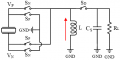
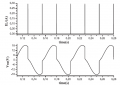
The figure below is the topological structure of my circuit. The purpose of the circuit is to extract the electrical energy from the low-frequency AC source and store the energy in the capacitor Cs. More accurate the peak detection, larger efficiency can be achieved. The input voltage is the sine waveform, and the magnitude and frequency depend on the actual source, and the input voltage will be doubled when the circuit is coupled with the source.
1592746059629.png
Topological structure
1592746514414.png
Waveforms
 

MisterBill2

Joined Jan 23, 2018
27,508
OK, the drawing explains a lot. What you are wanting is a synchronous rectifier, not a peak detector. Storing energy of a low frequency source in an inductance will be a large challenge, and in addition, you will need a series inductance so that the voltage can be added to the supply voltage.
 

Thread Starter

Nick Long

Joined May 12, 2020
75
OK, the drawing explains a lot. What you are wanting is a synchronous rectifier, not a peak detector. Storing energy of a low frequency source in an inductance will be a large challenge, and in addition, you will need a series inductance so that the voltage can be added to the supply voltage.
Yes, maybe you pass the floor 5th. I have attached the complete circuits (active and passive realizations), where an inductor is involved. Thanks.
 

MisterBill2

Joined Jan 23, 2018
27,508
I see the circuit and the waveform and the inductor current does not rise instantly like the drawing shows. So I suggest a capacitor voltage multiplyer, which is also a common circuit, with the benefit that no power is lost in the inductor resistance, since all inductors have an effective series resistance because of the length of the wire. An added benefit is that there exist ICs made for that exact function already available.
 

Thread Starter

Nick Long

Joined May 12, 2020
75
I see the circuit and the waveform and the inductor current does not rise instantly like the drawing shows. So I suggest a capacitor voltage multiplyer, which is also a common circuit, with the benefit that no power is lost in the inductor resistance, since all inductors have an effective series resistance because of the length of the wire. An added benefit is that there exist ICs made for that exact function already available.
Thanks for your suggestion. But, currently, I only want to find out the problem which causes the output voltage cannot be charged to the level like that in the passive circuit. The difference between the active and passive circuits is the peak detector. I compared the current through the inductor in both circuits, and the rising phase of the inductor current is almost the same. By observing the current waveforms through the diode in inductance freewheeling module in these two circuits, it can be found they are much different after operation about 2s. But the inductance freewheeling designs of the two circuits are the same. I feel so confused with this phenomena. Hope you can explain that. Thx!
 
Top