Facebook
 Google
 GitHub
 Linkedin
I'm new to this, in that I've never done a project with any analog inputs before. Ideally, I'd just separate the two categories on the board entirely and not worry about it, but I have physical limitations to work with (such as i/o connectors that are out of my control).
I learn best by example, so here is a section of my board I'm currently concerned with:
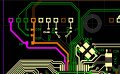
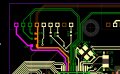
The pink line is analog supply, the orange is analog ground and the four green lines are analog signals (inputs). Everything else you see there is digital (brown is digital ground... not yet routed/poured and light pink, barely visible at the bottom, is digital supply).
I've managed to keep A Vs D seperate except for right here. As you can see, there are four digital traces (on the bottom of the board) that cross the 4 analog signal lines (which are on the top). I can't see a way to avoid it (*), but does it matter?
While I got you here, I'm still confused on grounding. I think what I'm going to do (barring better advice) is pour a ground plane on the bottom later for the digital and leave the analog as thick traces with no pour underneath them. I can do that by keeping VDDA and VSSA to the outside edge of the board. Then tie them together at/near the power source. That seemed the simplest to me anyway, thanks to my lack of understanding on how they interact.
Btw. I have read a TON on the subject. Sadly, my dyslexic brain just doesn't learn by reading. I've read so many guides with seemingly at-odds advice on grounding that its all just a mess to me still. So go easy on me
(*) Actually I now do see a way to avoid crossing the analog over the digital signal lines, but then those digital signal lines would have to cross the analog VDD/VSS lines. I was attempting to keep those pristine.
I learn best by example, so here is a section of my board I'm currently concerned with:
The pink line is analog supply, the orange is analog ground and the four green lines are analog signals (inputs). Everything else you see there is digital (brown is digital ground... not yet routed/poured and light pink, barely visible at the bottom, is digital supply).
I've managed to keep A Vs D seperate except for right here. As you can see, there are four digital traces (on the bottom of the board) that cross the 4 analog signal lines (which are on the top). I can't see a way to avoid it (*), but does it matter?
While I got you here, I'm still confused on grounding. I think what I'm going to do (barring better advice) is pour a ground plane on the bottom later for the digital and leave the analog as thick traces with no pour underneath them. I can do that by keeping VDDA and VSSA to the outside edge of the board. Then tie them together at/near the power source. That seemed the simplest to me anyway, thanks to my lack of understanding on how they interact.
Btw. I have read a TON on the subject. Sadly, my dyslexic brain just doesn't learn by reading. I've read so many guides with seemingly at-odds advice on grounding that its all just a mess to me still. So go easy on me
(*) Actually I now do see a way to avoid crossing the analog over the digital signal lines, but then those digital signal lines would have to cross the analog VDD/VSS lines. I was attempting to keep those pristine.