Facebook
 Google
 GitHub
 Linkedin


Hello,
I've got a design here that does a good job of cooking P channel MOSFETs. Even if I don't switch the gate, just leave the thing on so it conducts, it heats up. Which leads me to believe it's not all the way switched on. The way I understand the P-Channel MOSFETs work, which may be wrong, is that with a Gate to Source voltage differential of 0, they are off, or they don't conduct.
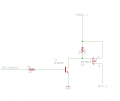
So in this circuit, when I drive the GP5 pin low, there's no current on the base of T1 so the voltage at the gate of Q2 is the same as that on the source so it should not conduct.
When I drive the GP5 pin high then T1 conducts and the voltage at the gate of Q2 drops to ~0V and Q2 conduts.
I'm using the IRF5305 http://www.irf.com/product-info/datasheets/data/irf5305pbf.pdf
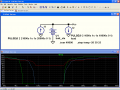
I attached an LTSpice sim as well.
I'm not sure why the MOSFET heats up. Any ideas? Thanks.
Attachments
-
 4.1 KB Views: 156
-
1.2 KB Views: 56