Overcharging a LIR2032 battery ...

Thread Starter

daba1955

Joined Apr 27, 2019
218
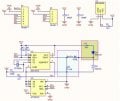
Here is the schematic of the TinyRTC I2C module.
TinyRTC.jpg

As can be seen, they are charging the LI2032 3.6V rechargeable coin cell battery with a series 200R resistor, and a 1N4148 diode, from the Vcc stated as being 5V

The spec for the 1N4148 says a MAXIMUM Vf of 1V, so it could be lower than that in practice.

I have just measured the cell voltage and it is 4.5V !!

With the battery out of its holder, I am measuring 4.57V on the battery connectors. Surely this is going to damage the battery ....

Your thoughts please ...
 

WBahn

Joined Mar 31, 2012
32,706
I would think so. IIRC, the voltage that you are supposed to charge a Li-ion cell to is 4.2 V, so I would think that 4.5 V is stressing it -- again, IIRC, anything above 4.3 V is considered unsafe. Also, my recollection is that to properly charge, they should not be charged when connected to a load because the load current can confuse a proper charging circuit that looks for a drop in terminal voltage associated with the onset of internal leakage current when full saturation is achieved. But I am FAR from an expert on rechargeable batteries dos and don'ts. Hopefully others with much more knowledge of these chemistries will be able to provide a better answer.
 

Thread Starter

daba1955

Joined Apr 27, 2019
218
I would think so. IIRC, the voltage that you are supposed to charge a Li-ion cell to is 4.2 V, so I would think that 4.5 V is stressing it -- again, IIRC, anything above 4.3 V is considered unsafe. Also, my recollection is that to properly charge, they should not be charged when connected to a load because the load current can confuse a proper charging circuit that looks for a drop in terminal voltage associated with the onset of internal leakage current when full saturation is achieved. But I am FAR from an expert on rechargeable batteries dos and don'ts. Hopefully others with much more knowledge of these chemistries will be able to provide a better answer.
Yes, my thoughts entirely, this 4.57V cannot be doing the battery any good....

I hope someone can come in and say it's acceptable, otherwise there's thousands of these RTC modules out there all with miniature potential bombs !!
 

Thread Starter

daba1955

Joined Apr 27, 2019
218
... anything above 4.3 V is considered unsafe.
Exactly my point !!

...Also, my recollection is that to properly charge, they should not be charged when connected to a load because the load current can confuse a proper charging circuit that looks for a drop in terminal voltage associated with the onset of internal leakage current when full saturation is achieved.
This obviously isn't a "proper charging circuit !!
 

Thread Starter

daba1955

Joined Apr 27, 2019
218
I've been comparing datasheets from quite a few manufacturers, charging voltage should NOT go above 4.2V.

The cell I have removed from the TinyRTC is already slightly bulging, after only a few hours "on charge" while I was testing the remainder of my project.

On the basis of my research, I have discarded ALL of my DS307 TinyRTC modules (all 10 of them), I will not use them, especially as there use would have been on projects for other people.

Instead I have ordered the DS3231 modules, which have the same (near enough) pinout and can be used on my PCBs without PCB modifications. The DS3231 modules do NOT use a rechargeable Lithium battery, just a standard CR2032 battery. They have the same functionality as the TinyRTC DS1307 modules, that is both a RTC and a 24C32 EEPROM chip, and are thus functionally compatible.

I strongly urge others to discontinue using the TinyRTC I2C Modules with the poorly regulated charging circuit.
I firmly believe these have the potential to explode or catch fire !!
 

Thread Starter

daba1955

Joined Apr 27, 2019
218
Of course, after the coin cell battery bursts the overcharge current will cease.!
That may be true, but there is also the possibility of the Lithium in the coin cell becoming exposed to the air, and that may be the contributing factor to a fire....
 

MrAl

Joined Jun 17, 2014
13,667
Here is the schematic of the TinyRTC I2C module.

View attachment 332720

As can be seen, they are charging the LI2032 3.6V rechargeable coin cell battery with a series 200R resistor, and a 1N4148 diode, from the Vcc stated as being 5V

The spec for the 1N4148 says a MAXIMUM Vf of 1V, so it could be lower than that in practice.

I have just measured the cell voltage and it is 4.5V !!

With the battery out of its holder, I am measuring 4.57V on the battery connectors. Surely this is going to damage the battery ....

Your thoughts please ...
Hello,

I brought this issue up years and years ago (more than 5 years ago) and I got arguments that it's such a small cell that it does not matter. Of course I disagree with that, because BEST case is that the cell gets damaged, and WORST case is that it catches on fire.

I can't understand why the circuit can be so good except for the fact that the cell is not being charged properly.
The only thing I can suggest is to improve the circuit by measuring the voltage with the microcontroller being used and turn off the charge current once it gets to the limit of 4.200 volts or even sooner. 4.150v is typical, and that also prevents internal plating that ruins the cell by a continuous non-stop charging current.
To measure in this way though you'd have to check that the cell being charged has the same ground as the microcontroller, or something else can be arranged to measure the voltage.

I can't help but think some designs are just thrown together without much thought. Funny though these circuits can be so accurate when it comes to keeping time. It could be that the designers knew a lot about what it takes to keep good time over long time periods but didn't know much about charging Li-ion batteries.
 

Hymie

Joined Mar 30, 2018
1,347
One simple fix (applicable to this circuit) would be the place an appropriately rated zener diode across the battery, preventing the charging voltage exceeding 4.2V.
 

Hymie

Joined Mar 30, 2018
1,347
The Information Technology product safety standard (IEC 62368-1) requires that under normal operation and single fault conditions, the battery charging voltage/current does not exceed the battery specification.

This can be an issue for non-rechargeable CR2032 batteries that are used on BIOS and RTC ICs. Typically a CR2032 battery has a maximum abnormal charge current of 10mA. With the battery connected directly to the IC’s Vbat pin, there is no charge current protection for the battery. A common arrangement (to protect the battery) is to connect the battery anode (to the IC) via a diode in series with a resistor.

If we consider that the IC Vbat pin could be at the supply voltage (3.3V) and the series resistor value is at least 3.3V/10mA = 330Ω, then when the battery is flat (0V) and the diode fails short circuit, the maximum abnormal battery charge current will be limited to 10mA. Should the series resistor fail short circuit, then the diode will block any abnormal battery charging current.

You might think that such a battery protection arrangement would result in the battery voltage (at the IC Vbat) being too low, since the diode drops 0.7V – but the battery drain current is less than a micro-amp, at this current the diode voltage drop is less than 0.1V.
 

WBahn

Joined Mar 31, 2012
32,706
One simple fix (applicable to this circuit) would be the place an appropriately rated zener diode across the battery, preventing the charging voltage exceeding 4.2V.
Need to be a bit careful there, as what happens when a fully charged battery is installed? If it exceeds the Zener diode voltage (which it needs to if you are going to allow for variations in the Zener voltage of your diode), you can end up dumping a lot of current through that Zener, depending on it's effective resistance. Plus, you need to consider how sharp or soft the Zener voltage is. It has to be high enough so that it is not discharging a charged battery, but low enough to that it can eat the maximum charging current under worst case conditions while not exceeding the maximum battery voltage.
 

Ya’akov

Joined Jan 27, 2019
10,226
That may be true, but there is also the possibility of the Lithium in the coin cell becoming exposed to the air, and that may be the contributing factor to a fire....
Lithium-Ion cell fires are not Li fires. The amount if Li metal in such a cell is vanishingly small. Lithium batteries are dangerous because of two things:

  • Extremely high energy density
  • Extremely flammable electrolyte (organic solvent)

Despite what might seem to make sense, Li-Ion battery fires are not metal fires, they are chemical fires (the solvent in the electrolyte) caused by thermal runaway. The only Li metal in a Li-Ion cell is what might have been deposited as Li plating by incorrect charging and this is almost nothing in even the worst cases and neither a source of ignition or fuel.

The LIR2032, so far as I know, doesn’t have a pressure relief vent like a cylindrical cell (e.g.: 18650) but they do seem to use ignition on reducing additives in the electrolyte. Remember, though, unlike a LiPo cell which is very vulnerable to physical damage, the LIR2032’s metal case protects in from things like short-circuiting punctures.

Now, all this said I must also say although a metal fire isn‘t one of the hazards, improper charging is a problem and at the very least and exploding or even leaking LIR2032 could really mess up your RTC’s day… and hour… and second…
 

MisterBill2

Joined Jan 23, 2018
27,187
One simple fix (applicable to this circuit) would be the place an appropriately rated zener diode across the battery, preventing the charging voltage exceeding 4.2V.
Poor choice because, when you look at a zener diode voltage/current curve, it becomes clear that the zener is conducting SOME current with voltages quite a bit less than the stated voltage AT SOME SPECIFIED CURRENT. An accurate regulation scheme in the charging system would be good, but considering that having the minimum possible cost is usually the very top design requirement for most products, accuracy will always suffer.
 

MrAl

Joined Jun 17, 2014
13,667
One simple fix (applicable to this circuit) would be the place an appropriately rated zener diode across the battery, preventing the charging voltage exceeding 4.2V.
Hi,

That's what a BMS does (Battery Management System). It shunts current around the cell if the voltage is exceeded.
However, these systems are fairly precise while a zener is one of the most imprecise components around. What would happen is if you selected a zener with the right voltage to clamp enough current with an overvoltage condition, it would continue to conduct even as the voltage dropped below the target level. That would discharge the cell to some degree, and it's most likely going to be too much.

An alternate would be to make your own BMS, where you use a precision shunt regulator. That means it will have a very narrow range of voltage where it actually conducts. That would act like a super precise zener.
The drawback here is that it will consume some power and so it will act as a load on the battery too. It could be too much for such a small battery (2032 for example) so this may not be a practical fix either.
Maybe it can be disconnected when the battery is not being charged.

A better way is probably to just use a precision voltage regulator for charging, and connect a resistor in series with it to limit the max charge current. The voltage would be regulated at a max of 4.200 volts and the current would not be able to exceed the limit set by the resistor.
 

Jon Chandler

Joined Jun 12, 2008
1,560
I strongly urge others to discontinue using the TinyRTC I2C Modules with the poorly regulated charging circuit.
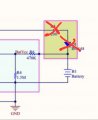
There's no need to throw these modules away. Yes, the battery circuit is unsafe and an extremely poor design, but it can be made safe by simply cutting out R5 or D1 and replacing the battery with a non-rechargeable cell.

SmartSelect_20241004_091055_Edge.jpg
 

Thread Starter

daba1955

Joined Apr 27, 2019
218
There's no need to throw these modules away. Yes, the battery circuit is unsafe and an extremely poor design, but it can be made safe by simply cutting out R5 or D1 and replacing the battery with a non-rechargeable cell.

View attachment 333023
I really like your comment "made safe", and enhanced by your use of bold text.

This is exactly how I will continue to use these modules. Desoldering just the diode is enough to isolate the battery charging, and is easy to do.

I wholly recommend that other users of these devices do the same. The DS3231 module is the same....
 
Top