Facebook
 Google
 GitHub
 Linkedin
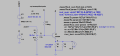
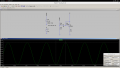
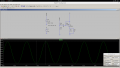
When I calculate the output impedance of the following circuit, I get about 8 Ohms at 1kHz. However, when I simulate the design, in order to attenuate the output by 1/2, I have to use a 16 Ohm load. My understanding is that if I match the output resistance to the load, I should get 1/2 the unloaded voltage swing.
The transistor model states Beta of 300. My thinking is that Rsource is dominated by the parallel combination of R19 and R20 which is in series with C1, R18 has minimal effect. I get 2.5k Ohms. 2.5k / Beta = 8 Ohms. So, I am expecting that a load of 8 Ohms will yield a voltage amplitude of 50mV, but I actually need 16 Ohms to achieve 50mV swing.
What am I missing here? Why does the simulation not agree with my calculations?
Unloaded Circuit:
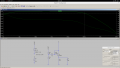
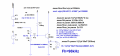
Circuit loaded to get 1/2 the voltage swing:
The transistor model states Beta of 300. My thinking is that Rsource is dominated by the parallel combination of R19 and R20 which is in series with C1, R18 has minimal effect. I get 2.5k Ohms. 2.5k / Beta = 8 Ohms. So, I am expecting that a load of 8 Ohms will yield a voltage amplitude of 50mV, but I actually need 16 Ohms to achieve 50mV swing.
What am I missing here? Why does the simulation not agree with my calculations?
Unloaded Circuit:
Circuit loaded to get 1/2 the voltage swing:
Attachments
-
4.5 KB Views: 9