Operation Amplifier Problems

Thread Starter

OggiSerbia

Joined Dec 28, 2017
34
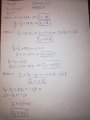
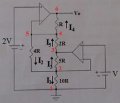
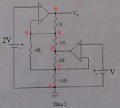
Vo is needed, but I have problem with this:
1) What is the voltage in Node 1?

2) And to check this: Voltages in other nodes are: (V2=V; V4=V5=2V; V6=Vo). Right?
Screenshot_3.jpg
 

WBahn

Joined Mar 31, 2012
32,833
Vo is needed, but I have problem with this:
1) What is the voltage in Node 1?
What does the ground symbol tied to that node mean?

2) And to check this: Voltages in other nodes are: (V2=V; V4=V5=2V; V6=Vo). Right?
If you don't know what the voltage is on Node 1, then how can you determine that the voltage on Node V2 is V or that the voltage on Nodes V4 and V5 are 2 V?
 

WBahn

Joined Mar 31, 2012
32,833
I only looked at your work enough to see that you claim that the output if four times the input (taking the voltage at the right to be the input).

So the next step is to check the correctness of the answer from the answer itself. To do this you assume the answer is correct and then see if it results in all of the voltages and currents being self-consistent. The best way is to use the generic form of 4·V at the output, but almost as useful is to just pick one or two specific voltages and see what happens.

One value that is often of interest, and usually fairly easy to check, is set Vin to 0 V (I'm going to use Vin instead of V so as to avoid confusion with the unit for volts).

If Vin = 0 V, then V2 = 0 V and I1 = 0 A.

Since V5 = 2 V, I2 = 2 V / 4 R = 0.5 V/R.

Since I1 = 0 A, I2 = I3, also I5 = I3; furthermore, since I2 = I3, no current crosses the bridge between node 4 and node 5, making I4 = I5.

The end result is that Vo = - I2·8R = -4 V

But this doesn't agree with your result that, for Vin = 0 V, that Vo = 4·Vin = 0 V
 

Thread Starter

OggiSerbia

Joined Dec 28, 2017
34
I only looked at your work enough to see that you claim that the output if four times the input (taking the voltage at the right to be the input).

So the next step is to check the correctness of the answer from the answer itself. To do this you assume the answer is correct and then see if it results in all of the voltages and currents being self-consistent. The best way is to use the generic form of 4·V at the output, but almost as useful is to just pick one or two specific voltages and see what happens.

One value that is often of interest, and usually fairly easy to check, is set Vin to 0 V (I'm going to use Vin instead of V so as to avoid confusion with the unit for volts).

If Vin = 0 V, then V2 = 0 V and I1 = 0 A.

Since V5 = 2 V, I2 = 2 V / 4 R = 0.5 V/R.

Since I1 = 0 A, I2 = I3, also I5 = I3; furthermore, since I2 = I3, no current crosses the bridge between node 4 and node 5, making I4 = I5.

The end result is that Vo = - I2·8R = -4 V

But this doesn't agree with your result that, for Vin = 0 V, that Vo = 4·Vin = 0 V

Ahhh... Yes... You are right. I'll try to find the mistake. :/
 

WBahn

Joined Mar 31, 2012
32,833
Yes, of course. I remember you had already told me that way of checking the result, but I forgot to try.
It's easy to forget stuff that you are new at, so the reminders will bring you back until it starts becoming habit.

If you keep at it, eventually, you'll feel very uncomfortable when you don't check an answer.
 

Thread Starter

OggiSerbia

Joined Dec 28, 2017
34
Woah, look, I wrote it badly in the picture and made a big big mistake.

Right voltage IS Vin, yes. And the left voltage is 2Vin, so the left voltage depends on the right voltage.

If we make Vin=0 - also the other (left) voltage will be zero => V4 and V5 will be zero and V0 will be zero which is OK. Right?
 

WBahn

Joined Mar 31, 2012
32,833
Woah, look, I wrote it badly in the picture and made a big big mistake.
Valuable lessons come from our mistakes. You can now see how critically important it is to prepare your starting point carefully. If you don't, you end up spending a bunch of time chasing an answer that's guaranteed to be wrong.

The way you annotated your latest diagram with the current definitions (label, location, and direction) bodes very well going forward.

Right voltage IS Vin, yes. And the left voltage is 2Vin, so the left voltage depends on the right voltage.
I thought the left voltage was just a fixed two volts. It's a bit unusual to have two related voltages in a problem, but it's certainly not impossible to create a circuit that behaves that way.

If we make Vin=0 - also the other (left) voltage will be zero => V4 and V5 will be zero and V0 will be zero which is OK. Right?
Yes, if both source voltages are zero, then the output will be zero.

Now that you've corrected the problem, take another shot at getting Vo in terms of Vin.
 

Thread Starter

OggiSerbia

Joined Dec 28, 2017
34
I made another mistake. That's what I get for trying to get something out while tending the stove.
No problem. Thanks for helping me always.
I'm sorry for taking you away so much time but my exam is tomorrow so I hope I won't be so tiresome anymore. :D
 
Top