Op Amp wave simulation ?

crutschow

Joined Mar 14, 2008
38,511
if I wanted to use an op amp with those two 9 volt batteries only and simply reduce it down to 7-8 volts output with a square wave, and NOT use my vehicles sensor as an input at all, could I do that?
Probably.
You don't need to reduce the voltage as maximum op amp output of 18Vpp is only 6.4Vrms.

But if you don't connect the circuit to the sensor, then you would need to configure the opamp as an oscillator and, since your engine would not be getting a proper speed signal, it may not operate properly .
 

Thread Starter

homerdodd

Joined Feb 10, 2018
69
Probably.
You don't need to reduce the voltage as maximum op amp output of 18Vpp is only 6.4Vrms.

But if you don't connect the circuit to the sensor, then you would need to configure the opamp as an oscillator and, since your engine would not be getting a proper speed signal, it may not operate properly .

OK, thanks. What would the oscillator schematic look like? Do you have link or diagram? I want to attempt all options, since these components are fairly cheap.
 

Alec_t

Joined Sep 17, 2013
15,119
since your engine would not be getting a proper speed signal, it may not operate properly .
I agree. It's all very well fooling the computer with a dummy sensor signal so that the warning light goes off, but the pulse frequency needs to be proportional to the shaft speed if the engine/transmission is to operate properly.
 

Thread Starter

homerdodd

Joined Feb 10, 2018
69
I agree. It's all very well fooling the computer with a dummy sensor signal so that the warning light goes off, but the pulse frequency needs to be proportional to the shaft speed if the engine/transmission is to operate properly.

I understand your concerns. However, there has not been much of a difference since the sensor went out of spec. Maybe just a slightly slower shifting into reverse. Other than that, no real issue. The "Check Engine" light must be off to pass state inspections.
 

crutschow

Joined Mar 14, 2008
38,511
So why not just do the amplifier, instead of an oscillator, so the engine will operate properly?
If that doesn't work then you can always do the oscillator.
 

Thread Starter

homerdodd

Joined Feb 10, 2018
69
So why not just do the amplifier, instead of an oscillator, so the engine will operate properly?
If that doesn't work then you can always do the oscillator.

I will try the one in #6 first (looks simplest) , then #17 or #18. Then the oscillator. What do you think about this approach ?
 

Thread Starter

homerdodd

Joined Feb 10, 2018
69
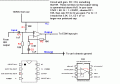
Voltage follower OpAmp circuit.

View attachment 151684

Circuit with gain.


http://www.radio-electronics.com/info/circuits/opamp_non_inverting/op_amp_non-inverting.php

Circuit with gain. R3 = R4, something like10K. These set bias
so that output swing is symmetrical about Vs/2. In your case
12V/2 = 6V. G = 1 + R2/R1, choose R2 = 10K, then calc R1
for G you want. For G = 3 it would be 3.3K. C1, C2 1 uF or
larger non polarized cap.

Note w/o having the datasheet of the sensor this is a best guess
at a solution, eg. its not optimized.

Regards, Dana.
OK, I built it a few weeks ago, and had time to install it today. It did increase the sensor output voltage. However, the output voltage at idle is still only 4.3 VAC, rising to about 4.7 VAC at driving speed, which is slightly lower than needed. I still need to get the output closer to 6 VAC. Is there any "tweek" I can do to the caps, resistors or voltage that can get the desired 5.5 + volts, or should I move on to the amp in post #18 instead? I think we are making some progress, and I thank you for the help !!
 
Last edited:

Thread Starter

homerdodd

Joined Feb 10, 2018
69
Voltage follower OpAmp circuit.

View attachment 151684

Circuit with gain.


http://www.radio-electronics.com/info/circuits/opamp_non_inverting/op_amp_non-inverting.php

Circuit with gain. R3 = R4, something like10K. These set bias
so that output swing is symmetrical about Vs/2. In your case
12V/2 = 6V. G = 1 + R2/R1, choose R2 = 10K, then calc R1
for G you want. For G = 3 it would be 3.3K. C1, C2 1 uF or
larger non polarized cap.

Note w/o having the datasheet of the sensor this is a best guess
at a solution, eg. its not optimized.

Regards, Dana.

Dana: the "circuit with gain" worked for the voltage amplification. While driving, it now measures between 5.5 and 6.5 ACV, which is above the 5 VAC requirement,so we are making progress. However, the Check Engine light remains on. I'm wondering if it is a frequency problem, or since it is assisted by 12 VDC, is the output a square wave? I do not have an O-scope to check the wave pattern, but wouldn't it still be a sine wave since the original input was AC, or does that change with opamp and DC assist voltage? If so, any way to increase the frequency on this circuit or other "tweak" to it you can recommend? Thanks for everything. We are getting there.
 
Last edited:

Thread Starter

homerdodd

Joined Feb 10, 2018
69
My car's powertrain computer is looking for a 6-10 VAC signal from inside the transmission,to control shifting points, yet the sensor itself is weak (permanent magnet two wire sensor, only putting out 3 VAC). I studied AC and DC wave forms and wanted to know if it is possible to use a DC 9 volt battery powered 741 op amp to "simulate" the AC sine wave (square wave) and send the signal to the computer, fooling it into thinking 6-10 volts is present and thus operating the transmission shift point correctly. I've seen some images of two 9 volt batteries supply positive and negative sides of the op amp for a wave output?
If any of you have a basic design or schematic of this, please let me know. Much appreciate, thanks !

Update: the attached picture, with notes in it, worked for the voltage. Output is now between 5.5 and 6.5 VAC. However, the check engine light came back on. I then measured the frequency. This may be the culprit. it only measured 200-300 Hz. I think the computer needs a minimum of 530 Hz. Any suggestions, or any way to "tweek" this circuit? We made real progress with all of your help. I built another circuit that actually turned the Check Engine light off for a few minutes during hard acceleration, even with the voltage over 5 VAC. So I'm really leaning toward a frequency issue. Thanks again.OpAmp 12 volt assist.GIF
 

crutschow

Joined Mar 14, 2008
38,511
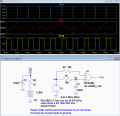
You could use a digital frequency doubler circuit such as shown below.
It would connect to the output of your circuit.

The value of R1 may need to be tweaked to get proper operation.

This circuit does not give a 50% output duty-cycle as the frequency changes so, if the ECN needs that, I have a circuit using a 555 that gives a 50% duty-cycle independent of frequency.

upload_2018-6-20_19-32-14.png
 

Alec_t

Joined Sep 17, 2013
15,119
I then measured the frequency.
Where did you measure it? At the sensor itself or at the amplifier output?
Unless you have changed the transmission (and hence reluctor wheel tooth count), or the TCU, the amplifier output frequency should be what the TCU is expecting, since the amplifier output frequency equals the sensor signal frequency. The only other way in which the measured frequency could be half what the TCU expects is if the meter you used doesn't respond accurately to non-sinusoidal signals or the circuit is clipping off negative peaks and the meter sees only the positive peaks. Perhaps your TCU needs dual-polarity peaks to recognise the sensor presence?
 
Top