Op Amp wave simulation ?

Thread Starter

homerdodd

Joined Feb 10, 2018
69
My car's powertrain computer is looking for a 6-10 VAC signal from inside the transmission,to control shifting points, yet the sensor itself is weak (permanent magnet two wire sensor, only putting out 3 VAC). I studied AC and DC wave forms and wanted to know if it is possible to use a DC 9 volt battery powered 741 op amp to "simulate" the AC sine wave (square wave) and send the signal to the computer, fooling it into thinking 6-10 volts is present and thus operating the transmission shift point correctly. I've seen some images of two 9 volt batteries supply positive and negative sides of the op amp for a wave output?
If any of you have a basic design or schematic of this, please let me know. Much appreciate, thanks !
 

eetech00

Joined Jun 8, 2013
4,705
My car's powertrain computer is looking for a 6-10 VAC signal from inside the transmission,to control shifting points, yet the sensor itself is weak (permanent magnet two wire sensor, only putting out 3 VAC). I studied AC and DC wave forms and wanted to know if it is possible to use a DC 9 volt battery powered 741 op amp to "simulate" the AC sine wave (square wave) and send the signal to the computer, fooling it into thinking 6-10 volts is present and thus operating the transmission shift point correctly. I've seen some images of two 9 volt batteries supply positive and negative sides of the op amp for a wave output?
If any of you have a basic design or schematic of this, please let me know. Much appreciate, thanks !
Hi

Should be able build a circuit for that. Do you have an image that shows the shape of the expected waveform?

eT
 

Thread Starter

homerdodd

Joined Feb 10, 2018
69
Hi

Should be able build a circuit for that. Do you have an image that shows the shape of the expected waveform?

eT

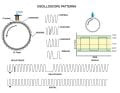
Here is what a o-scope pattern looks like for a general automotive 2 wire permanent magnet sensor, which generates it's own AC output. If I can get an op amp circuit to produce the same wave at approx 7 or 8 volts, then I am good. Thanks !!sensor waveform.jpg
 

wayneh

Joined Sep 9, 2010
18,104
I would not use the 741 because there are many more modern opamps that are more likely to give better results and better survive the automotive environment.

Rather than faking the signal, I’d be tempted to just add a gain of 2-3 to the current signal. Basically a voltage follower, but with a little gain. This would be a standard opamp circuit.

But my first effort would be to understand why the existing system isn’t working. It was designed to work and probably did at one time. Why not fix whatever has failed? Reducing the air gap to that sensor could have a huge effect.
 

Thread Starter

homerdodd

Joined Feb 10, 2018
69
I would not use the 741 because there are many more modern opamps that are more likely to give better results and better survive the automotive environment.

Rather than faking the signal, I’d be tempted to just add a gain of 2-3 to the current signal. Basically a voltage follower, but with a little gain. This would be a standard opamp circuit.

But my first effort would be to understand why the existing system isn’t working. It was designed to work and probably did at one time. Why not fix whatever has failed? Reducing the air gap to that sensor could have a huge effect.

I should have explained this first. The sensor is deep inside the transmission, and requires the engine and trans be lifted to gain access. Approx $2,000 in labor. That is why I simply want to "simulate" the signal, but any circuit that i can easily build. BTW, do you have a schematic for the voltage follower op amp circuit you recommended? Thanks !
 

danadak

Joined Mar 10, 2018
4,057
Voltage follower OpAmp circuit.

upload_2018-5-1_5-31-3.png

Circuit with gain.


http://www.radio-electronics.com/info/circuits/opamp_non_inverting/op_amp_non-inverting.php

Circuit with gain. R3 = R4, something like10K. These set bias
so that output swing is symmetrical about Vs/2. In your case
12V/2 = 6V. G = 1 + R2/R1, choose R2 = 10K, then calc R1
for G you want. For G = 3 it would be 3.3K. C1, C2 1 uF or
larger non polarized cap.

Note w/o having the datasheet of the sensor this is a best guess
at a solution, eg. its not optimized.

Regards, Dana.
 
Last edited:

Alec_t

Joined Sep 17, 2013
15,119
You might need to connect the output to the computer via a capacitor, in case the computer is looking for a signal which goes above and below the ground rail.
 

eetech00

Joined Jun 8, 2013
4,705
I should have explained this first. The sensor is deep inside the transmission, and requires the engine and trans be lifted to gain access. Approx $2,000 in labor. That is why I simply want to "simulate" the signal, but any circuit that i can easily build. BTW, do you have a schematic for the voltage follower op amp circuit you recommended? Thanks !
Hi

The input to the voltage follower circuit will rely on the original signal source being generated from the rotating transmission.
Is that available?

If not, we'll need to generate the signal.
Do you know the required frequency range?

eT
 

crutschow

Joined Mar 14, 2008
38,508
What is the lowest frequency of the waveform?

And you don't need a battery for the circuit, you can use the vehicles 12V.

I suspect that the computer would operate okay with a pulse input, so perhaps just a comparator would work with a hysteresis of 1-2V.
 
Last edited:

Thread Starter

homerdodd

Joined Feb 10, 2018
69
Voltage follower OpAmp circuit.

View attachment 151684

Circuit with gain.


http://www.radio-electronics.com/info/circuits/opamp_non_inverting/op_amp_non-inverting.php

Circuit with gain. R3 = R4, something like10K. These set bias
so that output swing is symmetrical about Vs/2. In your case
12V/2 = 6V. G = 1 + R2/R1, choose R2 = 10K, then calc R1
for G you want. For G = 3 it would be 3.3K. C1, C2 1 uF or
larger non polarized cap.

Note w/o having the datasheet of the sensor this is a best guess
at a solution, eg. its not optimized.

Regards, Dana.
Great thanks !! A few questions: if I'm looking at this correctly, then I simply feed the vehicles 12 volts as the input, and then feed the output to where my sensor would normally feed into? Is the ground just on the circuit board alone, or does it ground the vehicle's metal ground also? R-3 & R-4 should be 10K and R-1 & R-2 should be approx 10K also, or lower? If I am looking for a steady 7 volts that would be a gain on 1, correct? 8 would be gain of 2, and so forth? Am I doing anything with Vcc? Oh, which op amp should I select, not the 741?
 
Last edited:

crutschow

Joined Mar 14, 2008
38,508
The 12V ges to the Vcc rail.
Yes, the circuit Ground goes to the vehicle chassis ground.
The circuit Input goes to the transmission output.
The Output goes to the computer input.

For a 7v output with a 3V input the required gain is 7/3 = 2.33
For an 8V output the gain is 8/3 = 2.67.

But if you are talking RMS AC voltage, then the maximum you can output with a 12V (13.5V operating) supply is 13.5Vpp or 4.8VRMS, which is only slightly more than your transmission is already putting out.
Need clarification on that.
How did you measure the 3Vac output from the transmission?

As for opamps, a OPA197 should work.
 

wayneh

Joined Sep 9, 2010
18,104
Here is what a o-scope pattern looks like for a general automotive 2 wire permanent magnet sensor, which generates it's own AC output.
I'm wondering if this is part of your problem. You're describing a passive system that would generate an AC pulse train, but the diagram is typical of an active system that creates a DC pulse train that spans only 0.8 to 1.6V or so. Your computer is looking for one or the other and it's going to be critical to know which it should be.
 

Thread Starter

homerdodd

Joined Feb 10, 2018
69
The 12V ges to the Vcc rail.
Yes, the circuit Ground goes to the vehicle chassis ground.
The circuit Input goes to the transmission output.
The Output goes to the computer input.

For a 7v output with a 3V input the required gain is 7/3 = 2.33
For an 8V output the gain is 8/3 = 2.67.

But if you are talking RMS AC voltage, then the maximum you can output with a 12V (13.5V operating) supply is 13.5Vpp or 4.8VRMS, which is only slightly more than your transmission is already putting out.
Need clarification on that.
How did you measure the 3Vac output from the transmission?

As for opamps, a OPA197 should work.
I set my DMM on AC volts and connected them to the sensor output wires and test drove the car. It started out at idle about 1.1 volt, rising to about 3 VAC at best, during steady driving at street speed. This is clearly indicative of a weak sensor, a known problem with these GM cars. Still not enough,as the computer must see over 5 VAC minimum at all times, or it triggers a fault code. For comparison, known good sensor put's out about 5.5 at slow speed and rises up to 8, 9 volts at cruising speed, and no fault code is triggered. So bottom line is I need a steady 6-8 volts fed into the computer, and the light will stay off. Whatever I can do to get that 6-8 volts is what I'm asking for. Thanks !!
 

Thread Starter

homerdodd

Joined Feb 10, 2018
69
I'm wondering if this is part of your problem. You're describing a passive system that would generate an AC pulse train, but the diagram is typical of an active system that creates a DC pulse train that spans only 0.8 to 1.6V or so. Your computer is looking for one or the other and it's going to be critical to know which it should be.
The faulty sensor in the transmission is a two wire permanent magnet sensor, similar to an ABS brake wheel sensor. The trans shaft spins the tooted gear and the sensor generates it's AC signal. It is required to generate at least 5.0 VAC and increasing amplitude as speed increases, averaging approx 6-9 volts for a known good sensor. As long as the car's computer (ECM, PCM or ECA) see's over 5 VAC, then the "service engine soon" light will stay off and no code will be triggered. If voltage falls below the 5 VAC, then the fault will set and the pesky light will come on. I can clear it, but it comes back on in less than a block of driving. That is the essence of my problem. Anything I can do, circuit wise, to send over 5 VAC, or simulate that signal, to the computer is what I need the help with, and I thank you all for your assistance. If the op amp does the trick, even if it is battery powered, that is OK. Whatever works. I know of guys who have fixed their same problem with an op amp, but I cannot get in touch with them for the details.
 

Thread Starter

homerdodd

Joined Feb 10, 2018
69
Voltage follower OpAmp circuit.

View attachment 151684

Circuit with gain.


http://www.radio-electronics.com/info/circuits/opamp_non_inverting/op_amp_non-inverting.php

Circuit with gain. R3 = R4, something like10K. These set bias
so that output swing is symmetrical about Vs/2. In your case
12V/2 = 6V. G = 1 + R2/R1, choose R2 = 10K, then calc R1
for G you want. For G = 3 it would be 3.3K. C1, C2 1 uF or
larger non polarized cap.

Note w/o having the datasheet of the sensor this is a best guess
at a solution, eg. its not optimized.

Regards, Dana.

Dana:

Which op amp number do I need to buy? You said earlier not a 741, but maybe another number unit?
 

crutschow

Joined Mar 14, 2008
38,508
As I stated you can't get 5Vac RMS with a 13.5Vdc supply.
The max would be about 4.8V RMS.

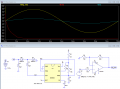
Below is my take on what's required to get at least 5.5Vrms from a 1.1Vrms signal.
It uses a 555 oscillator in a negative peak doubler circut to generate -12V from the +13.5V battery supply to power the opamp U2.
The opamp has a gain of +5 to amplify the 1.1Vrms signal to 5.5Vrms (15.4Vpp) for the computer.
A 3Vrms signal will cause clipping of the sine wave output (at about 25Vpp) but that shouldn't be a problem for the computer.

upload_2018-5-1_21-47-10.png
 
Last edited:

Alec_t

Joined Sep 17, 2013
15,119
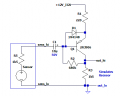
Here's a simple amplifier to try:
TachoSensorAdapter.PNG
This will give at least 5V peak output (albeit uni-polar) from a sensor signal as low as 1V peak (~0.7V RMS) and can tolerate a sensor signal >30V. R3 not only determines gain but also provides an impedance typical of an inductive tacho sensor, in case the computer does a check at power-up to see if the sensor is connected.
 

wayneh

Joined Sep 9, 2010
18,104
As I stated you can't get 5Vac RMS with a 13.5Vdc supply.
The max would be about 4.8V RMS.

Below is my take on what's required to get at least 5.5Vrms from a 1.1Vrms signal.
It uses a 555 oscillator in a negative peak doubler circut to generate -12V from the +13.5V battery supply to power the opamp U2.
The opamp has a gain of +5 to amplify the 1.1Vrms signal to 5.5Vrms (15.4Vpp) for the computer.
A 3Vrms signal will cause clipping of the sine wave output (at about 25Vpp) but that shouldn't be a problem for the computer.

View attachment 151737
Nothing against this circuit, but I think before I built it I’d try using two 9V batteries as the power supply to validate the approach. If that works, I’d go ahead and build the power supply to replace the batteries. Just my 2 cents.
 

Thread Starter

homerdodd

Joined Feb 10, 2018
69
Here's a simple amplifier to try:
View attachment 151751
This will give at least 5V peak output (albeit uni-polar) from a sensor signal as low as 1V peak (~0.7V RMS) and can tolerate a sensor signal >30V. R3 not only determines gain but also provides an impedance typical of an inductive tacho sensor, in case the computer does a check at power-up to see if the sensor is connected.

Thanks Alec. Looks simple enough. I am a bit confused as to which one to build, as these all are great suggestions. The one in post #6 was going to be my first choice, for simplicity reasons. Which do you all think I should try first? Remember; I only need a minimum of 5 VAC (RMS) to send to the computer. Which ever schematic most easily accomplishes this is what I will go with.
 
Top