One hump or two?

Thread Starter

Robartes

Joined Oct 1, 2014
57
No, this is not the age old camel question, but this one:
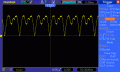
pic_6_1.gif

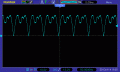
I got myself a (beginners) scope and was playing around with it and found something weird. The above is the signal from the DC side (without a smoothing cap) of a 4 diode bridge rectifier. As you can see, it has one hump too many :). There seems to be a sort of 'pre peak' before every second peak.

Is this an oscilloscope artefact, and if so what causes it (trigger settings included in the screenshot), or did I mess up something in the bridge rectifier?

Thanks!
 

MikeML

Joined Oct 2, 2009
5,444
Need the schematic, transformer specs, and currents.

Possibilities: overloaded or otherwise current-limited transformer, ferro-resonant transformer, inductive load
 

GopherT

Joined Nov 23, 2012
8,009
If you only connected a bridge rectifier and this is the unfiltered DC side, then I think you have an error with the circuit (maybe more). You should have some nice continuous equivalent dromedary humps right next to each other. You scope should read 100 Hz (assuming you live in a 50 Hz part of the world).

Show a photo of your circuit. And a drawing of your intended schematic if more than a simple bridge.
 

Thread Starter

Robartes

Joined Oct 1, 2014
57
Some more specifics:

- the 'circuit' is just the rectifier, no load (except for the probe & scope itself). I've already broken it down again (it was just 4 diodes on a breadboard) but I'll rebuild & photograph it later
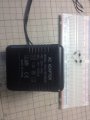
- the AC source is an old wall wart from (I think) an ADSL modem, which outputs 16V AC 1.2A according to the printed label. I haven't opened it up so I haven't looked at the actual transformer inside. The label lists the Model of the wall wart as SF48-1601200AG, on which my Google-fu came up empty
- yes, I live in a 50Hz part of the world :)
 

MikeML

Joined Oct 2, 2009
5,444
To see a classic "full-wave-rectified" waveform, you would have had to terminate the +- output of the bridge with a load resistor much lower than the input resistance of your scope or probe. Try 100Ohms to 1000Ohms the next time.

There is too much stray capacitance around if the only thing to discharge it is a 10megOhm or 1megOhm scope probe...
 
Last edited:

Thread Starter

Robartes

Joined Oct 1, 2014
57
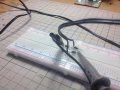
Here's some photos:

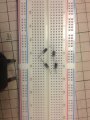
- The 'circuit' - 4 diode rectifier:

IMG_1729.jpg

- The wall wart:

IMG_1730.jpg

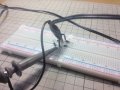
- Connecting wall wart & probe to AC side:

IMG_1731.jpg

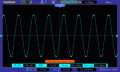
- This results in this waveform on the scope, pretty much as expected:

pic_7_1.gif

- Connecting probe to DC side:

IMG_1732.jpg

- Camel time:

pic_7_2.gif
 

Kermit2

Joined Feb 5, 2010
4,162
try using a small automotive bulb as a load. A brake light would be ideal. or the 100 ohm resistor.

other switchmode supplies can create such waveforms. if your supply hss no load then you are seeing current artifacts on your scope from other devices on the circuit.
 
Top