Old Capacitors value

Thread Starter

ren1976

Joined Oct 3, 2012
13
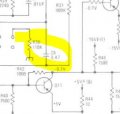
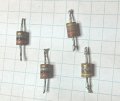
Hello, i've found some capacitors in a Hp1740a Oscilloscope.
I'm not sure about their value, can anybody help me?
On the service manual there are only value (0.47 - 0.33 - 0.22 - 0.30) but no unit.
Colors are:
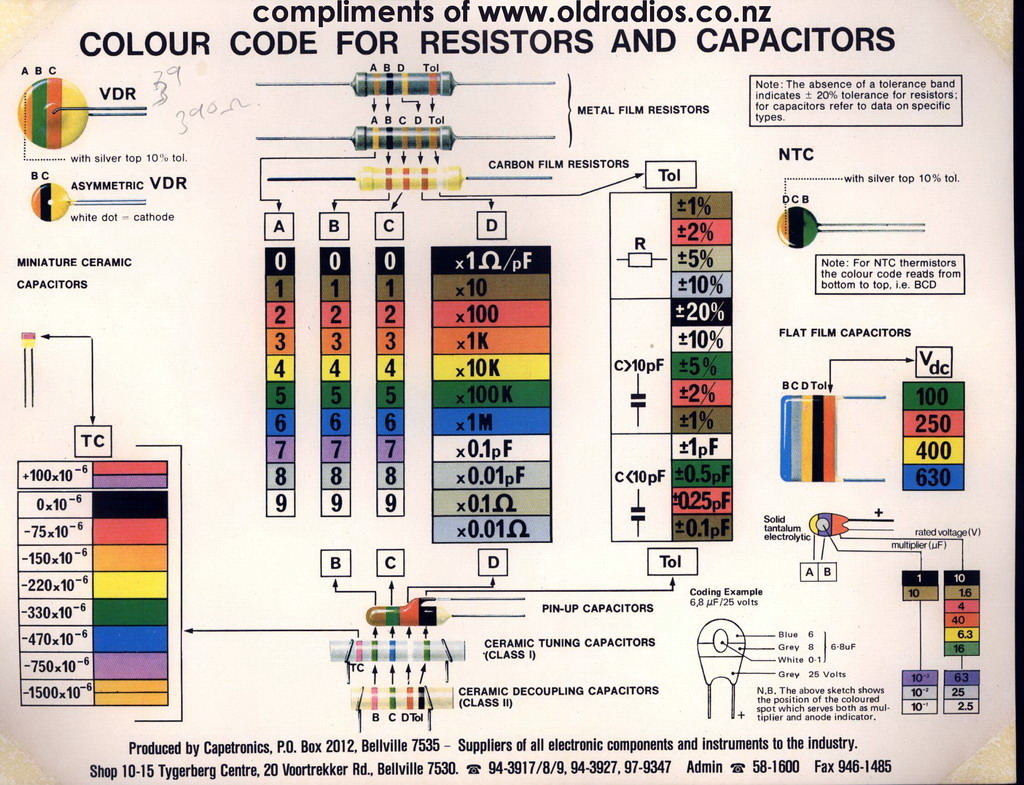
1-3 : orange-black-grey-gold
2 : red-red-grey-gold
4 : yellow-purple-grey-gold
The capacimeter can't read them. So maybe are broken or too small.
P.s. What kind of capacitors are them?

Mod: lightened your image.E
Condensatori2.jpeg
 
Last edited:

Ya’akov

Joined Jan 27, 2019
10,235
In the past, microfarads was assumed if no unit was present, it was also denoted “mf”, and “mmf” was pF.

The capacitor color code uses the same colors as the resistor code, as you can see, they correspond.

To be more certain, are any caps on the schematic marked with units? If they show “mmf”, it will increase confidence they are following the convention of assuming mF.
 

Thread Starter

ren1976

Joined Oct 3, 2012
13
Cond.JPG Thanks for your answer, in the manual others capacitors are marked with uF.
If they are picofarad, there is a procedure to test them? My capacitor tester wasn't able to read so small capacitance (0,22pF), i've another oscilloscope but only 35mhz.
 

Ya’akov

Joined Jan 27, 2019
10,235
View attachment 171026 Thanks for your answer, in the manual others capacitors are marked with uF.
If they are picofarad, there is a procedure to test them? My capacitor tester wasn't able to read so small capacitance (0,22pF), i've another oscilloscope but only 35mhz.
Then they are probably using pF as the base unit, which is also the base unit of the color code.

If you have a function generator that can produce a square wave you can measure the time constant of the discharge. You can find the procedure to do that online in many places.
 

pmd34

Joined Feb 22, 2014
529
It does look a bit like they are pF:


So the grey band indicates they have a multiplier of 0.01pF... also by the way the uF capacitors have units on the schematic.
You could try making an oscillator which uses a capacitor as an active element, and compare the frequency with a known "similar" value of capacitor, although with such a tiny capacitance I guess even unconnected wires could have more!
 

MrChips

Joined Oct 2, 2009
34,812
1) Those components look like resistors.
2) You are not going to encounter 0.22pF capacitors in an instrument. Stray capacitance is of the order of 1pF.
3) Capacitance values of 0.22, 0.33, 0.47 would be in μF, that is,
0.22 μF = 220nF = 220000pF
 

Ya’akov

Joined Jan 27, 2019
10,235
1) Those components look like resistors.
2) You are not going to encounter 0.22pF capacitors in an instrument. Stray capacitance is of the order of 1pF.
3) Capacitance values of 0.22, 0.33, 0.47 would be in μF, that is,
0.22 μF = 220nF = 220000pF
They do, though I have seen caps like that. I suhouldn’t have assumed the TS was certain about that which makes the next move obvious: measure the resistance of them and see if they correlate to the color codes in ohms.
 

Thread Starter

ren1976

Joined Oct 3, 2012
13
Found it on parts number list of the instrument. The value is really 0.47pF
I'll try to make a test but i think will be hard with my instruments. I've not a function generator, but i've a lot of ne555... Do you know what frequencies i need to test them?
Thanks to everybody for help.
 

Attachments

Ya’akov

Joined Jan 27, 2019
10,235
Found it on parts number list of the instrument. The value is really 0.47pF
I'll try to make a test but i think will be hard with my instruments. I've not a function generator, but i've a lot of ne555... Do you know what frequencies i need to test them?
Thanks to everybody for help.
I would just put in new caps but don't use cheap ones. Trying to measure such small values without calibrated instruments will be fruitless.
 

Ylli

Joined Nov 13, 2015
1,092
Yes, they are ceramic caps and the values would be in pf. Caps like these were typically used in VHF and UHF tuners and other high frequency devices. Trying to measure them is futile. Good news is that unless they are physically broken, the chance of one being bad is almost zero.
 
One thing you can do is to parallel the cap with a measurable one and a non-measurable one if the resolution would allow it to show up.

If you have an LCR meter, then perform the short and open zero and make sure it has the resolution.

It's rare to find a pf capacitor bad unless there is physical damage.

My thought was is that there are some HP part number to JEDEC number crosses around and Keysight has a p/n lookup with descriptiom.
Glad I got you pointed in the right direction. Sphere Research in Canada is probably the best HP parts source for vintage HP.

TEK has a lot more resources. There are also groups dedicated to HP and TEK equipment. either yahoo groups or groups.io. Tek (was Yahoo Tekscopes) moved to groups.io. Not sure if HP did.
 

MrChips

Joined Oct 2, 2009
34,812
The HP 1740A Service Manual identifies capacitors in pF unless otherwise noted.
Indeed, A7C8 is identified as 0.47 pF.
There is no simple way to test this value.
Why would you suspect that this component is faulty and needs replacing?
 

Thread Starter

ren1976

Joined Oct 3, 2012
13
First of all thanks to eveybody!
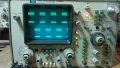
The main reason i've suspected fault of the capacitors is that , one of them is in series with e broken resistor (just broken without any sign of burnt, that i think is quite strange. Others are in the horizontal output assy. So, as you can see in the image, there is a big difference from channel a to B (the A is a blurry when channel B is much regular) IMG_20190301_084754.jpg
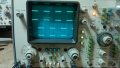
The decreasing v/d make beam less blurry but Always more than B channel.
IMG_20190301_084806.jpg Using Bandwidth limit gave me a small line but A is not sharp as B.
It's not a probe problem. I sweep them many times.
Also chop mode is very blurry on channel A.
To be honest, i'm not an engeener neither an electronic tecnicians. Just a enthusiast. This is my first time in a so complex instrument an this is much more a study experiment.
A last note...The first operation i've done is to open and clean all the potenziometer (trigger hold - position - sweep vernier - both trigger level) They had dry grease on the carbon and no contact so they didn't work. Now they works very well. Maybe the same problem on V/d ? I've cleaned olso contacts on time/div and delay. The blurry proble was present before evey operation….
Regards and thanks again
 

MrChips

Joined Oct 2, 2009
34,812
Don't go taking out and replacing components willy-nilly (i.e. without having a real reason for doing so).
Learn circuit theory and the purpose of each component.

Take C8, 0.47pF, for example.
C8 in circuit A7 is in parallel with R31, 909kΩ.
This RC pair is totally bypassed when the EXT TRIGGER attenuation switch is in normal mode and comes into play only when the switch is in divide by 10 setting. Hence C8 is for high frequency compensation across R31 on the EXT Trigger input only and has nothing to do with the poor display on the scope. I bet you don't use EXT Trigger input AND you don't select the 10 times attenuation option.

The fuzzy display is caused by excessive noise in the CHANNEL A vertical amplifiers. The HORIZONTAL section of the scope has nothing to do with this problem.

There are a number of AAC members here with years of experience trouble-shooting and fixing oscilloscopes. You would be better off making use of their experience and expertise rather than trying to fix this on your own.

Post your symptom and let the experts guide you in finding the fault and remedy.
 

AlbertHall

Joined Jun 4, 2014
12,625
What is v/d? I thought it might be volts/division but from the pictures they appear to be set the same.

Is A thicker than B with the input selector set to GND?
 

Thread Starter

ren1976

Joined Oct 3, 2012
13
Don't go taking out and replacing components willy-nilly (i.e. without having a real reason for doing so).
Learn circuit theory and the purpose of each component.

Take C8, 0.47pF, for example.
C8 in circuit A7 is in parallel with R31, 909kΩ.
This RC pair is totally bypassed when the EXT TRIGGER attenuation switch is in normal mode and comes into play only when the switch is in divide by 10 setting. Hence C8 is for high frequency compensation across R31 on the EXT Trigger input only and has nothing to do with the poor display on the scope. I bet you don't use EXT Trigger input AND you don't select the 10 times attenuation option.

The fuzzy display is caused by excessive noise in the CHANNEL A vertical amplifiers. The HORIZONTAL section of the scope has nothing to do with this problem.

There are a number of AAC members here with years of experience trouble-shooting and fixing oscilloscopes. You would be better off making use of their experience and expertise rather than trying to fix this on your own.

Post your symptom and let the experts guide you in finding the fault and remedy.

You are right for everything, i don't like to change component without any apparent reason , about the capacitors, i'had no manual before i desoldered them , so , to test them i desoldered. They are good. No way to measure them of course but...i used the calibrator of the scope set to 1Mhz. The results is the caratteristic wave of the capacitor. Compared the wave of the 0.47pF i found that was taller then 0.33pF, the 0.30pF was almost the same as 0.33pF adn 0.22pF was the smaller. I don't know if this is a conventional procedure but...
Now i'm working with manual and studing the schemes. Of course i'll ask help whenever i need but...this is a challenge! I'll try by myself before.
Yesterday for example i fixed the delay - broken transistor - and now it warks fine.
But a question i've to do. You looks like to know very well this scope...do you think could be a problem of the hybrid or just components around? I know hybrid are hard to find and very expensive...
 

MrChips

Joined Oct 2, 2009
34,812
If A and B traces are OK with inputs at GND then the problem is in your probes or the front end of the scope.
Are the probes identical?
Try interchanging the probes on channels A and B inputs.
 

Thread Starter

ren1976

Joined Oct 3, 2012
13
Thanks !!! This sounds like a good news!

Probes are identical and i swapped many time to test. Are from a Hameg 35Mhz scope. Maybe are not enough good for a 100mhz but i suppose enough good since i don't use for high frequencies.
Well, today, focusing on the main problems of the scope : chop mode unusable and absence of intensified area when i turn on delayed time/div i i followed them step by step until A12 - Main Gate Amp.
Here , after few test on voltages i discovered a ca3046 totally dead.
Four transistor of the array are broken. Only one still works. Tomorrow i'll try to find the component or the transistors to manually assembly.

---Maybe this argument is going off topic...i need to open another tread?---
 
Top