Noise on an intercom audio system

Ya’akov

Joined Jan 27, 2019
10,235
The OP posted the schematics of the phone. Which is one of those passenger airline intercom phones. The Phone is usually connected with 3 pair individually shielded cable 24 guage one set is the DTMF line for the intercom station switch, another pair is for the ear piece, one pair is for the microphone. What the OP doesn't have for the system is the intercom station controller, that all of the intercom phones are connected to.


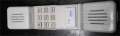
in the picture is a phone like what the OP has, with a function buttons to contact pilot, copilot, extensions, page tone, and intercom and PTT
I know what the TS is working on, and I know what the handsets can look like—but the specific handset depends on which system for which aircraft.

That photo has as much chance of being the handset as any of a dozen others and they are not alike in various ways.

It’s not a good idea to answer for the TS when someone asks for information you don’t have by guessing or assuming things.
 

Ya’akov

Joined Jan 27, 2019
10,235
Not assuming things, as a lot of this is somewhat generic. I have worked on many airplanes, have you? Some are interchangeable, others are not. This is one of the generic ones. The circuit I posted works for all of them.
Also, the original poster posted what he had in post #13.

Since the OP doesn't have the controller, the DTMF buttons are useless. Of course since its for a non working aircraft for training on the ground, TS can wire it whatever way he wants. But the best result would be a transformer coupled system from handset to cabin intercom speaker amp.
It doesn’t matter how many airplanes you’ve worked on, you are answering for someone else by assuming information you do not have. I don‘t discount your experience, but while it could make your answer more likely to be correct, it is still surmise—as you say “some are not“.

Please don’t answer questions directed to the TS unless you are quoting something that was posted by them in the thread directly.
 

MisterBill2

Joined Jan 23, 2018
27,508
Probably it is a good idea to go back to the start and look for just what the TS is in need of. It may also be good to discover just exactly what the TS is starting with. It appears that the thread has wandered a bit.
ALSO, if there is some hardware that works as required, but noise is an issue, then what can still be an option is an added noise gate, like I suggested a while back. A handy work-around, developed back in the vacuum tube era, but still useful.
 

MisterBill2

Joined Jan 23, 2018
27,508
OK, I went back to post #1 to review what the original request was. So now I have two suggestions: The first suggestion, which is that as the TS commented that improving the power filtering reduced the noise, that if the present supply is not filtered enough, that will be a simple place to start Adequate filtering is a fully mature concept with a huge amount of knowledge available.
Second suggestion is that if the noise is of a higher frequency spectrum than is required for good communication that still sounds sort of natural, additional reduction of higher frequency response in the amplifier section should be considered. Just a low-pass filter above whatever range is needed.

So there are my two suggestions, not meaning to be contentious.
 
Last edited:

Wendy

Joined Mar 24, 2008
23,798
To test the power supply theory would it be possible to replace it with batteries? Troubleshooting is always about removing one thing at a time that which you cannot remove is probably the problem. I have also found that proper ripple control in the form of power supply capacitors can solve problems you didn't even know you had. This being the voice of experience.
 

Thread Starter

cqtsdss

Joined Jun 6, 2016
9
The background noise seems to be generated in the headset, So if the microphones are electret types there can be a spread in noise outputs, because the internal FET amplifiers do vary a bit. If they are carbon microphones , they vary and can sometimes be cured by gentle bumping to break up carbon granule clumps.
The external fix will be a "noise-gate", which works a bit like a volume expander, except that the gain is lowered for inputs below some level. Noise gates are used in some sorts of PA systems to do just exactly that, which is to hold the volume/gain low until an intentional signal is present.
This is not a cure for the noise, BUT IT IS a solution to the audible noise problem.
I have not yet looked at the circuit of the original amplifier to see if it has an internal noise gate. That would be the circuit to copy, if it is included.
Thanks for your reply, I know and have used noise gates, and I have considered as a solution. I do agree with you about the hard to "cure" noise would get. For some reasons I had to leave this project aside. As soon as I get back to it I'll publish any results
 

Thread Starter

cqtsdss

Joined Jun 6, 2016
9
May I apologize for being so absent to the thread I opened? I have been very busy with other issues so I had to put this aside. I have been reading all the posts and, I believe, debate is good within a range. I really thank all of you the way you give some of your time to give help. As soon as I get my hands back on this project I'll let you know if my work, next to your ideas has provided positive results. Also, I send an image of the handset I am using, as requested.

1708285141396.png
 

MisterBill2

Joined Jan 23, 2018
27,508
A very well filtered DC power supply would be a valid start, both regulated and then well filtered, including capacitors of lower values to bypass the noise frequencies.
 
Top