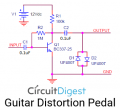
No sound at all on double-checked superbasic distortion circuit...

MisterBill2

Joined Jan 23, 2018
27,664
Would you care ELABORATING on what else would you want to know about this project besides being a distortion circuit for my very first distortion pedal?
The missing things are what you are using to hear the output, what voltage you are applying to the input, and the voltages on the transistor elements, Emitter, base, and collector. Knowing those voltages some of us could tell you just what is happening. AND, what is the "no sound at all" coming from?
 

Thread Starter

Vicc

Joined May 24, 2020
13
The missing things are what you are using to hear the output, what voltage you are applying to the input, and the voltages on the transistor elements, Emitter, base, and collector. Knowing those voltages some of us could tell you just what is happening. AND, what is the "no sound at all" coming from?
OK, I'm using a 9V battery. Now, I'm not quite sure if I'm using my meter right, but on DC voltage mode and lowest value (200mV), if I touch base with the red probe and the collector terminal with the black probe, it read between -57.5 and -58, though I don't know what that is...
 

Thread Starter

Vicc

Joined May 24, 2020
13
I forgot to mention the latter is true taking into account a 68K as the R2 resistor... If I touch base with the red probe and the collector terminal with the black probe, it reads -57.5 AND if I replace the R2 resistor with a 470Ω it reads -35.7
 

Thread Starter

Vicc

Joined May 24, 2020
13
Now, my electric guitar (with two humbucker pickups) is connected to the audio jack corresponding to the breadboard's "upper-left bus" and my mini amp combo w/3-watt speaker (where the "no sound at all" happens) is connected to the other audio jack... Remember that I could now subtly hear something using the latter resistor...
 
Last edited:

Audioguru again

Joined Oct 21, 2019
6,826
You said you are using an old 2N4001 transistor but you show a modern transistor. What is its correct part number? 2N4401?
With no input signal, set your voltmeter for a 10VDC or 20VDC range and connect the black probe to the circuit's 0V (ground).

1) With the 9V battery connected to the circuit, touch the meter's red probe to the battery positive terminal and tell us the voltage shown on the meter.
2) Touch the Meter's red probe to the collector of the transistor and tell us the voltage shown on the meter.

My simulation shows that it works fine when R2 is 68k. Do not change the value of R2.
Post the schematic of your mini-amp so we can see its input resistance.
 

DickCappels

Joined Aug 21, 2008
10,660
Be careful not to make that feedback resistor too small or at some value depending upon the output impedance of the audio source, make the amplifier linear, which defeats the whole purpose of the circuit. I used to use 100k resistors and the 2N3643 with a 10k pullup to square up small signals.
 

Thread Starter

Vicc

Joined May 24, 2020
13
You said you are using an old 2N4001 transistor but you show a modern transistor. What is its correct part number? 2N4401?
2N4001 is the correct part number.

With no input signal, set your voltmeter for a 10VDC or 20VDC range and connect the black probe to the circuit's 0V (ground).

1) With the 9V battery connected to the circuit, touch the meter's red probe to the battery positive terminal and tell us the voltage shown on the meter.
It read 8.9

2) Touch the Meter's red probe to the collector of the transistor and tell us the voltage shown on the meter.
It read 7.3

My simulation shows that it works fine when R2 is 68k. Do not change the value of R2.
Post the schematic of your mini-amp so we can see its input resistance.
Orange Amplification did not provide a schematic for such amplifier circuit.
 

Audioguru again

Joined Oct 21, 2019
6,826
Your voltages show that the battery is fine and the transistor has much less hFE than a modern 2N3904 but the old 2N4001 transistor should work with a reduced maximum output level.
 

sparky 1

Joined Nov 3, 2018
1,218
A special purposed amplifier is made to vary the distortion. circuit provided. logical decisions are made right or wrong.

This original amplifier circuit has R2, R3 68k, 2.2M respectively Not much current with 68k resistance, yes.
Does it matter what level you work at? does the guitar signal need to be attenuated ? hmm
look at the AG LTspice output. Does it work ? How much distortion? Where do you vary the distortion?
 

Thread Starter

Vicc

Joined May 24, 2020
13
A special purposed amplifier is made to vary the distortion. circuit provided. logical decisions are made right or wrong.

This original amplifier circuit has R2, R3 68k, 2.2M respectively Not much current with 68k resistance, yes.
Does it matter what level you work at? does the guitar signal need to be attenuated ? hmm
look at the AG LTspice output. Does it work ? How much distortion? Where do you vary the distortion?
I'm just at the initial test phase, basic stuff first, and it ain't working. Variation using a potentiometer will come later on... But right now, I can barely hear something coming out of the speaker only if I replace R2 with a 407R... There's NO GAIN and NO DISTORTION at all.
 

Audioguru again

Joined Oct 21, 2019
6,826
This circuit produces severe clipping distortion when its input level is high from the volume control on an electric guitar.
I think it is called "overdrive". The power amplifier can also produce severe clipping distortion when its input level is too high.
Since we do not know the input resistance of the amplifier this preamp is driving then this circuit might be overloaded by it.
 

MisterBill2

Joined Jan 23, 2018
27,664
The symptom is that the transistor does not have enough gain. That may be due to not being bised at the right point, or just plain being a low gain device. So a big question is what is the current with no signal. Based on the circuit shown as "Fig.1", the voltage across R3, the 470 ohm emitter resistor will tell us the current. That will help a lot with evaluating the problem. So give us a reading with the negative meter probe at the battery negative, and the positive probe on the emitter connection to that 470 ohm resistor. (yellow-violet-brown.)
 

Thread Starter

Vicc

Joined May 24, 2020
13
The symptom is that the transistor does not have enough gain. That may be due to not being bised at the right point, or just plain being a low gain device. So a big question is what is the current with no signal. Based on the circuit shown as "Fig.1", the voltage across R3, the 470 ohm emitter resistor will tell us the current. That will help a lot with evaluating the problem. So give us a reading with the negative meter probe at the battery negative, and the positive probe on the emitter connection to that 470 ohm resistor. (yellow-violet-brown.)
It read 6.67
 

MisterBill2

Joined Jan 23, 2018
27,664
It read 6.67
That indicates an emitter current of about 14.2 mA. Is R2, the collector resistor still 68K ohms, (blue-gray-orange)? The numbers do not work out for that value of collector resistor R2.
OR, that 6.67 could be millivolts, which would mean a collector current of about 0.0142mA. THAT would be reasonable with the 68K ohm R2 value. In that case it seems that probably the signal is being amplified and distorted and simply not enough to drive your amplifier. I am guessing that there was not much explanation along with the circuit you have.
So perhaps it would make sense to measure the output of the guitar pickup using the AC Volts mode of your meter. That may take some doing, since it will mean holding both probes onto the plug while playing the strings.THEN we will know exactly what the input is.
 
Last edited:

Audioguru again

Joined Oct 21, 2019
6,826
Why ask for the emitter voltage when he told you the voltage across the 68k collector resistor was 8.9V - 7.3V= 1.6V so the collector-emitter current is 1.6v/68k= 23.5uA and the voltage at the emitter will be a little more than 23.5uA x 470= 11.1mV.

One problem is that he is using an old low hFE 2N4001 transistor when the circuit was probably made for the modern high hFE 2N3904 that the schematic shows. Therefore the voltage across his 470 ohm emitter resistor is correct at about 6.67mV.

With the 2N3904 transistor, the input impedance is 30k ohms which is much too low for a guitar pickup that usually feeds the 1M ohms input of a vacuum tube.

Google is full of "distortion pedal" circuits made by amateurs who do not know the details of audio electronics.
Here is a similar circuit but without the emitter resistor and it has diodes to cause the distortion:
 

Attachments

AnalogKid

Joined Aug 1, 2013
12,158
Would you care explaining why for total newbies' (like myself) sake?
Because your circuit is powered by 9 V, the absolute worst case power dissipation in any resistor is calculated with Watt's Law:

P = E^2 / R -- Power dissipated in a resistor equals the voltage across the resistor squared, divided by the resistor value.

The worst case condition would be R3, 470 ohms. It might appear that its power dissipation could reach (81 / 470) = 0.17 W, but the actual worst case is when Q1 is saturated, placing a 68 K resistor (R2) in series with R3. This reduces the R3 power dissipation to 8 uW, with the power in R2 rising to 1.2 mW. Whatever problems the circuit has, power dissipation ain't it.

ak
 

Thread Starter

Vicc

Joined May 24, 2020
13
Why ask for the emitter voltage when he told you the voltage across the 68k collector resistor was 8.9V - 7.3V= 1.6V so the collector-emitter current is 1.6v/68k= 23.5uA and the voltage at the emitter will be a little more than 23.5uA x 470= 11.1mV.

One problem is that he is using an old low hFE 2N4001 transistor when the circuit was probably made for the modern high hFE 2N3904 that the schematic shows. Therefore the voltage across his 470 ohm emitter resistor is correct at about 6.67mV.

With the 2N3904 transistor, the input impedance is 30k ohms which is much too low for a guitar pickup that usually feeds the 1M ohms input of a vacuum tube.

Google is full of "distortion pedal" circuits made by amateurs who do not know the details of audio electronics.
Here is a similar circuit but without the emitter resistor and it has diodes to cause the distortion:
Audioguru, sorry for not being clearer before about what kind of amp I'm using... As a newbie, it never occurred to me that the "input impedance" may be the problem here... It is NOT a vacuum tube-based amp. It's a solid-state 3-watt amp combo w/3-watt speaker... probably the smallest amp out there! I just found a manual from the manufacturer (Orange Amplification) for an earlier, very similar mini amp model and it states that the rated input impedance is: 470 Kohms (no circuit schematic though...)

Orange Micro Crush manual
 

Audioguru again

Joined Oct 21, 2019
6,826
The input impedance of 470k ohms of the power amplifier is fine for this preamp to drive.
But this preamp has an input impedance of about 30k ohms which is 33.3 times less than the 1M ohms expected by the guitar.

Your photo shows a transistor in a black plastic case but you say the transistor is a 2N4001 that is in an old metal case. Then maybe you swapped its collector and emitter pins causing its gain to be VERY low. What transistor part number did you use? Did you get a fake Chinese transistor??
 
Top