Facebook
 Google
 GitHub
 Linkedin

Hello,
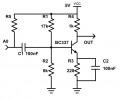
I am learning electorincs and trying to read sound from mic on Arduino. I have used KY-038 sound sensor (schema here) but since the unamplified analog ouput is not very strong (tens of mV) I've tried to build amplifier based on the common emitter tutorial but adapting that to 5V source, higher hFE (actually 280, for simplicity I've used 225), divider/base ratio of 20:1 and using 100nF capacitors (since I don't have full assortment at home). The result is attached - I have verified the quiescent current and voltage are according to my expectations. However, when I plot the voltage at output I don't see any gain. I have omitted the output capacitor since Arduino can read only values 0 - 5V so I would have to bias to 2.5V anyway. Please advise what mistake I did. According to the KY-038 mic schematics the input resistance should be 150 Ohm - do I need to adapt the circuit?
Note that I have powered the mic through 10k resistor directly to the analog ouput pin, it's probably as good as using the VCC pin and setting the pot. One thing that caught me by surprise is that measuring A0/GND pin resistance I see 3kOhms - as the mic should be a 'capacitor' I would expect infinite DC resistance.
I have found many schematics for various pre-amps, but besides that these are usually 9V/12V powered, there's rarely an explanation why it is designed that way. And I am interested in understanding the hows and whys (I have already ordered a $1 mic with well designed pre-amp built in). One thing that these have in common is high-resistance resistor between collector and base - I get that it stabilizes the output at the cost of lowering gain. Right now I have no gain to offer :-/.
Thanks!
I am learning electorincs and trying to read sound from mic on Arduino. I have used KY-038 sound sensor (schema here) but since the unamplified analog ouput is not very strong (tens of mV) I've tried to build amplifier based on the common emitter tutorial but adapting that to 5V source, higher hFE (actually 280, for simplicity I've used 225), divider/base ratio of 20:1 and using 100nF capacitors (since I don't have full assortment at home). The result is attached - I have verified the quiescent current and voltage are according to my expectations. However, when I plot the voltage at output I don't see any gain. I have omitted the output capacitor since Arduino can read only values 0 - 5V so I would have to bias to 2.5V anyway. Please advise what mistake I did. According to the KY-038 mic schematics the input resistance should be 150 Ohm - do I need to adapt the circuit?
Note that I have powered the mic through 10k resistor directly to the analog ouput pin, it's probably as good as using the VCC pin and setting the pot. One thing that caught me by surprise is that measuring A0/GND pin resistance I see 3kOhms - as the mic should be a 'capacitor' I would expect infinite DC resistance.
I have found many schematics for various pre-amps, but besides that these are usually 9V/12V powered, there's rarely an explanation why it is designed that way. And I am interested in understanding the hows and whys (I have already ordered a $1 mic with well designed pre-amp built in). One thing that these have in common is high-resistance resistor between collector and base - I get that it stabilizes the output at the cost of lowering gain. Right now I have no gain to offer :-/.
Thanks!
Attachments
-
 34 KB Views: 33