Newbie trying to make an oscillator with cd40106 ic chip

Thread Starter

pi_lee

Joined Oct 6, 2024
1
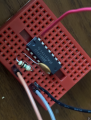
Hi, I'm trying to make an simple oscillator with cd40105 chip and 9v battery.

I'm using a 0.1uf capacitor and one 10k ohm resister, but It doesn't make any sound.

I tried with the 100k ohm, but still doesn't work.

When I turned on the battery, It first sounded like a lower beep, but very few times after it didn't make a sound anymore. What should I do to make proper sound?

I'm referencing this video -> https://bastl-instruments.com/support/tutorials/omsynth-project-1
 

Attachments

AlbertHall

Joined Jun 4, 2014
12,619
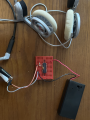
Probably because you have the headphones connected to it. Most headphones are very low impedance and will stop the oscillator running. As the site you refer to says you need a buffer between the oscillator output and the 'phones.
 

DickCappels

Joined Aug 21, 2008
10,661
It looks like you are driving the headphones directly from the ‘40106.

Try connecting the headphones through a resistor between 4.7k and 10k. The amplitude will be very low but at least you won’t be loading down the inverter.

Consider using an audio amplifier with a high input impedance and a low output impedance.

An LM380 would be a good place to start.

https://external-content.duckduckgo...0a1b43f9373fdb87e6e7f891228c4e5a35&ipo=images
 

sarahMCML

Joined May 11, 2019
695
Hi, I'm trying to make an simple oscillator with cd40105 chip and 9v battery.

I'm using a 0.1uf capacitor and one 10k ohm resister, but It doesn't make any sound.

I tried with the 100k ohm, but still doesn't work.

When I turned on the battery, It first sounded like a lower beep, but very few times after it didn't make a sound anymore. What should I do to make proper sound?

I'm referencing this video -> https://bastl-instruments.com/support/tutorials/omsynth-project-1
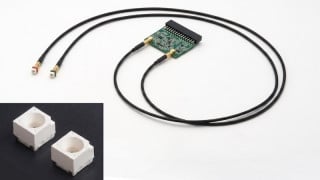
Are you sure your resistor isn't 1 Megohm instead of 10 Kilohms, as it's supposed to be. You'll be getting an output of around 13Hz if it is! I'm referring to the photo.
 

BobTPH

Joined Jun 5, 2013
11,463
INDEED!!! there is no reason to expect a CMOS device to operate without every input connected to a defined point, either V+ or common.
Someone please correct me if they know otherwise, but I think it should not matter with Schmitt triggers. The problem with unconnected inputs, as I understand it, is that they might float to a middle voltage that has both of the push pull drivers on and a large shoot through current flows. This cannot happen with a Schmitt trigger since it will snap to one or the other.
 

schmitt trigger

Joined Jul 12, 2010
2,027
Sometimes, when I have been lazy, I have left unused CMOS inputs unconnected.
But this is not a good practice! Tie them to the nearest Vdd or ground.
 

Bordodynov

Joined May 20, 2015
3,430
A dangling non-connected CMOS input will catch electromagnetic interference. This will lead to erratic switching. You're wrong to think that it's not scary for Schmitt triggers. It is important that it can have a sufficiently large supply current at intermediate input voltage levels (lying between Vdd and Vss (GND)). But even in the absence of interference at the input, there can be any level between the supply voltages. The protective diodes at the input are scattered among themselves. And what voltage is at the input is a matter of chance.
 

BobTPH

Joined Jun 5, 2013
11,463
I do not disagree that the input is undefined. I am saying that the Schmitt trigger output cannot stay in the middle and cause shoot through current. It will quickly flip to one side or the other, unlike an ordinary input. Perhaps there are other bad effects that I don’t know about.
 

MisterBill2

Joined Jan 23, 2018
27,186
Someone please correct me if they know otherwise, but I think it should not matter with Schmitt triggers. The problem with unconnected inputs, as I understand it, is that they might float to a middle voltage that has both of the push pull drivers on and a large shoot through current flows. This cannot happen with a Schmitt trigger since it will snap to one or the other.
In a schmitt trigger it is the OUTPUT that snaps at some level. The input still needs to be connected to something, even if it is not V+or common.
 

BobTPH

Joined Jun 5, 2013
11,463
In a schmitt trigger it is the OUTPUT that snaps at some level. The input still needs to be connected to something, even if it is not V+or common.
Why? I thought the problem with floating inputs was that both output drivers might be activated causing a large shoot through current. I don’t see how unconnected Schmitt trigger inputs would do that.
 

eetech00

Joined Jun 8, 2013
4,704
Why? I thought the problem with floating inputs was that both output drivers might be activated causing a large shoot through current. I don’t see how unconnected Schmitt trigger inputs would do that.
Because the state an unconnected input is undefined. Spurious signals at an unconnected input can cause the output to rapidly (or intermittently) oscillate, and it can happen whether the input is Schmitt or not. This could in turn, cause the circuit to operate erratically. Its best practice to never leave an unused input pin unconnected, and assert it either high or low, as required proper operation of the device.

Schmitt trigger inputs help prevent device undesired oscillations for signal with slow rising/falling edges.
 

MisterBill2

Joined Jan 23, 2018
27,186
Aside from that explanation, which is good, there is the fact that the actual circuit inside a digital IC is a great deal more complex. In some of the earlier IC data books the "equivalent internal circuit" was shown. Quite a bit more complex than one might expect.
Also, it makes no sense to argue about a precaution that every IC manufacturer posts.They all do it because it always applies.
 
Top