Network Theory, Examine the circuit

Thread Starter

copacabana81

Joined Oct 29, 2017
12
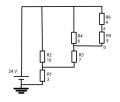
Reffering to attached circuit I have to visualising the voltages and flowing across resistors when V is changed between 0V and 48V. Resistor values remain constant. I have to use excel and multisim. Than i have to do exactly same thing but changing R3 value from 1kOhms to 14kOhms
I have no clue how to do it. I know I should use Kirchhoff's law and Ohm law but I don't know how to start...I know i need to calculate voltage drop across every resistor. But I don't know how to do it.
Shall I calculate total resistance first? That circuit driving me crazy. I couldn't sleep tonight. Can ayone explain it to me step by step calculating please?
Screenshot (1).png
 

LesJones

Joined Jan 8, 2017
4,511
I would suggest by working out what the effective resistance is across R2 with R2 in parallel with the network of resistors to the right of it. Consider R1 not being connected at this first step. The second step would be to work out the voltage across R2 with R1 re connected.

Les.
 

Thread Starter

copacabana81

Joined Oct 29, 2017
12
Thanks for reply.
Yes it's my uni homework
Could you tell me if I'm right?
R5 and R6 are in series if I replace them with equivalent resistor then it will be in parallel with R4?
I'm not sure about R2 and R3 are they in parallel?
And... Is R1 and R3 in series?

Regards
Anna
 

dl324

Joined Mar 30, 2015
18,326
R5 and R6 are in series if I replace them with equivalent resistor then it will be in parallel with R4?
Yes.
I'm not sure about R2 and R3 are they in parallel?
And... Is R1 and R3 in series?
Do you see similarities in the connection of R4, R5, and R6 with R2, R3, and R4'?

The problem might be easier to visualize if you start at the right and simplify as much as you can by using series/parallel combinations.
 

LesJones

Joined Jan 8, 2017
4,511
What is the resistance looking into the circuit to the right of R2 ? (Think of the circuit with the battery, R1 and R2 removed.)

Les.
 

WBahn

Joined Mar 31, 2012
32,823
It's a bit unclear what, exactly, you are being asked to do. Are you supposed to plot the voltages and currents in all six resistors as the voltage is changed? In other words, twelve different plots? Or are you just looking for the voltage/current for one specific resistor? Or the total current in the voltage source as the voltage is changed?

What approach is best really depends on exactly what you are trying to determine.

Have you been through node voltage analysis (also known as nodal analysis) or mesh current analysis?
 

bertus

Joined Apr 5, 2008
22,922
Hello,

Would it help when the circuit is drawn in an other way:

copacabana_circuit.png

Now you can see wich resistors are in series and wich are parallel.

Bertus
 

Thread Starter

copacabana81

Joined Oct 29, 2017
12
It's a bit unclear what, exactly, you are being asked to do. Are you supposed to plot the voltages and currents in all six resistors as the voltage is changed? In other words, twelve different plots? Or are you just looking for the voltage/current for one specific resistor? Or the total current in the voltage source as the voltage is changed?

What approach is best really depends on exactly what you are trying to determine.

Have you been through node voltage analysis (also known as nodal analysis) or mesh current analysis?
Basically I have to show on graph how voltage drop across resistors is changing when you apply a different voltage between 0V and 48V. Resistance value remain the same.
I was thinking to use mesh analysis but isn't only for a circiut with two power supplies?
 

MrAl

Joined Jun 17, 2014
13,702
Reffering to attached circuit I have to visualising the voltages and flowing across resistors when V is changed between 0V and 48V. Resistor values remain constant. I have to use excel and multisim. Than i have to do exactly same thing but changing R3 value from 1kOhms to 14kOhms
I have no clue how to do it. I know I should use Kirchhoff's law and Ohm law but I don't know how to start...I know i need to calculate voltage drop across every resistor. But I don't know how to do it.
Shall I calculate total resistance first? That circuit driving me crazy. I couldn't sleep tonight. Can ayone explain it to me step by step calculating please?
View attachment 138291
Hello there,

There are multiple ways to solve this. For some examples:
1. Nodal analysis (very general).
2. Loop analysis (very general).
3. Solve for total resistance working right to left, then solve for voltages working left to right (not as general).
4. Use Thevenin and Norton equivalents working left to right solving for voltages as you go (fairly general).

The method you pick will be the method you already know unless you are willing to learn a new method. Since Nodal is so general and you also need to know the voltages, that's a good way to do it unless you dont want to learn it if you dont already know it. It's simple enough to learn though.
To use Nodal you first locate the unknown nodes, then write one equation for each node. The equation for any node is just the equation that sums all the currents going into or out of the node and equates that to zero. Once you have all the equations, you can then use simultaneous equation solving to solve for all the voltages. You get all of the node voltages that way, then you can solve for differential voltages if you like (which would be node voltage 'a' minus node voltage b here for example).

So if you can given some idea what you would prefer to do, we can proceed in a manner which would be acceptable to you. If you are not sure then it depends on how much math you have had so far. For example, have you done simultaneous equations yet.
 

WBahn

Joined Mar 31, 2012
32,823
Basically I have to show on graph how voltage drop across resistors is changing when you apply a different voltage between 0V and 48V. Resistance value remain the same.
I was thinking to use mesh analysis but isn't only for a circiut with two power supplies?
Mesh analysis is nothing more than a systematic way of applying KVL to a linear circuit.

Since it appears you are expected to make six plots (the voltage drop across each of the resistors), it is probably best to just go ahead and solve the entire circuit directly (using mesh or nodal analysis are both reasonable choices, though nodal analysis is probably a better choice because while you have three essential nodes, the solution to one of them is trivial. Furthermore, since it's voltages you are looking for, you are closer to that with the results of a nodal analysis. But both will work fine.

If you think about it, you don't have to do a whole bunch of different analyses for a bunch of different source voltages. It's a linear circuit. If the voltage of the source doubles, what will happen to the voltage drops across each of the resistors?
 

Thread Starter

copacabana81

Joined Oct 29, 2017
12
Mesh analysis is nothing more than a systematic way of applying KVL to a linear circuit.

Since it appears you are expected to make six plots (the voltage drop across each of the resistors), it is probably best to just go ahead and solve the entire circuit directly (using mesh or nodal analysis are both reasonable choices, though nodal analysis is probably a better choice because while you have three essential nodes, the solution to one of them is trivial. Furthermore, since it's voltages you are looking for, you are closer to that with the results of a nodal analysis. But both will work fine.

If you think about it, you don't have to do a whole bunch of different analyses for a bunch of different source voltages. It's a linear circuit. If the voltage of the source doubles, what will happen to the voltage drops across each of the resistors?
Thanks,
I don't understand node analysis. I'm not sure which one are they if you know what I mean...
 

WBahn

Joined Mar 31, 2012
32,823
Thanks,
I don't understand node analysis. I'm not sure which one are they if you know what I mean...
Nodal analysis is just a systematic way of applying KCL at each (essential) node. An essential node is basically any node connecting more than two branches since a node that connects just two branches has a trivial solution -- whatever current comes in from one branch must go out the other.

There are many tutorials available on nodal analysis and I would hope that your text would cover it in detail.
 
Top