Need timer circuit.

Thread Starter

Mogman

Joined Jan 20, 2022
36
I have a solar submersible pump that uses a reed type float switch.
I need to "debounce" this circuit, when the wind blows or the cattle are drinking the relay cycles on and off.
I need a delay of around 5-7 min. the input can be high or low as the float can simply be turned 180deg (would prefer reed switch closed to run)
If the input stays "active" the pump should continue to run until the input goes inactive at that point the 5 min timer should start.
If the input bounces within the timer period the timer should reset.
System is 12V the relay pulls 120ma
I have some 555 chips, I think the 120ma is within its abilities.
It should have a low current drain when the pump is off.
I used to work allot with the 555 but that was over 40 years ago so things are a little fuzzy now, in fact everything is a little fuzzy now :)
If there is a better device that would be fine but I really need to get something working fast to protect the pump from damage
THANKS!!!
MM
 

WBahn

Joined Mar 31, 2012
32,702
I'd recommend putting in two floats, a lower and an upper. When the lower switch activates the pump is turned on and stays on until the upper switch activates, which shuts it down. It stays off until the lower pump activates again.
 

sghioto

Joined Dec 31, 2017
8,633
Agree with WBahn using two float switches might be less complicated.
However does the float switch control the pump directly drawing 120ma?
 

Thread Starter

Mogman

Joined Jan 20, 2022
36
Agree with WBahn using two float switches might be less complicated.
However does the float switch control the pump directly drawing 120ma?
No it is the relay that controls the pump, I did consider the two float option and there are two issues I can see.
First it will still require a control circuit and second considering the float is the highest likely failure point it would double the possibility of a failure.
 

Thread Starter

Mogman

Joined Jan 20, 2022
36
I am actually am considering two float switches in series at the same level, I would rather it fail off than fail on and it would give me the highest possibility of that outcome.
IIRC the circuit I am looking for is not that complicated.
 

Thread Starter

Mogman

Joined Jan 20, 2022
36
I am having a hard time finding the info but I IIRC as long as pin 2 (trigger) is held low the output will be high (555) this would do what I need it to do, I guess I need to dig out the old bread board...
 

sghioto

Joined Dec 31, 2017
8,633
I did consider the two float option and there are two issues I can see.
First it will still require a control circuit and second considering the float is the highest likely failure point it would double the possibility of a failure.
Same with the two float in series idea that also requires a control circuit.
 

Thread Starter

Mogman

Joined Jan 20, 2022
36
Same with the two float in series idea that also requires a control circuit.
Yes I know, it would just increase the chance of failing off rather than failing on being it would require both switches to be in the on state to initiate pump turn on, both switches would have to fail in the on position to overflow the tank and run the batteries down.
 

Thread Starter

Mogman

Joined Jan 20, 2022
36
It looks like if a diode was placed between pin 2 and pin 6/7 as long as pin 2 stays low pin 6/7 would never get to 2/3 supply voltage, only after pin 2 goes high would the timer start. it will take a day or two to get all the stuff together to confirm this.
555.JPG
 

Thread Starter

Mogman

Joined Jan 20, 2022
36
The two float switches if I installed the second float would work the same as one switch, only both of them would have to close to start the pump, it would only add a little failsafe to it, a manual reset TOT would also help ensure the system would not get stuck ON.
So the float switch is connected to pin 2 to ground and when it goes low the output pin 3 goes high and sources to pump relay.
The diode connecting 2 to 6/7 would ensure the pump would continue to run without timing out, cattle consume around 40 gal a day of water a day so a multiple cow visit can pull a 100 gal very low very fast.
When the tank gets to the point it opens the float switch then the timer period starts this is to help get the level high enough that the float switch is not likely to "bounce" and if it does bounce when the timer is running it will reset the time again so the pump again runs long enough to get well past the "bounce" level.
 

Thread Starter

Mogman

Joined Jan 20, 2022
36
Is there a senario where the pump keeps running and overfills?
Only if the float switch gets stuck, allota strange stuff happens around stock tanks :)
This one should be pretty reliable as long as I take reasonable care of it.
I am guarding the float with the escape ramp I built for the tank. (in case little critters fall in)
One consideration is I will be using a rather large "timing" capacitor so I will need to install a resistor in series with the diode so that if it "resets" near cutoff of the 2/3 or so supply voltage does not hit the reed switch with more than its rating (200ma) it would still be much lower in resistance than the timer resistor so it would still effectively reset the timer or at least extend the time in case of a really short bounce.
 
Last edited:

crutschow

Joined Mar 14, 2008
38,316
I need a delay of around 5-7 min.
A 555 circuit is problematic for that long a time, as the RC value gets very large and capacitor leakage becomes a problem.

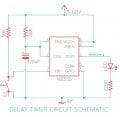
Better to use an oscillator-counter circuit such as this.
It's a fairly simple circuit, which has a low frequency RC oscillator that is counted down to get a long time delay, with a reasonable size RC value for the oscillator.
 

sghioto

Joined Dec 31, 2017
8,633
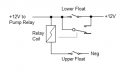
Here's a suggestion using upper and lower float switches.
Initially when the tank is full both switches are open and the relay is OFF
When the water level drops below the upper switch it closes, relay OFF.
When the level drops below the lower switch it closes activating the relay sending 12 volts to the pump.
At this time the lower switch is bypass by the now closed contacts to latch the relay ON until the level reaches the upper switch.
1737162386800.png
 

Thread Starter

Mogman

Joined Jan 20, 2022
36
Here's a suggestion using upper and lower float switches.
Initially when the tank is full both switches are open and the relay is OFF
When the water level drops below the upper switch it closes, relay OFF.
When the level drops below the lower switch it closes activating the relay sending 12 volts to the pump.
At this time the lower switch is bypass by the now closed contacts to latch the relay ON until the level reaches the upper switch.
View attachment 340582
That is very interesting, I will have to look and see how much it will take to add the second float, then to find relays with lower current than the ones I am using, at 120ma ea. two would be more than the switches are rated for.
That looks very doable!!
 

sghioto

Joined Dec 31, 2017
8,633
That is very interesting, I will have to look and see how much it will take to add the second float, then to find relays with lower current than the ones I am using, at 120ma ea. two would be more than the switches are rated for.
That looks very doable!!
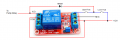
Relay Module suggestion.
Module draws less then 5ma through the float switches to activate.
1737167522771.png
 

MisterBill2

Joined Jan 23, 2018
27,160
There is a common scheme used for controlling pump which uses a single float that travels up and down on a rod, which has stops on it. When the float rises to the upper stop the switch is switched off. Then when the level falls to the point that the switch hits the lower stop, the switch is switched on. Foe a stock watering tank, you may need a separate water column not disturbed by the cattle, but that is coupled to the water level in the tank. Very simple, quite reliable, and it avoids cows playing with it.
 
Top