Need Help With This Question. Circuit Impedance. Much Appreciated

WBahn

Joined Mar 31, 2012
32,970
Thanks for the help, finally got my head around the complex numbers for impedance.

ok, I've managed to get the Total Impedance in Polar form. its 20.2<84.9degrees.

for the supply current, I've used I=V/Z and have worked it out to be 11.38<-84.9degrees A

To calculate the Branch Current at I1. What approach should I take for this?
How would you do it in a purely resistive circuit?

Assuming that your answers thus far are correct -- they can't be, since both are just numbers and impedance has units of impedance while current has units of current and I choose not to check fundamentally wrong answers since, by ignoring units even in your results you've indicated that you really don't care about getting correct answers and there's little reason for me to care more about the correctness of your answers than you do -- you know the voltage across all three impedances and you know the current in the series impedance. Is this not enough to find the voltage across the impedance that I1 is flowing through? Once you have the voltage across that impedance, can't you find the current through that impedance since you know the value of the impedance?

Wouldn't another option be to treat the right two impedances as a current divider?
 

WBahn

Joined Mar 31, 2012
32,970
Before I start, let me commend you on your extremely neat handwriting. This will serve you very well.

You need to ask if your work is making sense.

Does it seem reasonable that 5/6 is the same as 0.8?

Also, you should indicate what your designators refer to. When you use Zt in work like this without defining it, most people will assume it is the total impedance. But here you mean it to only be the equivalent impedance of the right two impedances. Label your diagram with appropriate designators and then use those to make clear what you mean. You've defined R1, R2, and R3 in a prior post. Since these are not resistances but rather impedances, better designators would be Z1, Z2, and Z3.

Also, imagine you are the grader looking at this work and not the person that wrote it. At the bottom of the first column you have Zt equal one thing and then at the top of the second column Zt magically is equal to something completely different. The grader is not a mind reader (and neither will your boss or your customer be). Make sure that the work you present is completely and communicates what you need to convey without requiring crystal balls or a lot of guessing.

So reserve Zt for what most people will naturally expect it to be -- the total impedance seen by the source. So at the top of your work you should make a definition like:

Z23 = Z2 || Z3

Now look at the denominator of your second row. You have j - 12², which is (-144 + j), not 144. Pure sloppiness. This WILL get you into trouble!

In that left column, you made your life a lot harder than it needed to be by jumping in and multiplying top and bottom by the complex conjugate of the denominator. This works, but it's a sledgehammer and sometimes you can use a much gentler tool. Just split it into two terms and go from there. The j's cancel out cleanly from one and multiplying top and bottom by j takes care of the other.

Now consider what would have happened if you had tracked your units from the beginning, like I tried to get you to.

\(
Z_{23} \; = \; \frac{\(10 \; + \; j10\) \; \Omega}{-j12 \; \Omega}
\;
Z_{23} \; = \; \frac{\(10 \; + \; j10\) }{-j12 }
\)

Gee. Remember what I tried to tell you about tracking units?

Notice that the units canceled out. That means that your answer is unitless when it MUST have units of impedance. That means that, had you tracked your units, your would have caught this mistake right here and could have stopped right here and figured out and corrected the mistake, before you spent a page of work that was guaranteed to yield a worthless answer.

And note that it was had for me to catch this mistake because you didn't set up your work properly. You just through an equation out with a couple of numbers in it and I had to go back and do the set up that YOU should have done to figure out where these numbers came from and what they meant in order to catch that your equation was wrong.

Something like:

\(
Z_{23} \; = \; Z_2 \; || \; Z_3
\;
Z_{23} \; = \; \frac{Z_2 \; Z_3}{Z_2 \; + \; Z_3}
\;
Z_{23} \; = \; \frac{\(\(10 \; + \; j10\) \; \Omega \)\( -j12 \; \Omega\)}{\(\(10 \; + \; j10\) \; \Omega\) \; + \; \(-j12 \; \Omega\)}
\;
Z_{23} \; = \; \frac{ 120 \; - \; j120 }{10 \; - \; j2} \; \Omega
\)

Do you see how the unit was treated just like any other factor and how it worked out to give the answer, at this stage, units of impedance. If it hadn't, then I would have known the answer was wrong and could have stopped at that point and figured out what was wrong and corrected it before proceeding.
 

Thread Starter

JohnKid5

Joined Nov 2, 2017
19
I now see the mistakes that I have made, Thanks for helping me out.

I would like to say, something I think I should have put in at the beginning, that I'm relatively new to this and am currently self teaching myself using a mates course work from college. The way all the lingo and answers are written down can be confusing to me at times and I sometimes am unsure on what goes where. I appreciate the pointers and am greatful for the guidance given by all.

I do enjoy a challange and will continue to attempt the questions and posted it for your viewing.

One last question, is it easier to change the equation to polar form when multiplying and dividing, then change my answer back to rectangular form. (Z23) Then proceed to the series part in rectangular form before finally changing it back to polar for the final answer? (Zt= Z1 + Z23)
 
One last question, is it easier to change the equation to polar form when multiplying and dividing, then change my answer back to rectangular form. (Z23) Then proceed to the series part in rectangular form before finally changing it back to polar for the final answer? (Zt= Z1 + Z23)
If you'll use the calculator I gave you a link for: https://www.mathportal.org/calculat...tor/complex-numbers-operations-calculator.php

you can do all your calculations in rectangular form and convert your final answer to polar when you're done.
 

WBahn

Joined Mar 31, 2012
32,970
I now see the mistakes that I have made, Thanks for helping me out.

I would like to say, something I think I should have put in at the beginning, that I'm relatively new to this and am currently self teaching myself using a mates course work from college. The way all the lingo and answers are written down can be confusing to me at times and I sometimes am unsure on what goes where. I appreciate the pointers and am greatful for the guidance given by all.

I do enjoy a challange and will continue to attempt the questions and posted it for your viewing.

One last question, is it easier to change the equation to polar form when multiplying and dividing, then change my answer back to rectangular form. (Z23) Then proceed to the series part in rectangular form before finally changing it back to polar for the final answer? (Zt= Z1 + Z23)
Addition and subtraction are easier in rectangular form while multiplication and division are easier in polar form. So you want to be conversant with transforming back and forth between the two. You often need to do so several times over the course of working a problem.

I would STRONGLY recommend that you NOT use a calculator that does this for you UNTIL you are conversant at doing them yourself (using just a scientific calculator's trig and sqrt capabilities). Otherwise, what will happen is that you will be using the calculator to do your thinking for you instead of just your grunt work. That is a BIG problem today with the sophisticated tools that are available.
 
I would STRONGLY recommend that you NOT use a calculator that does this for you UNTIL you are conversant at doing them yourself (using just a scientific calculator's trig and sqrt capabilities). Otherwise, what will happen is that you will be using the calculator to do your thinking for you instead of just your grunt work. That is a BIG problem today with the sophisticated tools that are available.
I agree with this as a general proposition, but looking at his work in post #18 he seems able to do the complex arithmetic. I think he is sufficiently conversant with the details of complex arithmetic that he can move on to using a calculator.

His problem so far has been that he doesn't follow the advice both you and myself have given him several times. He is not calculating the parallel equivalent of R2 and R3 as the first step. Maybe the amount of complex arithmetic involved is putting him off due to a bit of laziness. He needs to move beyond the calculations and think about the concepts. Perhaps using a calculator could help him make that move.

He says that he sees the mistakes he has made. We can only hope that he has finally got the correct result but since he hasn't shown us we'll never know. Why is it so hard to get people who ask for help on this forum to show their work, and to follow the advice we give them?
 

Thread Starter

JohnKid5

Joined Nov 2, 2017
19
image.jpeg

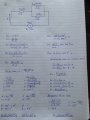
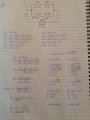
Here is my workings for total impedance in polar form. I've taken onboard all the information that both you guys have said. It's just getting to hips with it all takes a little patience.

Thanks again
 
You've made a mistake which propagates through the rest of the calculation.

On the left side of your work where you calculate the polar form of 10 - j2, you calculate the angle as arctan(2/10); this is wrong. You must remember that the imaginary part of 10 - j2 is negative. The angle of the polar form of 10 - j2 is arctan(-2/10), not arctan(2/10). This means that the angle is -11.30 degrees, not +11.30 degrees. You'll have to redo all that follows.

BUT, except for that mistake, the rest looks all good.
 
Another suggestion I have is to keep more digits as appropriate. When you converted the polar form of Z23 back to rectangular, you calculated 16.65*cos(-303.7). You got 9 for a result, but 9.238 is more appropriate. Your calculator probably has more digits than just 9. If you leave intermediate results in the calculator rather than truncating them to write down on paper, and then using those truncated values in further calculations you'll get a much more accurate result. If you can't keep the intermediate results in the calculator, you need to keep more digits in what you write down on paper.
 

WBahn

Joined Mar 31, 2012
32,970
View attachment 140333

Here is my workings for total impedance in polar form. I've taken onboard all the information that both you guys have said. It's just getting to hips with it all takes a little patience.

Thanks again
Nice, neat work. THANKS!

You are trying to track units, but not really doing so. You are actually just tacking them on here and there.

Look at your third line (the first line for Z23 having actual values).

You have an Ω in the top and in the bottom which would cancel each other out -- yet you someone keep an Ω in the fifth line. How?

Even more to the point, your denominator in that third (and fourth) line has mixed units. You have the dimensionless number (10+j10) added to the resistance (0-j12)Ω. You can't add two quantities unless they have the same units.

The easiest way to treat units correctly is to treat them just like any other algebraic symbol (i.e., variable). Imagine that instead of Ω there was the variable X there. How would you carry it through the work?

An impedance is the sum of a resistance and a reactance, both of which have units of Ω (which makes sense since we can't sum two things unless they have the same units).

So

\(
Z_2 \; = \; 10 \, \Omega \; + \; j10 \, \Omega
\)

Just like if that Ω was a variable X, we cannot write this as 10 + j10 Ω because that's (10) + (j10 Ω). We need to factor out the Ω just like we would factor out X, giving us

\(
Z_2 \; = \; \( 10 \; + \; j10 \) \, \Omega
\)

The parenthesis are non-negotiable -- the Ω multiplies the factor in parenthesis so that it will distribute properly across both terms inside.

This is why I have all of those parentheses in equation for Z23 in my prior post:

\(
Z_{23} \; = \; \frac{\(\(10 \; + \; j10\) \; \Omega \)\( -j12 \; \Omega\)}{\(\(10 \; + \; j10\) \; \Omega\) \; + \; \(-j12 \; \Omega\)}
\)

Several of those are non-negotiable -- if you remove them you change the expression.

Being more explicit on the next steps

\(
Z_{23} \; = \; \frac{\(10 \; + \; j10\) \( -j12 \) \; \Omega^2}{10 \; \Omega \; + \; j10 \Omega \; - \; j12 \Omega}
\;
Z_{23} \; = \; \frac{\(120 \; - \; j120\) \; \Omega^2}{\(10 \; + \; j10 \; - \; j12 \) \;\Omega}
\;
Z_{23} \; = \; \frac{\(120 \; - \; j120\) \; \Omega^2}{\(10 \; - \; j2 \) \;\Omega}
\;
Z_{23} \; = \; 120 \( \frac{1 \; - \; j1}{10 \; - \; j2} \) \( \frac{\Omega^2}{\Omega} \)
\;
Z_{23} \; = \; \( \frac{1 \; - \; j}{5 \; - \; j} \) \, 60 \Omega
\)

Do you see how the Ω is handled just like any other symbolic factor would be?

The other thing that you need to keep in mind is that the arctan function on your calculator is a two-quadrant function, but a complex number can be in any of the four quadrants of the complex plane. When you divide a negative real part by a positive imaginary part, you get the same value as when you divide a positive real part by a negative imaginary part. But the first is in the second quadrant while the second is in the fourth. So you either need a four-quadrant arctan function (typically called atan2 in most programming language libraries) or you need to adjust the results of your two-quadrant results. So take out a sheet of paper and go through all the possibilites and make yourself a little table of how to make the adjustments. There are only four entries (the four possibilities for the signs of the real and imaginary parts).
 
JohnKid5, WBahn's comment about the angle of your result is right on. Looking back at the bottom left corner of your work, I see where you have:

Θ = 360° - 11.30°

I now think you did that to get your angle in the right quadrant, and you did get it right, but there is a convention you should adhere to.

The angle should be expressed as one falling in the range -180° ≤ Θ ≤ 180°

So even though 348.7° is in the right quadrant, the conventional choice is to show it as -11.3°

Also, looking again, when you calculated the angle of 120 -j120 you have 3 lines shown on your work, like this:

Φ = -
Φ = 45°

169.7 ∠ 45° Ω

You need to have the minus sign attached to the angle. You can't say that Θ = - and then say Θ = 45°. Doing this led you to forget that the angle was -45°.

Later you had a result of Z23 = 16.65 ∠ -303.7° Ω, so I know you do know how to attach a minus sign to an angle.

Looking over your work again, it appears that if you had kept the 45° angle as negative in your later work where you calculated the angle of Z23 as (45-348.7) rather than as (-45° - 348.7°) you would have had z23 = 16.65 ∠ -393.7° Ω (you forgot the ° units, by the way).

Then when you reduced the angle -393.7° by 360° you would have gotten -33.7° instead of -303.7°.

This is the major error that led to your incorrect result.
 

Thread Starter

JohnKid5

Joined Nov 2, 2017
19
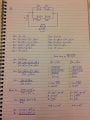
could you have a look at this and point out the mistakes i have made trying to find the total Impedance. Thanks

ps I know i have marked the the impedance as R1 R2 R3 R4 and it should read Z1 Z2 Z3 Z4IMG_1800.JPG
 
Where you have:
Z34 = (0-j16)Ω + (14+j0)Ω
Z34 = (0)Ω + (j14-j16)Ω

This is wrong. It should be:

Z34 = (0-j16)Ω + (14+j0)Ω
Z34 = (0+14)Ω + (j0-j16)Ω

Everything you did after this is, of course, incorrect.
 

WBahn

Joined Mar 31, 2012
32,970
Your major error has already been pointed out.

You want to get in the habit of setting up your basic solution and then asking if what you have at that point makes sense. In this case, a glance at R3 and R4 should convince you immediately that the series combination simply cannot have no resistive (real) component.

Your tracking of units is much better. Still some places where you are getting sloppy, but much improved.
 
Top