Musical bell, harpsichord circuits

Thread Starter

Wendy

Joined Mar 24, 2008
23,797
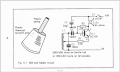
Periodically I want this sound effect electronically, I've come up with a few contenders that I may try later.
From this website:
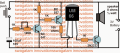
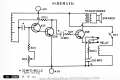
Junk.png


Then there is this one from the 101 projects kit made by RadioShack in the early 70s:
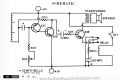
junk 2.png

so does anyone have any better circuits than these? I'm guessing it wouldn't be too hard to beat them.
 

sghioto

Joined Dec 31, 2017
8,633
What exactly is this sound byte?
Maybe it can be recorded on one of those sound chips and played back at the press of a button.
Do you have that UM66?
 
Last edited:

rsjsouza

Joined Apr 21, 2014
424
Generating an harpsichord sound will require a multitude of oscillators to synthesize it - something the Radioshack circuit will not accomplish.

Sampling the desired sound, writing the PCM samples to a non-volatile memory IC (Flash/EPROM) and playing it back is one way to do it. The "play back" could be done with a simple microcontroller or a logic circuit.

That or using a dedicated IC such as the UM66, with the drawback of not being able to customize the sound. Also, the UM66 has various suffixes that define the sound or music being played.

Its datasheet: https://www.alldatasheet.com/datasheet-pdf/view/113485/UMC/UM66T.html

(edit) the UM66 seems obsolete. If you go to Aliexpress, you can find all sorts of COB (Chip-on-board) devices for doorbells.
 

Thread Starter

Wendy

Joined Mar 24, 2008
23,797
Looking at the Radio Shack circuit you can see where The final stage is energized via the relay then slowly killed as the 200MFD is charged. Giving the ring sound.

junk 2.png
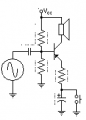
One this circuit S1 charges C3 and creates the ring when C3 discharges.

Bell1.png

Food for thought.
 

MisterBill2

Joined Jan 23, 2018
27,181
A Harpsichord note is not quite so simple. The scheme could be to record one very rapidly using a fast A/D converter, and then play that file back at a different rate, to a fast D/A, for each each note.
 

Thread Starter

Wendy

Joined Mar 24, 2008
23,797
I'm thinking of ways to keep the component count down. Transistors preferred.

I'm being silly I know.
 

MisterBill2

Joined Jan 23, 2018
27,181
Elektor magazine has a project for a drum machine completely analog that I almost built back in the 1980s. I can't remember the edition, but an article that shows the schematic diagram for the various sound generators (all-transistor) is shown here:
https://tubbutec.de/blog/unipulse-installation-ace-tone-rhythm-ace-fr3/
Have you listened to some of that "music" produced with the fake drums, that used just a Noise Gate??? It Give a Totally ROTTEN faked drum beat noise. Some things should never be synthesized.
 

rsjsouza

Joined Apr 21, 2014
424
Have you listened to some of that "music" produced with the fake drums, that used just a Noise Gate??? It Give a Totally ROTTEN faked drum beat noise. Some things should never be synthesized.
Regrettably not on this particular instance. As I mentioned, I didn't finish the project back then.

What I remember are magazines trying to bamboozle us young hobbyists having "chime" or "carrillon" doorbells or "electronic organs" but using an unmodulated 555 to generate the sound. Where you expected a sinewave or bell tone, you got a square scratch.
 

MisterBill2

Joined Jan 23, 2018
27,181
I do recall seeing some of those projects! Certainly they were very misleading. The fake drums stuff got all the way to broadcast radio, My guess is due to payments by the record companies, (Shades of Payola, possibly?) .
Certainly it might be that a square wave could be filtered to sound differently, although with only odd harmonics, maybe not. But the additional filters would add quite a lot to a simple project build.
 

rsjsouza

Joined Apr 21, 2014
424
Certainly it might be that a square wave could be filtered to sound differently, although with only odd harmonics, maybe not. But the additional filters would add quite a lot to a simple project build.
Indeed that would be of great help to improve the sound quality. What I remember from these days building designs from magazines is that I always had trouble getting a good oscillator or filter right - too many times I got wrong frequencies or not oscillating/filtering at all. I suspect this was either due to the quality and tolerances of the parts used back in the 70s-80s, or plain inexperience in assembly. If designs drew too many questions from readers, I could understand how the magazines would prioritize the simplicity of a 555 or the advanced use of a specialized IC such as the SN76477, for example.
 

MisterBill2

Joined Jan 23, 2018
27,181
Ordinary op-amp single or two pole filters should not be terribly complex to produce reasonably closely , if used 20% tolerance parts can be avoided.
For the circuit in post #1, certainly there will be a voltage change due to that 50 mfd capacitor charge time if that 9 volt battery is not new and fresh. So that may cause a tone change.
 
Top