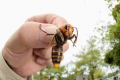
I wonder if they really are Asian hornets? A few years ago while cutting trees down for fire wood one of them was hollow and ended up having a hornets nest in it. Got stung several times while running away. The stings were on my face and hurt, but what was really weird was the lump or cyst in the skin. A week later the cyst broke and the poison came out into the skin. My whole face swelled so much I couldn't see,
These hornets were the biggest I ever saw, over 1 1/4 inch long. They were called European Hornets I found out, never saw one before and never want to again. Image from the web
I wonder if they really are Asian hornets? A few years ago while cutting trees down for fire wood one of them was hollow and ended up having a hornets nest in it. Got stung several times while running away. The stings were on my face and hurt, but what was really weird was the lump or cyst in the skin. A week later the cyst broke and the poison came out into the skin. My whole face swelled so much I couldn't see,
These hornets were the biggest I ever saw, over 1 1/4 inch long. They were called European Hornets I found out, never saw one before and never want to again. Image from the web View attachment 206316
Wow that's nuts. Yeah they look big too.
It could be the behavior is different than the Japanese strain. The Eu ones can be killed by a swarm of Eu honey bees the Japan ones cant (i think).
I read that European bees will form a swarm/ball around them, then by beating their wings create enough heat to cook the invader. Apparently the exoskeleton is too tough for a honey bee's stinger to penetrate. The source I read over over the weekend indicated that was a learned behavior.
Yeah and it takes a lot to scare me with things like this (animals) but that sounds really really really bad. They will have to find a way to get rid of them like they were (or maybe still are) trying to get rid of the bees from Brazil that invaded a while back.
I read that European bees will form a swarm/ball around them, then by beating their wings create enough heat to cook the invader. Apparently the exoskeleton is too tough for a honey bee's stinger to penetrate. The source I read over over the weekend indicated that was a learned behavior.
Yeah but i dont think that works with the Japan strain too does it? Or maybe it is just one type of bee that can not do it but other types of bees can.
My understanding is that the Asian honeybees have learned how to surround the Asian Giant Hornets to kill them, and the European Honeybees, which are common in the US, just try to sting them, which doesn't work.
If those hornets become established here, we may need to import the Asian Honeybees for the beekeepers.
Perhaps that question is better put to @crutschow. A dead hornet is a dead hornet either way.
What I think is silly is importing a new variety of honeybee into our ecosystem when insecticides can be used. Haven't you seen the devastation caused by the Asian Emerald Ash Borer because the USDA refused to use/or allow the use of an effective insecticide early on in Detroit?
Perhaps that question is better put to @crutschow. A dead hornet is a dead hornet either way.
What I think is silly is importing a new variety of honeybee into our ecosystem when insecticides can be used. Haven't you seen the devastation caused by the Asian Emerald Ash Borer because the USDA refused to use/or allow the use of an effective insecticide early on in Detroit?
I am not sure what you are saying because there are different species and they have different behaviors. You have to know the exact type of animals to know what they are capable of.
This from Snopes.com: "in 2020 we took a look at a defense mechanism of the Japanese honeybee which involved a swarming “bee ball” that cooked these large predators to death (True)."

 Facebook
 Google
 GitHub
 Linkedin